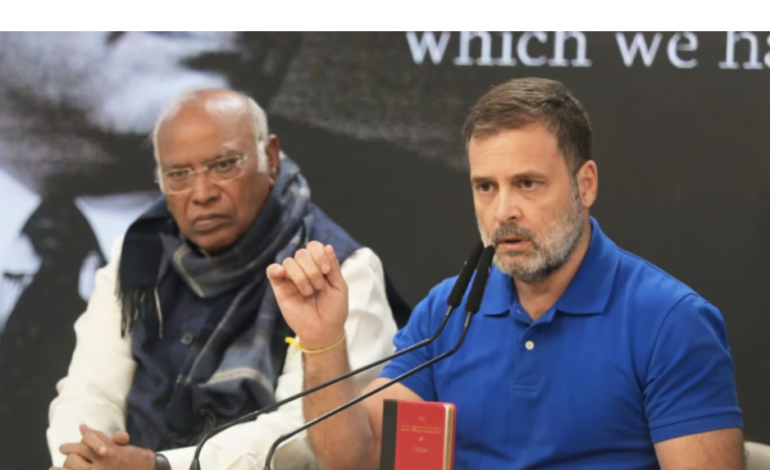
Flawed, predetermined: Rahul Gandhi, Kharge on selection of new NHRC chair

Congress issued a dissent note on Tuesday, a day after President Droupadi Murmu appointed former Supreme Court judge Justice V. Ramasubramanian as the National Human Rights Commission (NHRC) chairperson. The party said the selection process was fundamentally flawed, predetermined, and raised concerns about the impartiality and fairness of the process.
Rahul Gandhi, the Leader of Opposition in Lok Sabha, and Mallikarjun Kharge, the Leader of Opposition in Rajya Sabha, recorded their dissent “without prejudice to the names of the Chairperson and members approved by the Selection Committee.”
The dissent note, dated December 18, outlined four points.
It states, “Firstly, the selection process adopted by the Committee was fundamentally flawed. It was a pre-determined exercise that ignored the established tradition of mutual consultation and consensus, which is essential in such matters. This departure undermines the principles of fairness and impartiality, which are critical to the credibility of the Selection Committee. Instead of fostering deliberation and ensuring a collective decision, the Committee relied on its numerical majority to finalize the names, disregarding the legitimate concerns and perspectives raised during the meeting.”
The second point highlights the NHRC’s role as a vital statutory body tasked with safeguarding the fundamental human rights of all citizens, especially those from oppressed and marginalized communities. “A diverse leadership ensures that the NHRC remains sensitive to the unique challenges faced by various communities, especially those most vulnerable to human rights violations.”
The note mentions that Gandhi and Kharge had proposed the names of Justice Rohinton Fali Nariman and Justice Kuttiyil Mathew Joseph for the position of Chairperson, emphasizing both merit and inclusivity.
“Justice Rohinton Fali Nariman, a distinguished jurist from the minority Parsi community, is renowned for his intellectual depth and unwavering commitment to constitutional values. His inclusion would send a strong message about the NHRC’s dedication to representing India’s pluralistic society. Similarly, Justice Kuttiyil Mathew Joseph, a former Supreme Court judge from the minority Christian community, has consistently delivered judgments that emphasize individual freedoms and the protection of marginalized groups, making him an ideal candidate for this critical position.”
For the position of members, Gandhi and Kharge recommended the names of Justice S. Muralidhar and Justice Akil Abdulhamid Qureshi, both of whom have exemplary track records in upholding human rights. Justice Muralidhar is widely respected for his landmark judgments advancing social justice, including his work on custodial violence and the protection of civil liberties. Justice Qureshi, from the Muslim minority community, has defended constitutional principles and shown a strong commitment to accountability in governance. Their inclusion would enhance the NHRC’s effectiveness and its commitment to diversity.
The third point stresses that while merit is important, maintaining a balance that reflects the regional, caste, community, and religious diversity of the nation is equally crucial. “This balance ensures that the NHRC operates with an inclusive perspective, sensitive to the lived experiences of all sections of society. By neglecting this critical principle, the Committee risks eroding public trust in this esteemed institution.”
The fourth point expresses regret over the dismissive approach adopted by the majority of the Selection Committee. “The NHRC’s credibility and effectiveness depend on its ability to embody the diversity and inclusiveness that define India’s constitutional ethos.”
Gandhi and Kharge stated that the names they proposed reflect these principles and align with the foundational values of the Commission. “Their exclusion raises significant concerns about the impartiality and fairness of the selection process,” they concluded.