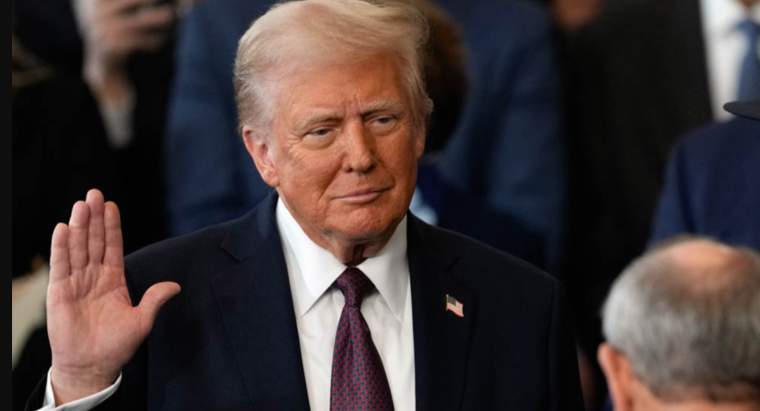
The third eye: President Trump starts his second tenure on expected lines

The series of directives issued by President Donald Trump within hours of his swearing-in was – as expected – unambiguous, assertive, and geopolitically significant. They seemingly confirmed that the new US President was determined to take complete control of the governance, implement the ‘America First’ agenda, and prioritize building the economic strength of the US to fulfill that mandate.
The first of the ten executive orders signed by him, even before moving to the Oval Office, suspended 78 notifications issued by the Biden Presidency. His directives included a freeze on the hiring of federal employees, except for those in the military, immigration control, national security, and public safety, a halt on further notifications by federal officials, and a restoration of complete freedom of speech, ending the ‘weaponization’ of governance instruments used in the previous administration.
Trump also declared withdrawal from the Paris Climate Treaty to save $3 billion in American aid given annually to the climate fund. This and the pullout from the WHO – depriving the UN agency of the annual US contribution of $130 million – will have international repercussions. Trump’s long-standing criticism of WHO stems from his belief that it was influenced by China, which he holds responsible for the Covid-19 pandemic, and that the WHO mishandled the crisis.
Trump’s mission of ‘Making America Great Again’ seems to drive many of these early actions, including foreign policy, domestic management of inflation and unemployment, and economic and trade strategies. In his second term, President Trump is focused on transforming the US and leaving a legacy of decision-making that no other President could rival.
The first directives signed by Trump addressed issues from border security to asserting presidential control over governance. He terminated all remote working arrangements for federal employees and ordered their return to in-person work. He also called for a plan to downsize the federal government’s workforce through efficiency and attrition.
Simultaneously, Trump directed executive departments and agencies to implement ’emergency price relief measures’ to lower the cost of housing, healthcare, food, and fuel, and to create more employment opportunities.
In an extraordinary executive order, Trump renamed the US Digital Service as the Department of Government Efficiency (DOGE) and proposed placing it under Elon Musk to maximize government efficiency and productivity. Trump has directed his Secretary of State, Marco Rubio, to implement the ‘America First’ foreign policy, which prioritizes the US and its citizens above all else.
He also ordered the rechristening of the Gulf of Mexico as the Gulf of America and the restoration of Denali’s original name (Mount McKinley) in recognition of the 25th US President. At home, Trump has called for stricter immigration laws. A directive titled ‘Protecting the American People Against Invasion’ introduces policies aimed at curbing immigration.
Trump declared a ‘national emergency’ to check immigration and directed military personnel to help secure the southern border, using physical barriers and drones. The Homeland Security Secretary has been tasked with establishing Homeland Security Task Forces in all states to ensure the faithful execution of immigration laws.
Additionally, Trump has ended birthright citizenship for children born in the US to undocumented immigrant parents or those on temporary visas, and he has threatened mass deportations of illegal migrants, including those whose birthright citizenship has been revoked.
President Trump has designated certain drug cartels as ‘foreign terrorist organizations,’ arguing that their violence and terrorism pose a security risk to the US. The designation could open the door for military action against cartel targets in Mexico and other countries. Trump’s focus on countering terrorism is likely to be appreciated by India.
In another directive, Trump imposed visa restrictions on applicants from certain countries to safeguard the US from potential foreign terrorists, with enhanced vetting for visa seekers from high-risk regions.
Trump has restored the death penalty for public safety reasons and asked the Attorney General to pursue the death penalty for all capital crimes. He also criticized the Diversity, Equity, and Inclusivity (DEI) programs of the Biden Administration, calling them ‘radical’ and ‘wasteful,’ and emphasized prioritizing ‘merit’ and ‘skill’ in hiring.
Trump rejected ‘gender identity politics’ and the ‘diversity’ regulations from the previous administration. His government will recognize only two sexes – male and female – and will use the term ‘sex,’ not ‘gender.’
In line with his ‘America First’ doctrine, Trump declared a ‘National Energy Emergency,’ calling for a review of legal barriers to domestic energy infrastructure creation, such as the Endangered Species Act. He paused all federal wind energy projects, rejected renewable energy, and endorsed the revival of the oil and natural gas industries. Trump also highlighted the ‘America First Trade Policy,’ focusing on reviewing ‘unfair and unbalanced trade’ with all countries, particularly China.
Some of Trump’s orders appeared to benefit him personally. He granted pardons and commuted sentences for those involved in the January 6, 2021, Capitol events and ordered the dismissal of all related pending indictments, claiming political vendettas were behind the cases.
Trump also directed flags to be flown at full mast on presidential inauguration days, reversing Biden’s directive for a month-long mourning for former US President Jimmy Carter, which would have coincided with Trump’s swearing-in.
Trump delayed the shutdown of the popular China-owned TikTok, offering Elon Musk a potential opportunity to purchase the platform. This move could prove beneficial for both Musk and Trump politically.
Targeting the Deep State, Trump signed an order ending the ‘weaponization of government’ against political opponents, directing the Attorney General to investigate alleged misuse of the Department of Justice, Securities and Exchange Commission (SEC), and the Federal Trade Commission (FTC). The current conservative-leaning US Supreme Court is seen as supportive of Trump’s actions, especially as it recently ruled that Presidents are largely immune from prosecution for official actions taken during their terms.
Trump’s policy framework continues to unfold, but his ‘America First’ stance is already evident in foreign policy, trade tariffs, and national security issues. He is vocal about his intention to transform the US and make it ‘Great Again.’
India is likely to align with Trump on issues like global terrorism, which he has directly linked to certain countries and regions, making it a potential area of cooperation. However, India should approach Trump’s policies on tariffs, immigration, and border security with caution, particularly in light of his call for a merit-based society. As a major power in a multipolar world order, India supports global peace, fairness in international trade, and bilateral relations based on mutual security and economic interests. It can engage with Trump’s administration on these merits.
(The writer is a former Director, Intelligence Bureau)