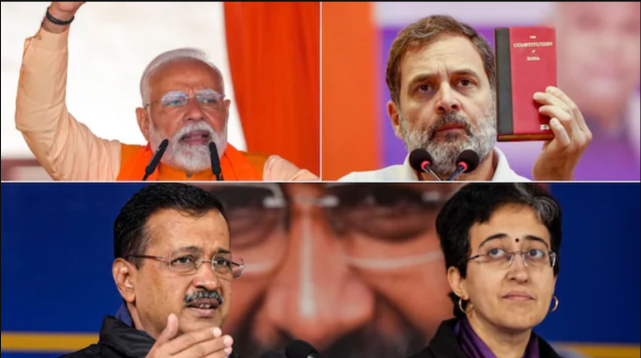
Delhi polls: BJP crosses halfway mark in early trends, AAP leads in 20 seats

The Bharatiya Janata Party (BJP) is leading in 37 Assembly seats, while the Aam Aadmi Party (AAP) is ahead in 20 seats as of 9:50 am on Saturday, according to the Election Commission of India (ECI).
Counting for the Delhi Assembly elections began at 8 am, with the BJP and AAP locked in a battle to form the government in the national capital. Voting for all 70 Assembly seats took place on Wednesday, February 5, and several candidates visited temples to offer prayers ahead of the results.
Early trends show AAP national convenor Arvind Kejriwal leading from the New Delhi Assembly seat, while BJP’s Parvesh Verma is trailing. The BJP is also leading in several other constituencies, but as these are initial trends, a clearer picture is expected to emerge by noon.
In the Bijwasan constituency, BJP candidate Kailash Gahlot is ahead, while AAP’s Surender Bhardwaj is trailing. In Greater Kailash, AAP’s Saurabh Bhardwaj leads, with BJP’s Sikha Roy behind. BJP candidates Anil Kumar (RK Puram) and Bhuvan Tanwar (Delhi Cantt) are also leading in their respective constituencies.
Exit polls had projected a BJP victory in Delhi after 27 years, with the party expected to comfortably cross the majority mark of 36 seats, potentially winning 10-15 more. The Congress, however, is predicted to secure only 0-3 seats.
According to Election Commission data, the voter turnout stood at 60.54%, with North East Delhi recording the highest voting percentage at 66.25%, while South East Delhi had the lowest at 56.40%.
The 2025 Delhi Assembly election is primarily a contest between AAP and BJP, with AAP aiming for a third consecutive term. In the 2020 election, AAP had won 62 of the 70 seats, while BJP secured eight. The Congress, which ruled Delhi for 15 years, failed to win any seats in the last two elections and is predicted to perform similarly this time.
The counting process began with postal ballots, which include votes from government officials, service voters, and elderly or differently-abled voters who opted for postal voting. Once the postal ballots are counted, Electronic Voting Machines (EVMs) will be unlocked, and votes will be tallied in multiple rounds throughout the day.
The Election Commission will provide regular updates on vote trends, with a clearer picture expected by noon, offering an early indication of the likely winner.