What caused the plane crash in Toronto, and how did everyone manage to survive?

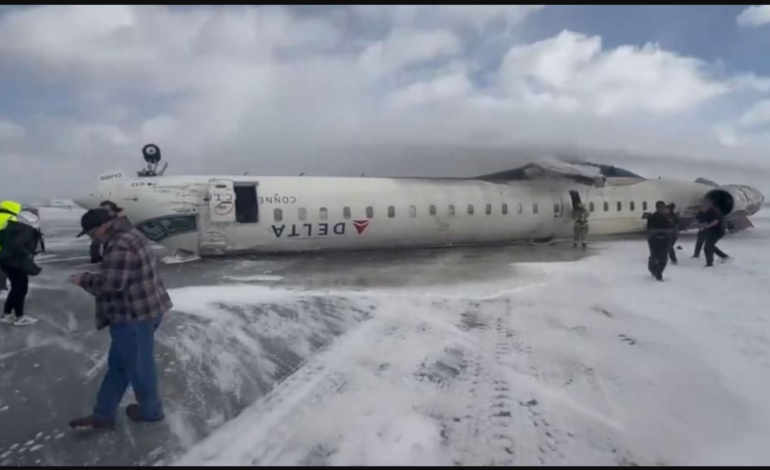
Passengers aboard a Delta flight that crash-landed in Toronto on Monday afternoon have described their astonishment after nearly all of them escaped unharmed. The flight, carrying 80 people, experienced a harrowing crash sequence when it skidded along the runway in flames before flipping over and coming to a stop upside down, losing its tail and one wing in the process.
The chaotic scene left several passengers suspended upside down, still strapped to their seats. They scrambled over luggage to escape onto the snow-covered runway. Miraculously, no fatalities were reported, although 21 people were injured, with 19 later discharged from local hospitals.
The incident occurred at 2:00 PM local time on Monday (7:00 PM GMT) involving Delta Air Lines flight DL4819, a CRJ-900 aircraft arriving from Minneapolis. The plane, which carried 76 passengers and four crew members, struck the runway on landing, slid for some distance, and then flipped over, catching fire. Firefighters quickly responded to extinguish the flames.
Passenger Pete Carlson recalled the violent impact to CBC, saying, “It was a very forceful event,” describing the deafening sound of “concrete and metal” at the moment of impact. He and others were left hanging upside down in their seats, struggling to unbuckle themselves and crawl over the cabin ceiling to escape.
What caused the crash? Experts believe the weather may have played a role. Despite snow stopping prior to the crash, the airport fire chief noted that frigid temperatures and gusty winds were present. Air traffic control had warned of gusts reaching 38 mph (61 km/h) and mentioned the possibility of a “slight bump” in the glide path. The pilots attempted a “crab maneuver” to align the plane into the wind before landing. This technique might have resulted in a hard landing, causing one wheel to strike the ground first, which may have caused the landing gear to collapse and triggered the aircraft’s flip.
While experts consider weather and the plane hitting an object on the runway as potential causes, they emphasize the role of safety features in ensuring survival. Delta Airlines highlighted the “high-impact 16G seats” as a critical factor in protecting passengers during the crash.
How did everyone survive? Remarkably, all 80 people aboard the flight survived. Experts have credited the design of the aircraft and its safety features for the remarkable survival rate. The fuselage of the aircraft remained intact, preventing significant damage to passengers. The seats, designed to withstand high impacts, absorbed much of the force from the crash, while the wings detached as expected to prevent further destruction to the fuselage.
Former FAA inspector David Soucie explained that the plane’s safety features, including the design of the cabin and seat belts, played a crucial role in preventing injuries. “The seatbelt is the ultimate thing that stops people from being thrown around the cabin,” Soucie added. Additionally, the swift response of flight attendants and emergency crews on the ground ensured that passengers were evacuated quickly, saving lives.
Passenger Pete Carlson praised the collective efforts of those on board. “What I saw was everyone on that plane suddenly became very close in terms of how to help one another,” he said. “How to console one another.”
Other recent plane crashes This incident follows a string of major crashes in North America within the last month, with authorities continuing to investigate these tragedies. However, experts reassure the public that air travel remains exceedingly safe. According to the US National Transportation Safety Board (NTSB), global fatal accidents in 2024 totaled 257, compared to 362 in 2014.
While this crash in Toronto was dramatic, it serves as a reminder of the safety measures that have made air travel one of the safest modes of transportation worldwide.
Key Takeaways:
- The crash involved Delta Air Lines flight DL4819, which landed in Toronto after arriving from Minneapolis.
- The plane skidded, caught fire, flipped over, and lost its tail and wing.
- Remarkably, all 80 passengers survived, with 21 requiring hospitalization.
- Weather, the pilots’ maneuver, and possible runway obstacles may have contributed to the crash.
- High-impact seats and the plane’s safety features played a vital role in preventing fatalities.