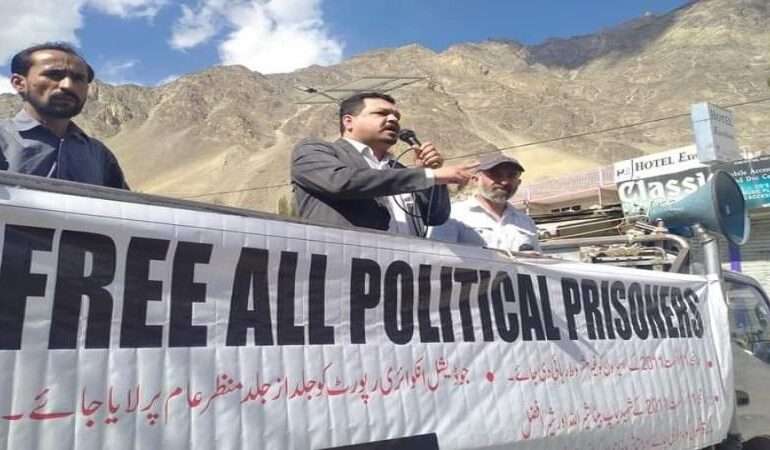
People of Gilgit-Baltistan demand justice, autonomy amid Pakistan’s neglect

Residents of Pakistan-occupied Gilgit-Baltistan (PoGB) are increasingly voicing frustration over decades of political neglect, lack of representation, and exploitation by the Pakistani state. A report by the Washington-based Middle East Media Research Institute (MEMRI) outlines how the region remains trapped in a governance model built on executive decrees, not democratic participation.
Despite braving freezing temperatures, protests have become routine in PoGB, where people demand land rights, oppose unjust taxation, and resist federal projects like the China-Pakistan Economic Corridor (CPEC) that seize local land without compensation.
PoGB is still governed under outdated presidential orders and remains excluded from Pakistan’s constitution. The region has no representation in the National Assembly and no say in policies that affect its people. The legal ambiguity dates back to the 1949 Karachi Agreement, signed without local representation, which handed control of the region to Pakistan.
Skardu, the largest city in PoGB, experiences up to 22 hours of daily power outages during winter. Projects like the Satpara Dam, meant to provide electricity to thousands of homes, have failed to deliver. The region remains disconnected from the national power grid.
Public anger continues to rise against legislation like the GB Revenue Authority Bill, which imposes taxes without offering voting rights or representation. Activists, including Shabir Choudhry, warn that Gilgit-Baltistan is on the edge of chaos.
The region was not even consulted during the 1963 border agreement between Pakistan and China that ceded parts of historical Hunza territory. The Karakoram Highway has further destabilized the region, bringing in weapons, drugs, and extremist elements, altering the demographic fabric of PoGB.
The people of Gilgit-Baltistan are demanding dignity, justice, constitutional rights, and the freedom to determine their own future.