India’s Maritime Vision: From SAGAR to Indo-Pacific to MAHASAGAR

By: Suchitra Durai
Former Ambassador of India to Thailand
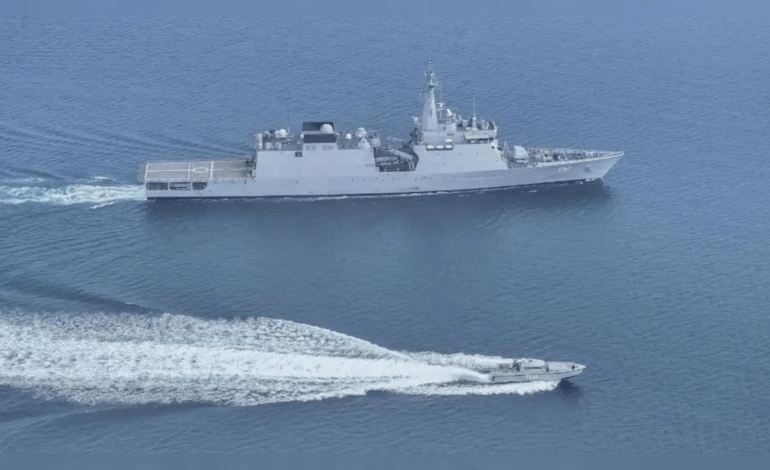
A decade ago, on March 12, 2015, while commissioning the Offshore Patrol Vessel Barracuda in Mauritius—built at Garden Reach, Kolkata, to Mauritian specifications—Prime Minister Narendra Modi outlined India’s policy toward the Indian Ocean Region (IOR): SAGAR—Security and Growth for All in the Region. The Indian Ocean, he pointed out, is critical to the future of the world, bearing two-thirds of global oil shipments, one-third of bulk cargo, and half of container traffic. The forty littoral states of the IOR are home to nearly 40% of the world’s population.
The SAGAR policy emphasized five key aspects:
- Safety and security of the Indian mainland and island territories, ensuring a safe, secure, and stable IOR;
- Deepening economic and security cooperation with friends in the IOR, particularly maritime neighbors and island states, through capacity building;
- Collective action and cooperation;
- Pursuing a more integrated and cooperative future toward sustainable development for all;
- Increasing maritime engagement in the IOR, as the primary responsibility for the region’s stability and prosperity lies with its inhabitants.
If SAGAR represents India’s external maritime outreach, it is complemented domestically by the Sagarmala port-led development initiative.
For long, India faced criticism for its continental bias—focusing primarily on its northern and northwestern frontiers while neglecting its vast maritime interests. However, this has changed dramatically. Since launching the Look East Policy in 1992, which evolved into the proactive Act East Policy in 2015, India has been reclaiming its maritime legacy. Prime Minister Modi recently released a special coin commemorating 1,000 years of Emperor Rajendra Chola’s naval achievements.
The Indian Navy has been at the forefront of maritime diplomacy through capacity building initiatives, joint exercises, plurilateral conferences, and humanitarian assistance and disaster relief (HADR) and search and rescue (SAR) activities. The 2004 tsunami cemented India’s credentials in disaster relief operations, establishing it as the first responder and net security provider in the IOR, especially to neighboring states.
India’s prompt assistance to Myanmar after Cyclone Nargis in 2008 and being the first country to deliver drinking water during the Maldives’ 2014 freshwater crisis further consolidated this image. In March 2025, India launched Operation Brahma, a large-scale relief and rescue mission following an earthquake in Myanmar.
India has now graduated to becoming a preferred security partner in the Indo-Pacific region, forming defense partnerships that include joint exercises, capacity building, and defense equipment exports, either as grants or under lines of credit at partner states’ requests.
Trilateral maritime security cooperation with Sri Lanka and Maldives, which began in 2011, has extended to other Indian Ocean states including Mauritius and Bangladesh, with Seychelles as an observer under the Colombo Security Conclave. The conclave now has a charter and secretariat based in Colombo.
The Indian Ocean Naval Symposium (IONS), initiated by the Indian Navy in 2008, is an inclusive platform for discussing maritime issues and developing coordinated responses. IONS currently includes 25 participating countries from South Asia, West Asia, Africa, Southeast Asia, and European states with Indian Ocean territories, plus nine observers. The chairmanship rotates, and India will assume the chair at the end of 2025.
MILAN, a biennial multinational exercise hosted by the Indian Navy, aligns with India’s SAGAR and Act East policies.
A crucial facet of maritime security is enhanced maritime domain awareness. India has pursued white shipping agreements with 22 countries to date and established the state-of-the-art Information Fusion Centre (IFC-IOR) in Gurugram to facilitate maritime information sharing among member states.
India’s long history of development partnerships dates back to pre-independence times, shaped by its struggle for freedom, solidarity with colonized and developing nations, and the inspiring leadership of Mahatma Gandhi, who declared, “My patriotism includes the good of mankind in general.” Reflecting this ethos of Vasudhaiva Kutumbakam (“the world is one family”), India shares its developmental experience and technical expertise with other countries.
As Prime Minister Modi stated in his 2018 address to the Ugandan Parliament:
“Our developmental partnership will be guided by your priorities. It will be on terms that are comfortable for you, that will liberate your potential and not constrain your future.”
India’s model of developmental cooperation is comprehensive, involving grants, concessional lines of credit, capacity building, and technical assistance. Above all, it is unconditional, transparent, sustainable, and financially viable.
In June 2018 at the Shangri-La Dialogue, PM Modi outlined India’s Indo-Pacific vision. For India, the Indo-Pacific stands for a free, open, and inclusive region that “embraces us all in a common pursuit of progress and prosperity.” He emphasized ASEAN centrality, a rules-based order, freedom of navigation, unimpeded commerce, and the peaceful settlement of disputes under international law.
India’s vision aligns closely with the ASEAN Outlook on the Indo-Pacific. In November 2019, at the East Asia Summit in Bangkok, India launched the Indo-Pacific Oceans Initiative (IPOI)—a coherent framework of seven pillars of practical cooperation built on the SAGAR vision. India’s active participation in the QUAD (Australia, India, Japan, and the U.S.) is also part of this vision. Earlier, in 2014, India established FIPIC (Forum for India-Pacific Islands Cooperation) to strengthen diplomatic and economic ties with Pacific island nations.
In 2023, during India’s G20 presidency—with the theme of inclusivity—the African Union was invited to join the grouping. India’s presidency revived multilateralism, amplified the Global South’s voice, and championed development. Since then, India has hosted three editions of the Voice of the Global South Summit.
Ten years after SAGAR, during an official visit to Mauritius in 2025, PM Modi announced MAHASAGAR (Mutual and Holistic Advancement for Security and Growth Across Regions), an updated doctrine. If SAGAR represents the “sea,” MAHASAGAR—meaning “ocean” in Hindi and several other Indian languages—signifies a strategic evolution from a regional Indian Ocean focus to a global maritime vision, with particular emphasis on the Global South.
PM Modi’s recent engagements with Mauritius, Maldives, Trinidad and Tobago, Ghana, and the Philippines align with the MAHASAGAR vision.