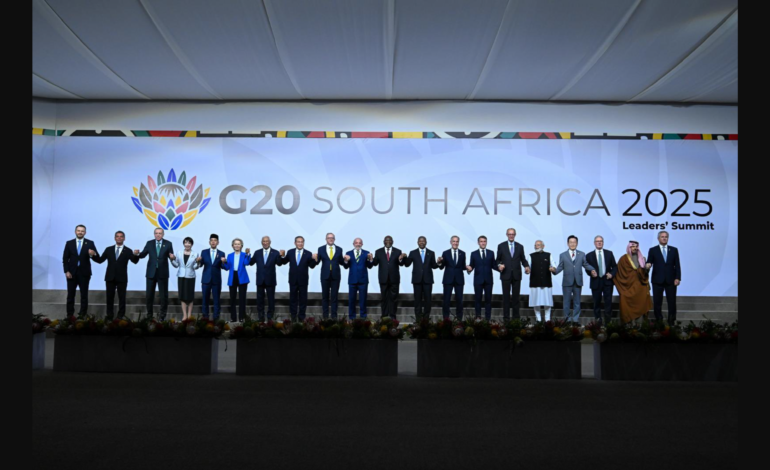
G20 South Africa 2025 — India’s rising leadership amid global fractures

By: Dr Avi Verma
The 2025 G20 Summit in Johannesburg will be remembered not for its ceremonial speeches or grand photo-ops, but for the geopolitical tremors it exposed. Convened for the first time on African soil, the South Africa G20 carried immense symbolic value. Yet beneath the celebration of Global South leadership lay a moment of truth: the world’s most influential economies are drifting further apart, global governance is being contested, and new centers of leadership are emerging. At the center of this shifting landscape stood India—calm, steady, and increasingly indispensable.
India’s Steady Hand in an Unsteady World
Among all leaders present, Prime Minister Narendra Modi drew the most attention for presenting not merely opinions, but a structured roadmap for the world’s shared future. His interventions combined sustainability, technology, civilizational knowledge, and human-centric development—an approach that set India apart from both Western transactionalism and authoritarian unilateralism.
The most notable proposal was India’s call for a Global Traditional Knowledge Repository, a monumental initiative aimed at documenting and circulating indigenous wisdom from every culture. Built on India’s Indian Knowledge Systems (IKS) program, the repository would include traditional medicinal sciences, ecological farming models, native environmental practices, and community-based knowledge that has guided societies for centuries. At a time when climate extremes, biodiversity collapse, and cultural erosion threaten humanity, India’s proposal sought to preserve global heritage while enabling responsible scientific collaboration.
This initiative reflects India’s growing confidence in offering civilizational solutions as global public goods—asserting that ancient knowledge and modern science can co-exist and enrich one another.
Modi also announced several transformative Global South–focused initiatives:
- G20–Africa Skills Multiplier Initiative to train one million African trainers in a decade.
- Global Healthcare Response Team, a multinational pool of medical experts prepared for rapid deployment.
- Counter-Drug & Anti-Terror Nexus Initiative, linking efforts against synthetic drugs and terrorism.
- Open Satellite Data Partnership to democratize access to earth observation data.
- Critical Minerals Circularity Initiative, encouraging recycling, urban mining, and sustainable supply chains.
Together, these positioned India as a “policy entrepreneur,” offering long-term, values-driven solutions when many global powers are turning inward.
The Absences That Rewrote the Summit
Despite South Africa’s careful diplomacy, the summit’s dynamics were shaped by who didn’t show up. For the first time, the President of the United States was absent, signaling an unprecedented boycott. China’s Xi Jinping and Russia’s Vladimir Putin were also no-shows.
The U.S. absence—rooted in domestic political rhetoric about alleged discrimination against white minorities in South Africa—carried outsized geopolitical weight. It was read globally as a sign that Washington is selectively disengaging from multilateral structures it once dominated.
Without the U.S., discussions shifted decisively toward Global South priorities: debt restructuring, climate justice, development financing, and Africa-focused cooperation. Leaders felt freer to advance agendas often slowed by American objections.
The Gavel Controversy: A Symbol of Global Disorder
In a historic break from tradition, South Africa could not physically hand the G20 gavel to the incoming president—the United States—because no senior U.S. leader was present. When Washington requested that a junior diplomat receive it, South Africa declined on grounds of protocol. The gavel was passed symbolically, but its absence revealed the fragility of global institutions.
It prompted urgent questions:
- Can the G20 function without the U.S.?
- Does absence accelerate multipolarity?
- Does this strengthen alternative blocs like BRICS?
G20 2025 and Its Impact on BRICS
Ironically, the Johannesburg G20 became a showcase for BRICS-level leadership even though China and Russia were absent. With the U.S. disengaged, middle powers—India, Brazil, South Africa, Indonesia, Saudi Arabia—dominated the agenda.
Three consequences for BRICS emerged:
1. Enhanced Legitimacy of Non-Western Platforms
The U.S. boycott reinforced perceptions that Western-led institutions are becoming unreliable. This strengthens BRICS as a stable alternative for countries seeking multipolar engagement.
2. India’s Centrality Within BRICS Increases
India’s visionary proposals at the G20—combined with its credibility, democratic governance, and global partnerships—further positioned it as the bridge between advanced economies and the Global South. This strengthens India’s hand within BRICS, especially as China-India relations remain complex.
3. Momentum for Alternative Economic Architecture
With the G20 divided, BRICS gains more room to advance non-dollar payment systems, development financing reforms, and critical mineral supply cooperation. The Global Traditional Knowledge Repository itself aligns with BRICS goals of knowledge-sharing and South-South cooperation.
A Summit of Signals, Not Statements
The 2025 G20 Summit revealed a world in transition. But one signal rose above the noise: India is stepping into the leadership vacuum with clarity, values, and institutional imagination.
At a time when old powers withdraw, India is offering presence.
When global norms fracture, India is offering stability.
And when uncertainty dominates, India is offering vision.
The Johannesburg G20 marked the beginning of a new era—one where India’s leadership is no longer emerging; it is unmistakably here.