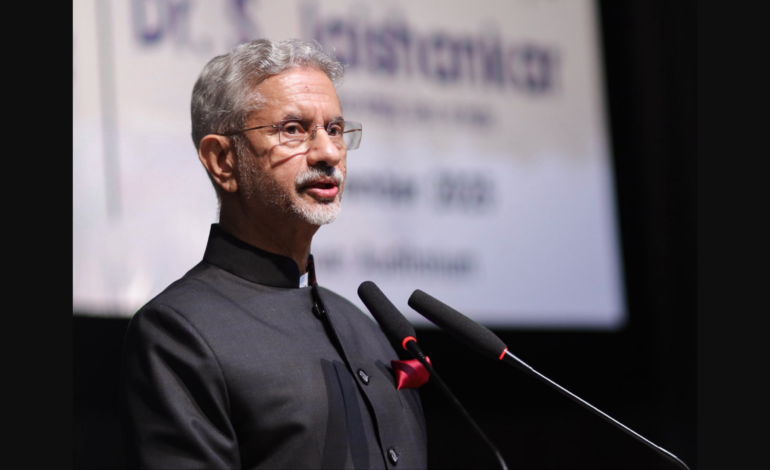
Jaishankar says no country can dictate India’s foreign partnerships as Putin visit strengthens ties

External Affairs Minister S. Jaishankar reaffirmed India’s commitment to independent and interest-driven diplomacy, declaring that no country can expect a “veto or a say” in how New Delhi shapes its relationships. His remarks follow Russian President Vladimir Putin’s high-profile visit to India, which triggered renewed scrutiny from Washington over India’s continued energy and defence cooperation with Moscow.
Speaking at the Hindustan Times Leadership Summit in New Delhi, Jaishankar said India’s foreign policy is rooted in strategic autonomy and the ability to maintain balanced ties with competing global powers. As India rises on the world stage, he said, it is essential that New Delhi keeps “key relationships in good place” and engages with multiple partners across geopolitical divides.
“For a country like us — big, rising, and expected to occupy a more important place — it is important our key relationships are in good place,” he said. “We maintain good cooperation with as many players as possible, and that is what foreign policy is about.”
Putin’s just-concluded visit, Jaishankar emphasized, produced tangible outcomes, including a new mobility agreement, progress on a fertiliser joint venture, and renewed commitment to strengthening bilateral cooperation. These developments, he said, underscore India’s effort to diversify and expand its engagement with Russia beyond traditional defence-oriented ties.
Addressing concerns that deeper strategic engagement with Moscow could complicate India’s growing partnership with the United States, Jaishankar rejected the suggestion outright. “I disagree,” he said. “Everybody knows that India has relations with all the major countries of the world. For any country to expect to have a veto or a say in how we develop our relations with others is not a reasonable proposition.”
He stressed that India’s relationships evolve differently depending on historical, economic, and political contexts. For instance, India’s economic ties with the United States grew rapidly in the 1980s and 1990s, while defence cooperation expanded meaningfully only after the civil nuclear agreement. Similarly, India has deep economic and political ties with several European powers, though these have not always translated into significant defence collaboration.
In the case of Russia, Jaishankar noted that both countries historically looked toward the West and China for economic engagement, shaping the tempo of their bilateral partnership. However, new areas of cooperation are emerging, and both sides are actively exploring opportunities to broaden their relationship.
Situating Putin’s visit within India’s broader diplomatic landscape, Jaishankar framed New Delhi’s approach as multi-aligned rather than aligned with any single bloc. He said India’s foreign policy is guided by its own national interests and the belief that independent decision-making is essential for a country of India’s size, aspirations, and global role.
The minister’s comments come amid intensifying global competition, especially between the US, China, Russia, and the larger Indo-Pacific coalition. As India continues to navigate an increasingly complex geopolitical environment, Jaishankar’s message was unequivocal: India will engage widely, act independently, and resist any external pressure that seeks to narrow its strategic choices.