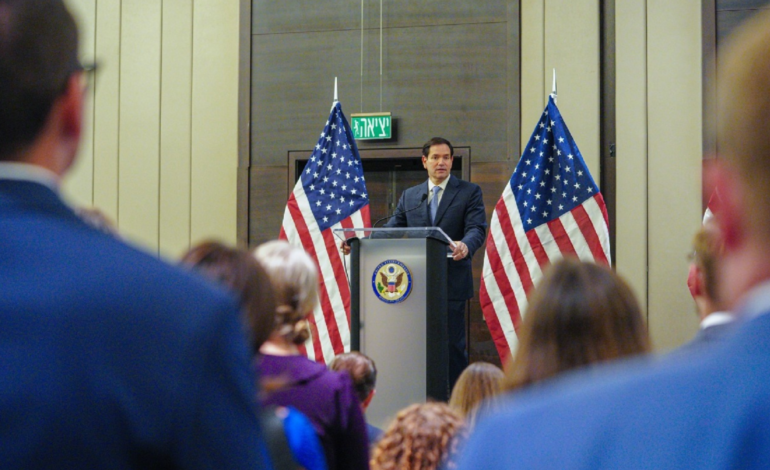
Rubio says US balancing China ties while strengthening Indo-Pacific alliances

US Secretary of State Marco Rubio has said the United States is pursuing a carefully calibrated strategy that seeks to manage tensions with China while simultaneously reinforcing its alliances and partnerships across the Indo-Pacific, a region central to global security and economic stability.
Speaking at his year-end news conference in Washington, Rubio acknowledged that friction with Beijing is unavoidable given China’s growing global influence, but stressed that the US does not view confrontation as an end in itself.
“Look, there will be tensions, there’s no doubt about it,” Rubio said, noting that China “is and will continue to be a rich and powerful country and a factor in geopolitics.” He emphasized that Washington recognizes the necessity of maintaining channels of engagement with Beijing, even amid disagreements.
“We have to have relations with them. We have to deal with them,” Rubio said. “We have to find the things we can work together on.” He suggested that responsible diplomacy requires identifying areas of cooperation, whether on global economic stability, climate-related challenges, or crisis management, without compromising US principles or strategic interests.
At the same time, Rubio made clear that engagement with China does not come at the expense of America’s long-standing allies and regional partners. He described the US approach as a balancing act—managing rivalry with Beijing while deepening trust and cooperation with allies.
“Our job is to balance these two things,” he said, highlighting Japan as a cornerstone of US strategy in Asia. “The Japanese are a very close ally of the United States,” Rubio added, reaffirming Washington’s commitment to regional security and collective defense.
Beyond Japan, Rubio underlined that US alliances span the broader Indo-Pacific, including South Korea, India, Australia, New Zealand, and other regional partners. These relationships, he said, are essential to maintaining a free, open, and rules-based regional order.
“That includes not just Japan but South Korea, the Indo-Pacific,” Rubio said, adding that Washington’s partnerships are designed to promote stability rather than provoke confrontation. “I don’t want to leave anybody out,” he noted, emphasizing inclusive cooperation with a wide range of nations.
However, Rubio was candid in acknowledging that points of tension with China are likely to persist for the foreseeable future. “There will be points of tension now and for the foreseeable future,” he said, pointing to enduring disputes over trade practices, advanced technology, Taiwan, and security dynamics in the South and East China Seas.
US-China relations have been strained in recent years as Washington has sought to counter what it sees as Beijing’s assertive behavior, while China has criticized US alliances and military presence in the region. Despite this, Rubio suggested that both sides understand the importance of managing competition responsibly.
“I think both sides understand that,” he said, referring to the need for clear communication and guardrails to prevent escalation.
Rubio also highlighted the growing importance of India in the US Indo-Pacific strategy. New Delhi has emerged as a key strategic partner, with expanding cooperation in defense, technology, trade, and supply chains. Frameworks such as the Quad—bringing together the US, India, Japan, and Australia—reflect Washington’s emphasis on collective security and regional resilience.
As global power dynamics continue to evolve, Rubio’s remarks underscored Washington’s intent to pursue a dual-track approach: engaging China where possible, deterring destabilizing actions where necessary, and strengthening alliances to ensure long-term stability in the Indo-Pacific and beyond.