India and Japan deepen cooperation on disaster risk reduction and resilience

India and Japan have reaffirmed their commitment to strengthening bilateral cooperation in disaster risk reduction and disaster resilience, underscoring the growing strategic depth of the Special Strategic and Global Partnership between the two countries.
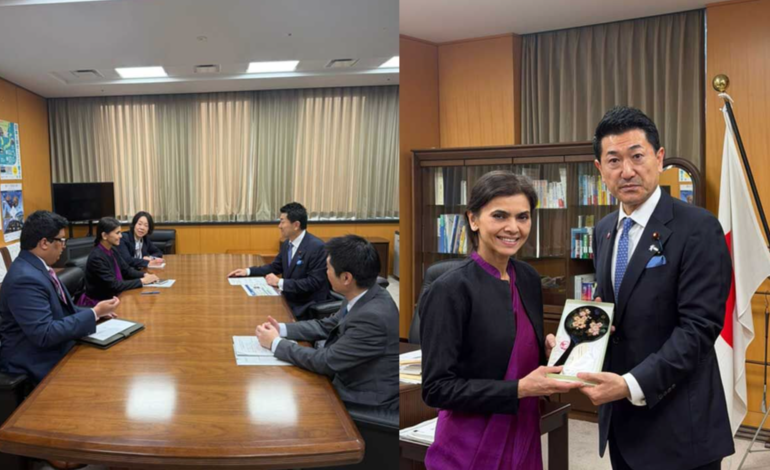
India’s Ambassador-designate to Japan, Nagma Mallick, on Monday met Akama Jiro, Japan’s State Minister for Disaster Management, to discuss collaborative approaches to disaster preparedness, mitigation, and resilience-building. The discussions focused on sharing best practices, leveraging technology, and enhancing institutional coordination to address natural disasters, which both countries frequently face due to their geographical vulnerabilities.
In a statement shared on social media platform X, the Indian Embassy in Japan noted that the meeting highlighted the importance of India-Japan cooperation in strengthening disaster risk reduction frameworks and improving resilience mechanisms at both national and regional levels.
The engagement comes at a time when climate change-induced extreme weather events are increasing in frequency and intensity across the Indo-Pacific region, making disaster preparedness a critical pillar of bilateral and multilateral cooperation.
Ambassador-designate Mallick has been actively engaging with senior Japanese leadership since assuming her role, reinforcing momentum in India-Japan relations. On December 18, she met Kiuchi Minoru, Japan’s Minister of State for Economic and Fiscal Policy, where discussions covered a wide range of issues under the India-Japan Special Strategic and Global Partnership, including economic collaboration and policy coordination.
She also held talks with Yasutoshi Nishimura, Member of Japan’s House of Representatives and Chairman of the Japan-India Parliamentary Friendship Group. Both sides discussed avenues to further strengthen parliamentary exchanges, people-to-people ties, and cooperation on issues of mutual strategic interest.
Earlier, on December 15, Mallick met Fukushiro Nukaga, Speaker of Japan’s House of Representatives, focusing on enhancing parliamentary cooperation and deepening political dialogue between the two democracies.
At the leadership level, India-Japan ties continue to receive strong political backing. On November 23, Prime Minister Narendra Modi held a bilateral meeting with Japanese Prime Minister Sanae Takaichi on the sidelines of the G20 Summit in Johannesburg. The leaders discussed ways to accelerate cooperation in key sectors such as innovation, defence, talent mobility, and trade.
In a post following the meeting, Prime Minister Modi emphasised that a strong India-Japan partnership is essential for addressing global challenges and building a sustainable future.
India-Japan relations have steadily evolved over the past two decades. The partnership was elevated to a Global Partnership in 2000, a Strategic and Global Partnership in 2006, and further upgraded to a Special Strategic and Global Partnership in 2014. Defence and security cooperation, alongside economic engagement and people-centric initiatives, form core pillars of the bilateral relationship.
Disaster risk reduction cooperation adds another vital dimension to this partnership, reflecting shared values, mutual trust, and a joint commitment to safeguarding lives and infrastructure in an increasingly uncertain global environment.