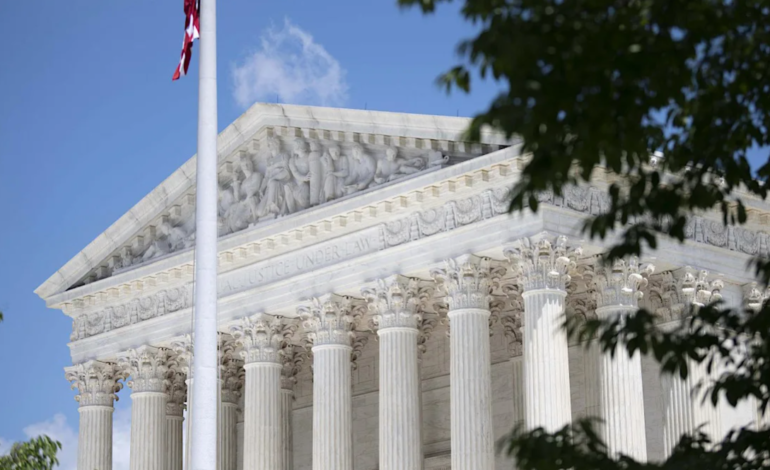
US Supreme Court blocks Trump administration from deploying National Guard to Illinois

The US Supreme Court has dealt a significant legal setback to President Donald Trump by blocking his administration’s attempt to deploy the National Guard to Illinois, ruling that the federal government failed to establish clear legal authority for the move.
In a 6–3 decision, the top court denied the Trump administration’s request to overturn lower court rulings that had barred the deployment. According to the court’s order, issued at an early stage of the litigation, the administration did not demonstrate a lawful basis for using military forces to enforce civilian laws within the state.
“At this preliminary stage, the government has failed to identify a source of authority that would allow the military to execute the laws in Illinois,” the court said in its order.
The dispute stems from actions taken in early October, when President Trump ordered the federalization of approximately 300 members of the Illinois National Guard for deployment in and around Chicago. A day later, members of the Texas National Guard were also reportedly federalized and sent to the city, escalating tensions between the White House and Illinois’ Democratic leadership.
The Trump administration argued that the deployment was necessary to protect federal property and law enforcement personnel amid unrest and protests. However, Illinois officials strongly opposed the move, asserting that the federal government was overstepping its constitutional authority and infringing on state sovereignty.
On October 9, the US District Court for the Northern District of Illinois issued a temporary restraining order blocking the federalization and deployment of National Guard forces within the state. That decision was later upheld by the US Court of Appeals for the Seventh Circuit on October 16. While the appeals court allowed the administration to federalize National Guard units, it ruled that deploying them to enforce laws within Illinois was not permitted.
Following those rulings, the Trump administration appealed to the Supreme Court, seeking emergency relief that would allow the Guard’s deployment. The Supreme Court’s refusal to intervene effectively leaves the lower court decisions in place while the broader legal challenge continues.
Reacting to the ruling, White House spokeswoman Abigail Jackson defended the administration’s actions, stating that the president had acted to safeguard federal officers and prevent damage to federal buildings and property.
Illinois Governor JB Pritzker, a Democrat who had vocally opposed the deployment, welcomed the Supreme Court’s decision, calling it a victory for both the state and constitutional governance.
“This is a big win for Illinois and American democracy,” Pritzker said, reiterating that public safety in the state should remain under the control of state and local authorities unless extraordinary legal conditions are met.
Chicago Mayor Brandon Johnson had also opposed the deployment, warning that the federal move risked inflaming tensions rather than restoring order.
Legal experts note that the ruling reinforces long-standing limits on the federal government’s ability to deploy military forces domestically without clear statutory authority, particularly when state leaders object. While the case may continue through lower courts, the Supreme Court’s decision signals judicial skepticism toward expansive interpretations of executive power in domestic law enforcement.
The ruling adds to a growing list of legal challenges confronting the Trump administration as it seeks to assert broader federal authority over states on issues of public order and security.