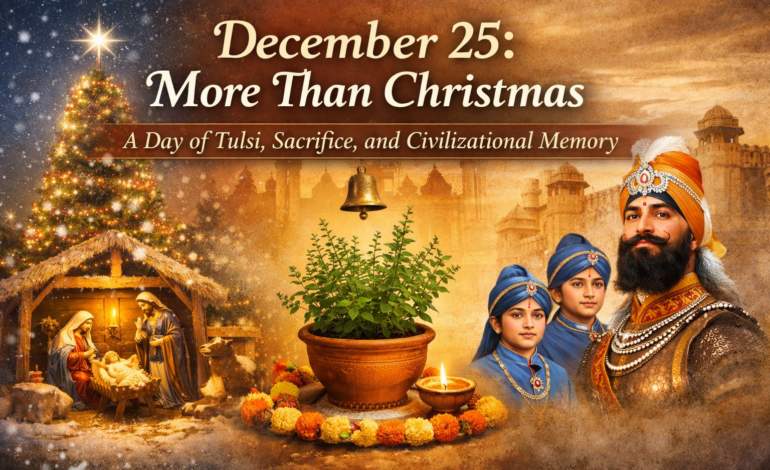
December 25 is more than Christmas: A day of Tulsi, sacrifice, and truth behind the celebration, conscience, and civilizational memory

By: Dr. Avi Verma
December 25 is celebrated across the world as Christmas, commemorating the birth of Jesus Christ, whose message of love, compassion, sacrifice, forgiveness, and service to humanity has inspired billions across centuries. Christmas is not merely a festival of lights, gifts, and goodwill; at its core, it is a reminder of humility, charity, and moral responsibility. Its global observance reflects humanity’s shared yearning for peace, kindness, and hope—values that deserve sincere respect.
At the same time, December 25 in India carries layered and profound meanings, especially within the Hindu and Sikh traditions, where the day transcends festivity and enters the realm of spiritual discipline, remembrance, and sacrifice.
For Hindus, December 25 is observed as Tulsi Pujan Diwas, a day dedicated to the worship of Tulsi Mata (Holy Basil)—revered not symbolically, but as a living, divine presence in Hindu homes. Tulsi is believed to be an avatar of Goddess Lakshmi and is lovingly called “Vishnupriya”, the beloved of Lord Vishnu. Worshipping Tulsi on this day is believed to invite purity, prosperity, peace, and spiritual balance.
Beyond modern observance, December 25 often aligns with the Dashami Tithi (tenth lunar day) of the Krishna Paksha (waning moon) in the sacred Pausha month, a spiritually significant period in the Hindu lunar calendar. This alignment deepens the day’s sanctity, linking it to ancient mythology, devotion, and seasonal spiritual practice. The Tulsi tradition also connects directly with Ayurveda, recognizing Tulsi as a powerful adaptogen and medicinal plant used for mental well-being, immunity, respiratory health, and stress relief—symbolizing the Hindu integration of spirituality, health, and nature.
Tulsi Pujan Diwas therefore offers a compelling spiritual alternative to excessive material celebration—calling for mindfulness over indulgence, devotion over intoxication, and ecological responsibility over excess.
For the Sikh community—and indeed for the conscience of the nation—December 25 marks the most solemn days of remembrance associated with the supreme sacrifices of Sri Guru Gobind Singh Ji, the Tenth Sikh Guru. A saint, poet, philosopher, and fearless warrior, Guru Gobind Singh Ji sacrificed his entire family for the defense of Dharma, justice, and freedom of belief.
This sacred remembrance culminates on December 26, now nationally observed as Veer Bal Diwas, honoring the martyrdom of the youngest Sahibzadas—Baba Zorawar Singh Ji (9) and Baba Fateh Singh Ji (7)—who were bricked alive for refusing to abandon their faith. Their sacrifice stands unmatched in world history, redefining courage, conscience, and moral strength at an age when innocence itself becomes resistance.
Veer Bal Diwas is not merely a historical observance; it is a moral education for future generations, reminding society that true strength lies in principles, not power, and that faith and conviction can triumph even over empire and cruelty.
At IndoUS Tribune, we believe that honoring Christmas and its universal message does not require forgetting our own civilizational roots. December 25 is a rare convergence—a day where global compassion, Hindu spiritual ecology, and Sikh martyrdom intersect.
Celebrate Christmas with joy, generosity, and goodwill.
Observe Tulsi Pujan Diwas with devotion, gratitude, and reverence for nature and health.
Bow in solemn respect during Veer Bal Diwas to the eternal sacrifice of Guru Gobind Singh Ji’s Sahibzadas.
Together, these observances remind us that celebration is richest when anchored in faith, remembrance, and conscience—and that true civilization thrives when joy and sacrifice walk hand in hand.