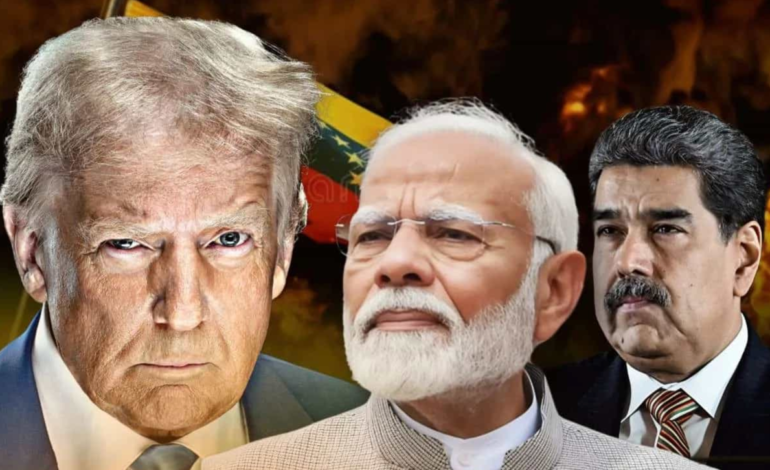
After Maduro, who’s next? Trump’s ‘run the country’ doctrine and the strategic wake-up call for India

By: Dr Avi Verma
The capture of Venezuelan President Nicolás Maduro by U.S. forces marks a geopolitical rupture unlike anything seen since the end of the Cold War. This was not a proxy conflict, not a covert operation acknowledged years later, and not a multilateral intervention framed through the United Nations. It was a unilateral assertion of power, followed by an extraordinary declaration from President Donald Trump that the United States is now “going to run” Venezuela.
Taken together with warnings issued toward Cuba, Colombia, and Mexico, open talk of territorial ambition—from Greenland to strategic choke points—and threats of punitive tariffs as high as 500 percent against countries deemed noncompliant, the Maduro episode raises a profound question: Are we witnessing the collapse of the post–World War II international order?
For decades, global stability rested—imperfectly—on shared rules: respect for sovereignty, limits on the use of force, congressional authorization for war, and international institutions meant to arbitrate disputes. That framework is now under direct assault, not by rogue states alone, but by the world’s most powerful democracy. Trump advisers are no longer masking the doctrine. They are saying it openly: might is right, international law is optional, and institutions exist only if they serve immediate national interest.
If that is the doctrine, then the implications are enormous.
The United Nations, already weakened by veto paralysis and selective enforcement, risks sliding into irrelevance. Calls for emergency Security Council meetings ring hollow when permanent members either back the action, block accountability, or issue condemnations with no enforcement power. When China, Russia, Iran, North Korea, Latin America’s largest democracies, and much of Europe all cite violations of international law—and nothing follows—it is fair to ask whether the UN system is effectively dead, or merely ceremonial.
The reactions to Maduro’s capture underscore the fracture. Colombia fears border instability and humanitarian fallout. Cuba calls it a criminal attack. Brazil warns of an unacceptable breach of sovereignty. China demands Maduro’s immediate release and labels the operation a clear violation of international law. Russia decries armed aggression. Europe urges restraint and de-escalation while scrambling to protect its nationals. Israel applauds decisiveness. The world is not aligning—it is splintering.
Equally alarming is the domestic dimension. The operation in Venezuela dramatically escalates what many constitutional scholars describe as Congress’s abdication of its war powers. The arrest of a foreign head of state and the assertion of U.S. control over another country’s governance go far beyond tactical military action. They represent a strategic occupation in all but name—without authorization, without debate, and without a defined endgame. This sets a precedent not just for this administration, but for every future one.
For India and other emerging powers, the message is unsettling. New Delhi has long balanced strategic autonomy with engagement across blocs. But in a world where tariffs of 500 percent are floated as leverage, where military force replaces diplomacy, and where sovereignty is conditional, even long-standing partnerships become fragile. India’s concerns are not hypothetical: trade, energy security, diaspora safety, and regional balance all hinge on predictable rules. If power alone determines outcomes, middle powers are left exposed.
Is this a new world order? Perhaps not yet—but it is unmistakably a new phase. One where norms are openly contested, where legality follows power instead of constraining it, and where smaller nations are forced to choose between alignment and vulnerability. The capture of Maduro is less about Venezuela than about the signal it sends: borders are negotiable, institutions are secondary, and restraint is optional.
History suggests such moments rarely end quietly. They either force a renewal of rules through crisis—or usher in prolonged instability until new balances are forged. The coming months will reveal whether the international community can reassert law over force, or whether the world is indeed entering an era where the strongest actor writes the rules in real time.
What is clear is this: after Maduro, no nation—friend or foe—can assume that yesterday’s assumptions still apply.