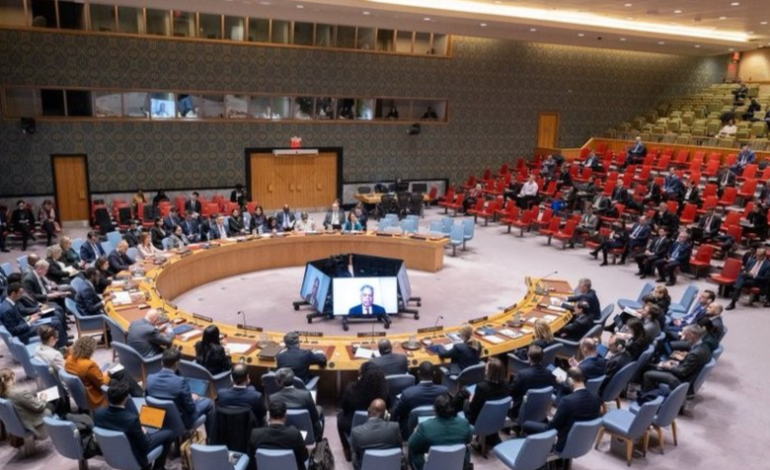
Alarm at UN Security Council over Russia’s use of nuclear-capable hypersonic missile in Ukraine war

As the war in Ukraine approaches its fourth year, mounting concern was voiced at the United Nations Security Council over Russia’s deployment of a nuclear-capable hypersonic missile, an action widely described as a dangerous escalation with potential global consequences.
Briefing the Security Council, UN Under-Secretary-General for Political and Peacebuilding Affairs Rosemary DiCarlo warned that Russia’s use of the Oreshnik missile system has heightened international alarm due to its nuclear-capable design. The missile, which reportedly struck targets near Ukraine’s western city of Lviv close to the Polish border, is believed to be capable of carrying nuclear warheads, intensifying fears of escalation near NATO territory.
DiCarlo noted that this marked only the second known use of the weapon since 2004. Describing it as a “potentially devastating” system, she said the missile is an intermediate-range ballistic weapon capable of traveling at approximately 2,300 kilometres per hour—around ten times the speed of sound—making interception extremely difficult.
Russia’s Permanent Representative to the UN, Vassily Nebenzia, openly boasted about the missile’s capabilities during the Council meeting, asserting that “there is no air defence protection so far” against the Oreshnik. His remarks drew strong reactions from Western delegations, many of whom viewed the missile’s deployment as a calculated signal amid intensified diplomatic efforts to pursue peace.
The United States strongly condemned the move. Deputy Permanent Representative Tammy Bruce described the launch as “another dangerous and inexplicable escalation” at a moment when Washington and its partners are pushing urgently for a negotiated settlement. Britain’s Deputy Permanent Representative James Kariuki echoed the concern, warning that the use of such weapons threatens regional and international security and raises the risk of miscalculation.
Ukraine had requested the emergency Security Council meeting following a massive Russian aerial assault involving missiles and drones. DiCarlo said that between Thursday and Friday alone, Russia reportedly launched 242 drones and 36 missiles across Ukraine, striking energy infrastructure and civilian targets. The attacks coincided with severe winter conditions, worsening the humanitarian impact.
Ramesh Rajasingham, head of the UN Office for the Coordination of Humanitarian Affairs (OCHA), said plunging temperatures—nearing minus 10 degrees Celsius—have made civilian suffering more acute. He warned that continued attacks on power and heating systems were pushing emergency services and winter survival mechanisms to the brink.
Ukraine’s Permanent Representative Andriy Melnyk accused Moscow of escalating brutality, saying Russia had once again demonstrated that “there is no bottom to its criminal intent.” He said millions of Ukrainians were left without electricity, heating and water as a result of the strikes.
Nebenzia sought to justify Russia’s actions, claiming they were retaliatory measures following a Ukrainian attack on a residence linked to President Vladimir Putin. Ukraine categorically denied the allegation, a position supported by several Western countries.
Melnyk also rejected Russia’s portrayal of strength, arguing that Moscow was masking deep internal crises, including economic strain and severe labour shortages caused by mass emigration since the war began.
Meanwhile, the United States signaled a firmer tilt toward Kyiv. Bruce said Russia’s ongoing attacks on civilian and energy infrastructure “make a mockery of the cause of peace,” stressing that ending the war remains a priority for the international community and President Donald Trump.
As diplomatic efforts intensify, the missile deployment has underscored fears that the conflict could spiral further, complicating negotiations and heightening risks far beyond Ukraine’s borders.