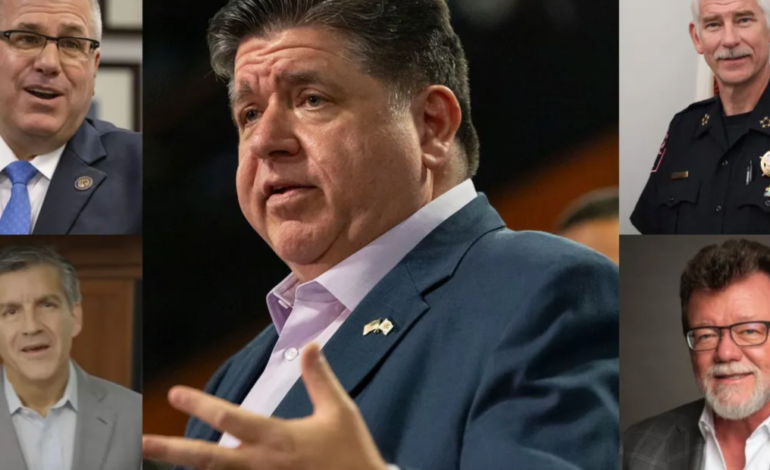
Illinois governor’s race 2026: incumbency, identity, and the battle for relevance

By: Dr. Avi Verma
As Illinois moves steadily toward the March 17, 2026 primaries and the November 3 general election, the contest for governor is emerging as a study in political asymmetry. On one side stands a deeply entrenched Democratic incumbent seeking a rare third term; on the other, a Republican Party still wrestling with its identity, message, and electability in a state that has trended decisively blue over the last decade.
Governor JB Pritzker’s decision to seek re-election was never seriously in doubt. Since first winning office in 2018, Pritzker has consolidated power within the Democratic Party while presiding over a period marked by improved state finances, progressive legislative victories, and firm alignment with national Democratic priorities. His re-election campaigns have been built not only on policy outcomes but on a broader ideological positioning of Illinois as a counterweight to conservative governance elsewhere in the country. For many Democratic voters, Pritzker has become both administrator and symbol—of stability, predictability, and resistance to national Republican politics.
The Democratic primary, in this context, functions largely as a formality. Pritzker’s challenger, Patricia Tillman, brings limited name recognition and minimal statewide infrastructure. Her candidacy reflects pockets of grassroots dissatisfaction rather than a serious electoral threat. With former Deputy Governor Christian Mitchell returning as the lieutenant governor nominee, Pritzker has reinforced continuity while strengthening ties to key Democratic constituencies, particularly in Chicago and its suburbs. Barring an unforeseen political shock, the Democratic ticket for November appears effectively settled.
The Republican primary, by contrast, is unsettled, crowded, and revealing. Seven candidates are vying for the nomination, each representing a different vision of how—and whether—the GOP can compete statewide. The sheer size of the field speaks to Republican ambition but also to fragmentation, with no clear consensus on strategy or ideology.
Darren Bailey, the party’s 2022 nominee, enters the race with the most recognizable name and a loyal base of support, particularly in downstate and rural Illinois. Bailey’s appeal lies in authenticity and ideological clarity. He is a cultural conservative unafraid of sharp contrasts with Democratic governance, and his selection of Cook County Republican Chair Aaron Del Mar as his running mate reflects an effort to broaden geographic appeal. Yet Bailey’s previous decisive loss to Pritzker still looms large. For many donors and suburban voters, Bailey symbolizes a ceiling rather than a path to victory.
Other Republican contenders are attempting to chart alternative routes. Ted Dabrowski, president of Wirepoints, offers a data-driven critique of Illinois’ fiscal health and population trends, positioning himself as a reform-minded technocrat. James Mendrick, the DuPage County Sheriff, emphasizes public safety and executive experience in hopes of appealing to suburban moderates. Their challenge is not necessarily ideological but structural: neither has yet demonstrated the grassroots reach needed to overtake Bailey’s base in a low-turnout primary.
The remaining candidates—Rick Heidner, Joseph Severino, Max Solomon, and Gregg Moore—add texture to the race but, at present, lack the resources or momentum to emerge as dominant contenders. Ironically, their presence may strengthen Bailey’s position by fragmenting opposition support.
Looking ahead to the general election, the most likely matchup remains a rematch between Pritzker and Bailey. In such a scenario, the underlying fundamentals favor the incumbent. Illinois’ Democratic coalition—anchored in Chicago, the suburbs, and increasingly diverse metropolitan regions—has proven durable. Pritzker’s ability to self-fund, define opponents early, and nationalize key issues such as abortion rights and gun policy further strengthens his position.
Bailey’s path to victory, while not impossible, would require a convergence of favorable conditions: diminished Democratic turnout, a sharply deteriorating economic or political climate, and significant suburban erosion for Democrats. Without these factors, the Republican nominee faces a steep uphill climb.
Ultimately, the 2026 Illinois governor’s race is less about uncertainty at the top of the ballot than about the future direction of the state’s opposition party. For Democrats, the challenge is managing incumbency fatigue without alienating a broad coalition. For Republicans, the task is more existential—deciding whether to double down on base politics or recalibrate for a changing electorate.
As the primaries approach, the question is not simply who will win, but what kind of contest Illinois voters will ultimately be offered in November. At present, the advantage rests firmly with the incumbent—but politics, as ever, remains a dynamic and evolving arena.