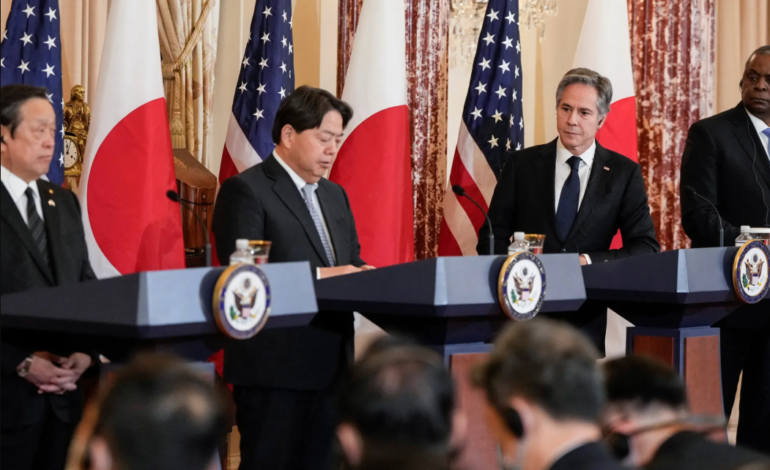
US, Japan underscore alliance in security and economic talks

The United States and Japan this week reaffirmed the central importance of their alliance in maintaining peace, stability, and economic resilience in the Indo-Pacific, as senior officials from both countries held a series of high-level engagements across defence, diplomacy, and economic policy.
The discussions were highlighted by talks in Washington between US Secretary of War Pete Hegseth and Japanese Defence Minister Shinjirō Koizumi, during which both sides underscored the alliance’s role as a cornerstone of regional deterrence amid an increasingly complex security environment.
Hegseth described the US-Japan partnership as “one of the most remarkable relationships in the world,” saying Koizumi’s visit demonstrated the “actual physical strength” of the alliance. He welcomed Japan’s decision to significantly increase defence spending, calling it an important and appreciated step that strengthens collective security.
“Our approach is based on hard-nosed realism and common sense,” Hegseth said, emphasizing the need for realistic training, exercises, and preparedness to ensure “peace through strength” in the Indo-Pacific.
Koizumi said the meeting reflected the growing depth and pace of bilateral cooperation since he assumed office in October. He noted extensive discussions with US military leadership on responding to what he described as a “severe and evolving security environment,” and stressed the importance of linking the vision of a free and open Indo-Pacific with the strength of the Japan-US alliance.
According to a defence readout, the two leaders reaffirmed the alliance’s critical role in deterring aggression in the region and agreed to continue upgrading command-and-control systems, enhance the realism of joint training and exercises, strengthen alliance force posture and presence—including in Japan’s southwest islands—and maintain close coordination on defence industrial base cooperation.
Beyond Washington, alliance coordination extended to the Western Pacific. On January 15, Special Advisor to the Prime Minister of Japan Oue Sadamasa visited US Marine Corps Camp Blaz in Guam, where he received briefings on ongoing construction and infrastructure development projects. The visit underscored Japan’s close interest in US military posture and readiness in the region.
Oue met Rear Adm. Brett Mietus, commander of Joint Region Marianas, and Brig. Gen. Charles D. Cooley, commander of the 36th Wing at Andersen Air Force Base, to exchange views on regional security and Japan-US defence policy. He also paid tribute at the South Pacific Memorial Park, laying a wreath and offering a silent prayer, according to a media release.
Diplomatic engagement continued in Washington on January 16, when US Deputy Secretary of State Christopher Landau met Japanese Vice Minister for Foreign Affairs Funakoshi Takehiro. A State Department readout said the two reviewed bilateral cooperation and reaffirmed their shared commitment to the US-Japan alliance as the foundation of peace and security in the Indo-Pacific. They also discussed opportunities to deepen economic ties and strengthen deterrence through closer security coordination.
Economic cooperation featured prominently as well. US Treasury Secretary Scott Bessent met Japanese Finance Minister Satsuki Katayama on January 12, thanking her for participating in the US critical minerals summit. Bessent highlighted the importance of securing critical mineral supply chains among democratic nations.
According to the Treasury Department, the two discussed global minimum tax issues, exchange rate volatility, and the need for sound monetary policy formulation and communication. Bessent reaffirmed confidence in the US-Japan alliance, calling it vital not only for regional security but also for global economic stability.
Together, the week’s engagements reflected the breadth of the US-Japan partnership, spanning defence readiness, diplomatic coordination, and economic resilience, as both countries seek to reinforce their alliance amid shifting geopolitical and economic challenges.