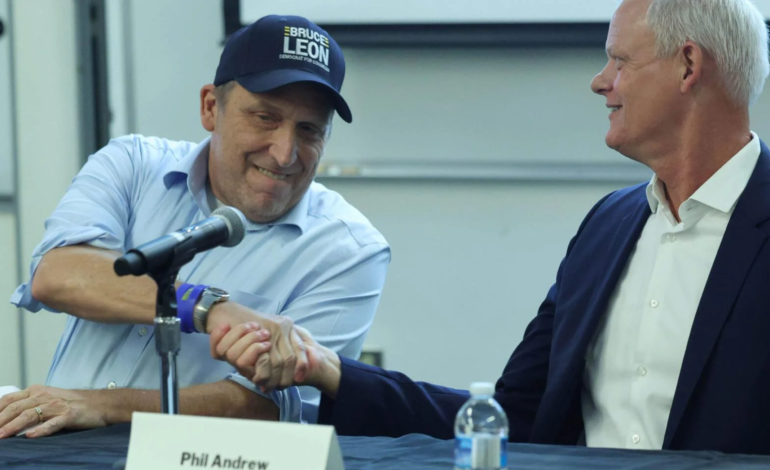
Leon bows out, backs Phil Andrew, and redraws the Democratic battle lines in Illinois’ 9th Congressional District

By: Dr. Avi Verma
The Democratic primary for Illinois’ 9th Congressional District has entered a decisive new phase following the withdrawal of 50th Ward Committeeman Bruce Leon and his endorsement of former FBI agent, hostage negotiator, and gun violence survivor Phil Andrew. What began as a crowded, ideologically diverse contest is now rapidly consolidating around questions of leadership, credibility, and electability, particularly among moderate and pragmatic voters seeking experience over rhetoric.
Leon’s exit is not merely a subtraction from the ballot; it is a strategic realignment that may fundamentally reshape the race.
A turning point in a crowded field
Illinois’ 9th District—stretching across Chicago’s North Side and inner-ring suburbs such as Skokie, Evanston, and Glenview—has long been defined by high civic engagement, a strong Jewish community, and voters who value competence, ethics, and public safety alongside progressive social values.
This cycle, the Democratic primary has drawn a large and ideologically varied field, including experienced elected officials, progressive activists, and first-time candidates. While such diversity reflects the district’s political energy, it has also risked fragmenting the vote—particularly among moderates and voters concerned about governance, security, and institutional stability.
Bruce Leon’s withdrawal, formally filed on January 13, 2026, represents the clearest effort yet to consolidate that lane.
Why Bruce Leon’s endorsement matters
Leon was not a marginal candidate. As a long-serving ward committeeman and respected community leader in Chicago’s Orthodox Jewish community, he brought organizational credibility, donor networks, and deep local relationships to the race. His campaign emphasized public safety, antisemitism, and frustration with what he described as excessive outside political pressure and ideological rigidity.
His decision to endorse Phil Andrew was framed not as a concession, but as a value based alignment.
“Is there a better time than now to send a hostage negotiator to Congress?” Leon asked, underscoring Andrew’s real-world experience in de-escalation, public safety, and crisis management.
Leon cited Andrew’s work as the FBI’s lead hostage negotiator during the 2008 Mumbai terror attack on the Chabad House, as well as his collaboration with the Illinois Holocaust Museum on hate-crime training for law enforcement—credentials that resonate deeply in a district increasingly concerned about antisemitism and political violence.
Importantly, Leon has described the endorsement as a “merger” of campaigns, committing himself actively to Andrew’s outreach and events rather than stepping aside quietly. That level of engagement signals to voters that this is a genuine coalition, not a transactional endorsement.
Phil Andrew’s profile: Experience over ambition
Phil Andrew enters this new phase of the race with a profile that is increasingly distinctive in a field dominated by career politicians and media-driven candidates.
A survivor of gun violence, Andrew has grounded his advocacy in lived experience rather than abstract ideology. His career as an FBI agent, counterterrorism expert, and hostage negotiator positions him uniquely at a moment when voters express anxiety about political extremism, rising hate crimes, and institutional breakdown.
Following his federal service, Andrew founded Pax Group, LLC, a global conflict-management consultancy, further reinforcing his image as a problem-solver rather than a partisan brand-builder.
Leon captured this distinction pointedly saying, “Phil is about public service, not self-service… We don’t need lifetime politicians fighting for us at a time when our institutions are under attack.
That message may find traction with voters fatigued by performative politics and constant ideological escalation.
How the Andrew–Leon team compares to the rest of the field
With Bruce Leon’s exit and endorsement of Phil Andrew, the Democratic primary in Illinois’ 9th Congressional District is increasingly sorting itself into distinct strategic and ideological lanes—each appealing to different segments of the electorate.