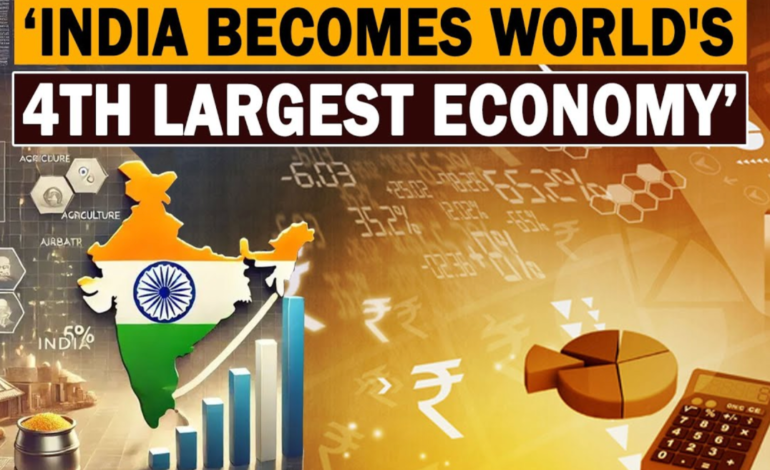
India at No. 4: A moment of pride, purpose, and global promise

By: Dr Avi Verma
India’s emergence as the world’s fourth-largest economy marks a defining inflection point in the nation’s post-independence journey. With a nominal GDP now exceeding $4 trillion, India has moved decisively into the top tier of global economic powers—behind only the United States, China, and Germany. This milestone is not simply about overtaking another economy or climbing a statistical ladder. It represents a profound shift in how India is positioned, perceived, and respected in the global order.
For decades, India’s potential was widely acknowledged but rarely realized at scale. Growth came in fits and starts, often constrained by structural bottlenecks, policy uncertainty, and underinvestment in infrastructure. Today’s ranking signals that India has crossed a psychological and economic threshold. It has moved from being an “emerging” economy in perpetual transition to a systemically important global player whose performance influences markets, supply chains, and strategic calculations worldwide.
For the Indian diaspora, this moment carries special resonance. Across the United States, Europe, the Middle East, Africa, and Asia-Pacific, Indians abroad have long balanced pride in their heritage with the reality of global stereotypes that often underestimated India’s capabilities. India’s rise to No. 4 reshapes that narrative. It strengthens the sense of belonging to a nation that is not merely participating in global conversations—but actively shaping them. Economic strength reinforces cultural confidence, diplomatic credibility, and collective self-esteem.
This achievement is the product of sustained leadership and policy continuity over the past decade. Under the leadership of Prime Minister Narendra Modi, India has pursued a coherent vision centered on structural reform, infrastructure expansion, and national self-confidence. The emphasis has been on long-term capacity building rather than short-term optics—an approach that has gradually altered the country’s economic trajectory.
The stewardship of Finance Minister Nirmala Sitharaman has been particularly consequential. Navigating global shocks ranging from the pandemic to geopolitical conflict and inflationary pressures, India maintained fiscal discipline while continuing capital investment. Tax reforms, rationalized subsidies, improved compliance, and a renewed focus on public balance sheets helped stabilize macroeconomic fundamentals even during periods of global volatility.
Equally important has been the role of India’s economic institutions and policy thinkers. Chief Economic Adviser Dr. V. Anantha Nageswaran’s focus on balancing growth with inflation control, financial stability, and domestic demand has reinforced a pragmatic, evidence-driven approach to policymaking. This steady hand has reassured investors and markets alike that India’s growth is not accidental, but deliberate and sustainable.
Transformational reforms have strengthened India’s economic architecture. The Goods and Services Tax (GST) unified a fragmented domestic market. Digital public infrastructure, including Aadhaar, UPI, and the digital payments ecosystem, has expanded financial inclusion while lowering transaction costs. Production-linked incentive (PLI) schemes have catalyzed manufacturing in sectors ranging from electronics to pharmaceuticals, while massive investments in roads, railways, ports, and airports have improved logistics and connectivity.
India’s rise, however, is not driven by policy alone. It is powered by its people. With one of the world’s youngest populations, an expanding middle class, and a vibrant entrepreneurial ecosystem, India possesses a demographic and human capital advantage few nations can match. Domestic consumption provides a stable growth engine, while innovation—from fintech to space technology—has positioned India as a laboratory for scalable solutions.
As multinational companies diversify supply chains and reduce overdependence on single markets, India is increasingly seen as indispensable. Foreign direct investment, strategic partnerships, and technology collaborations are deepening. India’s voice in global economic forums such as the G20, World Bank, and IMF now carries greater weight—not just because of population size, but because of economic scale and credibility.
Yet this moment of celebration must also be one of reflection and responsibility. Economic size alone does not guarantee widespread prosperity. The true measure of India’s success will be how effectively growth translates into jobs, rising incomes, quality education, accessible healthcare, and social mobility. Bridging regional disparities, improving urban governance, investing in skills, and addressing environmental sustainability will be essential as India moves forward.
The ambition of becoming a developed nation by 2047, the centenary of independence, is bold but not unrealistic. Achieving it will require continuous reform, productivity gains, deeper global integration, and unwavering investment in human capital. It will also demand political maturity—an ability to prioritize national interest, institutional strength, and long-term outcomes over short-term gains.
Still, moments like this deserve recognition. India’s position as the world’s fourth-largest economy signals a decisive rebalancing of global economic power. It reflects a nation that has found confidence in its capabilities and clarity in its direction.
For Indians everywhere, this milestone is a reminder that the country we call home is rising—not noisily, not impulsively, but steadily and with purpose. The journey ahead is long, but the promise is real. India’s ascent to No. 4 is not the destination. It is a powerful statement that the future is firmly within reach.