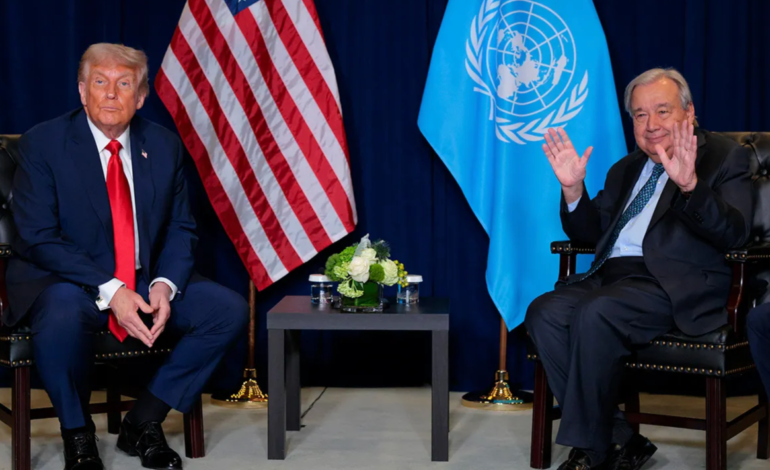
Trump claims he can fix UN financial crisis as US withholds $4 billion in dues

As the United Nations faces what its leadership has described as a severe financial emergency, former US President Donald Trump has insisted that he could resolve the crisis “very easily,” even as the United States continues to withhold nearly $4 billion in unpaid contributions to the world body.
The UN is reportedly on the brink of a budgetary breakdown, with Secretary-General Antonio Guterres warning member states of an “imminent financial collapse.” Although his message did not directly name the United States, officials within the organization have confirmed that Washington is the largest debtor, owing more than $2.1 billion to the regular UN budget and approximately $1.8 billion to peacekeeping operations.
Excluding its 2026 assessment, which is not yet due, the United States still owes around $1.4 billion in overdue payments. Given that the US contributes 22 percent of the UN’s core budget under a formula approved by the General Assembly, its arrears have placed significant strain on the institution’s ability to function effectively.
Despite this, Trump struck a surprisingly optimistic tone in recent remarks, suggesting that the UN retains “tremendous potential” as a global peacekeeping body. He framed his approach as one focused on accountability rather than withdrawal, stating that if world leaders sought his intervention, he could compel countries to meet their financial obligations within minutes.
Drawing a parallel with his past approach to NATO, Trump claimed that his pressure tactics successfully pushed several alliance members to increase defense spending. He argued that a similar strategy could be applied to the UN, although he did not clarify whether he would authorize payment of America’s own outstanding dues.
However, analysts note that the comparison is flawed. Unlike NATO defense spending, which countries can adjust independently, UN budget contributions are determined collectively by the 193-member General Assembly through a negotiated formula. Any attempt by the US to unilaterally alter this system would require broad international consensus—an outcome that appears unlikely.
While some smaller nations such as Mexico and Venezuela are also behind on payments, their combined arrears are relatively minor and would not significantly improve the UN’s financial outlook even if settled immediately. Most major contributors, including China, Japan, and European Union members, are up to date with their 2025 payments and have until the end of 2026 to submit their next assessments.
In response to the funding crunch, the UN has already begun relocating certain administrative functions to lower-cost locations outside New York and is reviewing additional cost-cutting measures. Officials have warned that if the crisis worsens, the organization could be forced to suspend key operations by mid-2026, potentially jeopardizing high-profile events such as the annual General Assembly session in September.
There are also concerns that the UN headquarters in New York could face temporary closures if funds run out, a scenario described by insiders as unprecedented in the institution’s history.
Guterres has called on all member states to honor their financial commitments or agree to reform the funding structure to prevent future crises. Yet with deep political divisions among major powers, any overhaul of the UN’s financial model would likely be contentious and time-consuming.
For now, the central question remains unanswered: will the United States ultimately pay what it owes? Until that happens, the UN’s fiscal stability will continue to hang in the balance—regardless of Trump’s confidence that he could fix it “in minutes.”