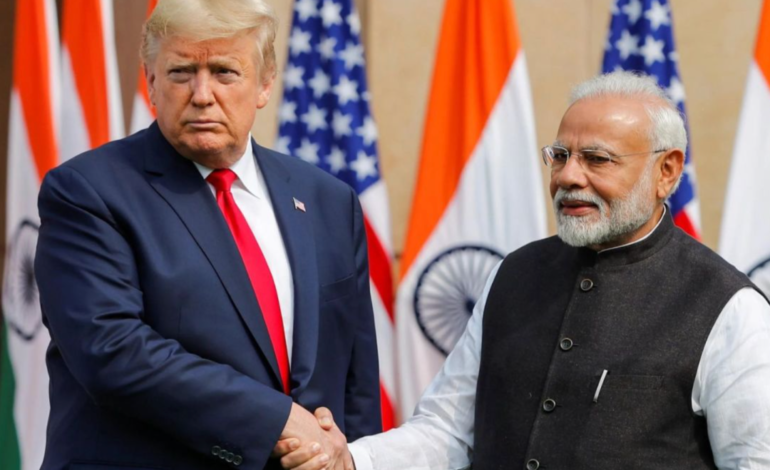
US and India agree on framework for interim trade deal

The United States and India have agreed on a framework for an Interim Trade Agreement aimed at advancing negotiations toward a comprehensive bilateral trade pact, the White House announced on Saturday. As part of the move, Washington will lower tariffs on Indian imports from 25 per cent to 18 per cent.
A joint statement said the framework reaffirms both countries’ commitment to a US–India Bilateral Trade Agreement, talks for which were launched by President Donald Trump and Prime Minister Narendra Modi on February 13, 2025. Officials said the interim deal is meant to deliver early economic gains while strengthening resilient supply chains.
Describing the pact as a “historic milestone,” the statement said the agreement reflects a shared commitment to reciprocal and balanced trade based on mutual interests and measurable outcomes.
Earlier this week, Trump spoke with Modi and later said on Truth Social that both sides had reached a trade understanding focused on reciprocity, expanded market access, and correcting long-standing trade imbalances. He framed the deal as strategically significant for US–India economic ties.
Under the framework, India will cut or remove tariffs on all US industrial goods and many agricultural products, including dried distillers’ grains, red sorghum, tree nuts, fruits, soybean oil, wine, spirits and other farm items.
In return, the US will impose an 18 per cent tariff on a range of Indian goods such as textiles, apparel, leather, footwear, plastics, organic chemicals, home décor, artisanal products, and certain machinery under an executive order addressing persistent US trade deficits.
If the interim deal is finalised, Washington has committed to lifting reciprocal tariffs on key Indian exports, including generic medicines, gems and diamonds, and aircraft parts. The US will also remove tariffs on certain Indian aircraft components imposed earlier under national security rules on metals.
India will receive a preferential tariff-rate quota for automotive parts and negotiated outcomes on generic pharmaceuticals, subject to a US Section 232 review.
Beyond tariffs, both sides agreed to tackle non-tariff barriers. India will ease restrictions on US medical devices, remove restrictive licensing on US ICT goods, review technical standards within six months, and improve access for American farm products.
The framework also includes cooperation on digital trade, supply chain security, investment screening, and export controls. India has indicated plans to purchase $500 billion worth of US goods over five years, including energy, aircraft, technology products, precious metals, and coking coal.
Both governments said they will move quickly to implement the framework and work toward concluding a broader Bilateral Trade Agreement.