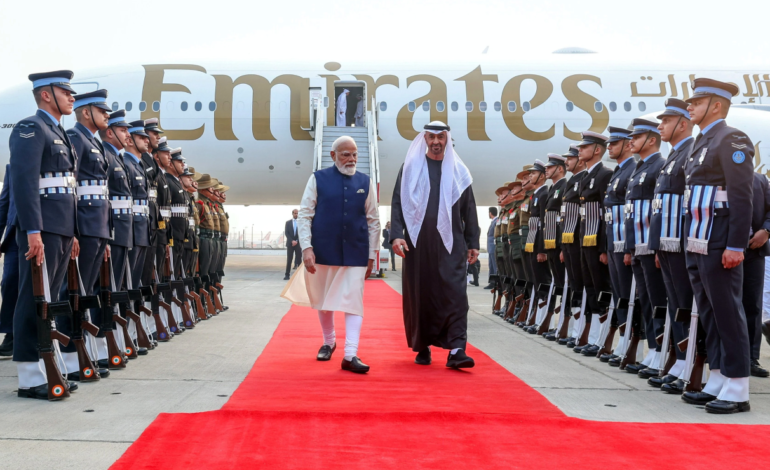
India–UAE defence pact signals deeper strategic security alignment

India and the United Arab Emirates (UAE) are steadily elevating their relationship from transactional engagement to a structured defence and security partnership, following the signing of the Strategic Defence Partnership Agreement in January 2026. Analysts say the pact marks a significant shift in bilateral ties, embedding security cooperation within the broader framework of their Comprehensive Strategic Partnership.
According to a recent analysis by Dr. Anu Sharma of the Amity Institute of Defence and Strategic Studies, the agreement expands collaboration across multiple domains, including defence manufacturing, advanced technology, military training, cyber security, counter-terrorism, and special operations. Unlike earlier ad hoc military interactions, the new framework institutionalises cooperation through aligned doctrines, joint capacity building, and greater interoperability between the two forces.
The timing of the pact reflects growing geopolitical volatility in West Asia. For the UAE, diversifying strategic partnerships has become critical to strengthening military capabilities, intelligence-sharing, and access to advanced defence technologies. For India, stability in the Gulf region is vital for energy security, maritime safety, and the welfare of millions of Indian expatriates.
Counter-terrorism and financial security have emerged as central pillars of the partnership. Both countries have reaffirmed their commitment to combating terrorism in all forms and strengthening cooperation under the Financial Action Task Force framework to curb terror financing and money laundering.
The agreement also aligns with the India–Middle East–Europe Economic Corridor, highlighting the role of defence cooperation in protecting trade routes, digital networks, and critical infrastructure. Analysts describe the pact as an “insurance layer” for India’s geoeconomic strategy, linking security with connectivity.
While not a formal military alliance, the partnership represents a pragmatic strategic alignment, enabling both nations to address emerging threats such as cyber warfare, drones, maritime risks, and supply chain disruptions.
For India, the pact signals a more proactive security role in West Asia. For the UAE, it offers access to India’s expanding defence-industrial ecosystem and opportunities for joint manufacturing. Together, the two nations are shaping a resilient security partnership suited to a multipolar and unpredictable regional order.