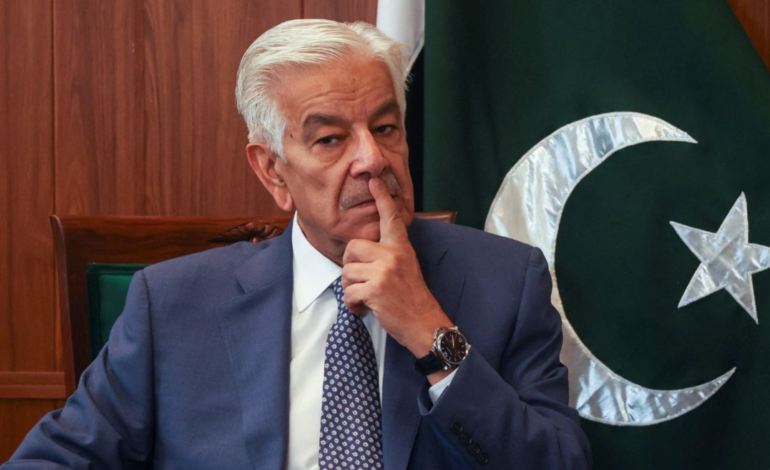
Pakistan defense minister says U.S. used Islamabad ‘like toilet paper,’ calls Afghan wars a mistake

Pakistan’s Defense Minister Khawaja Muhammad Asif delivered a scathing critique of the United States in Parliament on Tuesday, accusing Washington of using Islamabad for its strategic goals and later discarding it “worse than toilet paper.” He also acknowledged that Pakistan’s involvement in the Afghan wars was a historic blunder that continues to haunt the country.
Speaking to lawmakers, Asif said Pakistan paid a “heavy and lasting price” for realigning with the U.S. after 1999, particularly in the wake of the September 11, 2001 terrorist attacks. He argued that Islamabad was drawn into conflicts that were not in its national interest, leaving it with decades of instability.
Calling Pakistan’s participation in both Afghan wars “a mistake,” Asif linked the rise of militancy inside Pakistan to those decisions, describing today’s violence as “blowback” from past policies.
The defense minister squarely blamed former military rulers General Zia-ul-Haq and General Pervez Musharraf for pushing Pakistan into foreign wars to please Washington rather than to defend national or religious interests.
“Two dictators joined the Afghan war not for Islam, but to appease a superpower,” Asif told Parliament, adding that Pakistan continued to suffer even after the U.S. withdrew from the region.
He further claimed that Pakistan’s education system was reshaped during those years to support a war-driven ideology — changes that, in his view, still influence society today.
Asif said that while the U.S. eventually exited Afghanistan, Pakistan was left grappling with terrorism, political instability, economic strain, and radicalization along its western border.
His remarks mark one of the most candid admissions by a senior Pakistani official about the costs of Islamabad’s alliance with Washington during the War on Terror.
The minister also dismissed claims that Pakistan’s Afghan policy was rooted in religious solidarity, insisting it was instead driven by geopolitical pressure.
Local media reported that several lawmakers reacted strongly to his speech, with some agreeing that Pakistan must avoid becoming a battlefield for global powers in the future.
The U.S. has not officially responded to Asif’s comments, and HT said it could not independently verify the viral video of his remarks.
Analysts say the statement reflects growing debate inside Pakistan about its foreign policy choices, its troubled history with the Taliban, and the long-term consequences of military rule.
As Islamabad reassesses its global alignments, Asif’s blunt criticism signals a shift toward a more skeptical view of U.S.-Pakistan relations — and a recognition that past decisions have shaped today’s security crisis.