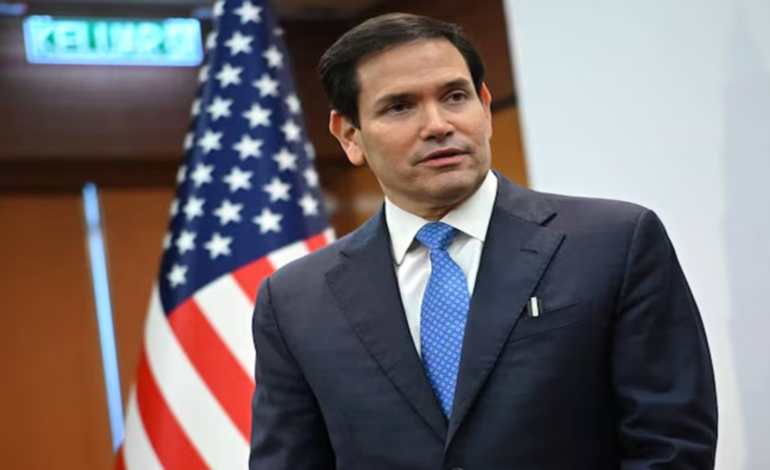
Rubio says US-China ties at ‘strategic stability’, flags supply chain risks

US Secretary of State Marco Rubio said the United States and China have reached a phase of “strategic stability” in their relationship, even as Washington remains cautious about supply chain dependence, technology transfers and Beijing’s expanding nuclear arsenal.
Speaking to reporters in Saint Kitts and Nevis, Rubio said both sides understand the dangers of escalation. “Having an all-out global trade war between the United States and China would be deeply damaging to both sides and to the world,” he said, noting that while tensions persist, outright economic confrontation would carry serious consequences.
He acknowledged that key disagreements remain and could continue to serve as irritants in bilateral ties. US President Donald Trump is expected to travel to China in about four weeks, underscoring continued high-level engagement between the two powers.
Supply chains and technology concerns
Rubio stressed that overdependence on any single country for critical goods is unsustainable. “We don’t think it’s sustainable to live in a world where we depend on some country for 90 per cent of anything — whether it’s supply chains, critical minerals, or pharmaceuticals,” he said, describing diversification as a national security priority.
On technology, Rubio pointed to concerns about Chinese access to advanced US semiconductor technology. He said agreements made by the President undergo full national security reviews to minimise risks, though he cautioned that “no measures are perfect.” He added that China has been building its own capabilities, sometimes using information acquired from abroad.
Despite tensions, Rubio emphasised that communication between the world’s two largest economies — both nuclear-armed states — is essential. “It would be reckless and irresponsible for the United States and China not to have meetings,” he said, calling continued dialogue necessary even amid areas of conflict.
Arms control and nuclear expansion
Rubio also argued that any meaningful 21st-century arms control agreement must include China. He said Beijing’s nuclear stockpile has increased significantly and dismissed claims that it still trails far behind the US and Russia as “irrelevant,” citing China’s capacity to rapidly expand.
While China has publicly rejected joining a trilateral arms control framework, Rubio said Washington cannot compel participation but can create incentives. “If they don’t want to do it, then we won’t have one. We’ll just keep doing what we need to do,” he said.
Rubio added that limited progress has been made in areas such as fentanyl precursor scheduling and increased Chinese purchases of American agricultural goods, even as strategic competition continues across trade, technology and security domains.