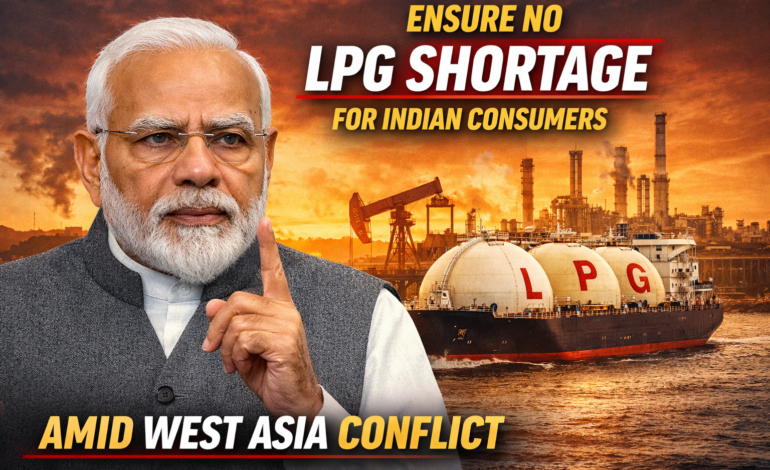
Modi directs ministers to ensure no LPG shortage for Indian consumers amid West Asia conflict

Prime Minister Narendra Modi has directed senior ministers to ensure that Indian consumers do not face shortages of liquefied petroleum gas (LPG) or other petroleum products amid rising tensions in West Asia that have disrupted global energy supplies.
During a high-level meeting held on Tuesday, the prime minister reviewed the country’s energy situation and instructed officials to closely monitor supply chains and prices. The meeting took place against the backdrop of escalating conflict involving the United States, Israel, and Iran, which has raised concerns about global oil and gas availability.
According to government sources, Modi asked ministers to coordinate closely to prevent any disruption in the supply of petroleum products and cooking gas across the country.
Also See: Anti-India hate surges online in US amid immigration debate, NCRI report finds
India is heavily dependent on imports for its energy needs, particularly crude oil and natural gas, making it vulnerable to fluctuations in international markets. The ongoing crisis in West Asia has already pushed global oil prices higher and triggered fears of supply constraints.
The prime minister met with External Affairs Minister S. Jaishankar, Petroleum and Natural Gas Minister Hardeep Singh Puri, Finance Minister Nirmala Sitharaman, and Commerce and Industry Minister Piyush Goyal to assess the situation and discuss contingency measures.
Officials indicated that the government has taken proactive steps to protect domestic consumers from the impact of rising global energy prices.
India sources a significant portion of its energy from the Middle East. However, in recent years the country has diversified its energy imports to reduce dependency on a single region. Supplies are now also being sourced from countries such as the United States, Russia, Venezuela, Australia, and other Oceanic nations.
Despite these efforts, the widening conflict in West Asia has affected energy flows to India. Reports indicate that nearly 30 percent of the country’s gas supply from the region has been disrupted due to instability and logistical challenges, including stalled tanker movements through the strategic Strait of Hormuz.
India consumes around 191 million standard cubic metres per day (mmscmd) of natural gas, about half of which is imported. Approximately 60 mmscmd of gas from the Middle East has reportedly been affected by the current disruptions.
To address the situation, the government has reprioritized the allocation of available gas. Priority is being given to essential sectors including LPG production, compressed natural gas (CNG) for transportation, and piped natural gas (PNG) for households.
Officials said the revised allocations will ensure that LPG supply remains uninterrupted for domestic consumers while also maintaining fuel availability for public transport and fertiliser production.
The government continues to monitor the evolving situation in West Asia and is expected to take further measures if global energy markets remain unstable.
Also See: Iran warns oil could hit $200 a barrel after attacks on merchant ships in Gulf