Analysis: Illinois at a political crossroads: The high-stakes primaries that could reshape Democratic power

By: Vandana Jhingan
Illinois politics is entering a rare moment of transition. For decades, the state’s federal delegation has been defined by long-serving figures whose influence extended far beyond Springfield and Chicago. With the retirement of Dick Durbin and the decision of Jan Schakowsky not to seek reelection, Illinois voters now face a set of primary contests that could reshape the direction of Democratic leadership in the state for years to come.
These races are not merely about replacing two respected incumbents. They represent a deeper struggle over the future of Democratic politics in Illinois — a contest between institutional power and grassroots energy, between political machines and independent campaigns, and between competing visions of progressive governance.
The Senate race: Money vs. machine
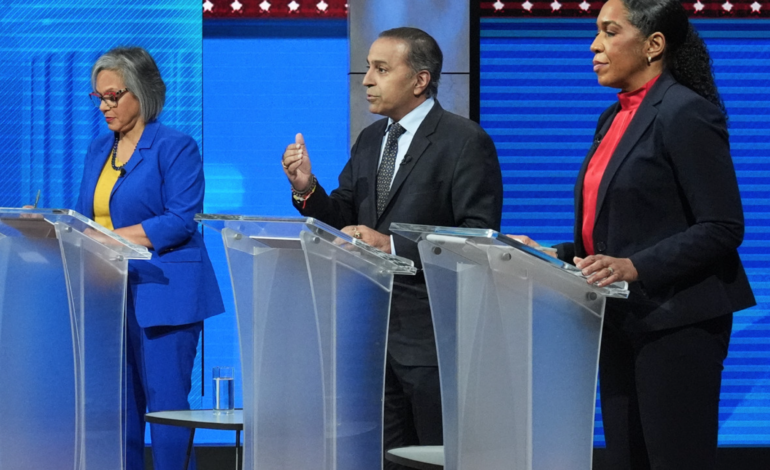
The open U.S. Senate seat has quickly become the most consequential Democratic primary in Illinois in decades. With the departure of Durbin, three prominent Democrats have emerged as the leading contenders: Raja Krishnamoorthi, Juliana Stratton, and Robin Kelly.
At first glance, Krishnamoorthi appears to hold a commanding advantage. Armed with a massive fundraising operation that has generated tens of millions of dollars, he has dominated television advertising and built statewide name recognition well before many voters began paying attention to the race. His campaign has emphasized economic opportunity, innovation, and national security experience gained through his role on the House Intelligence Committee.
But elections in Illinois have rarely been decided by money alone.
Stratton enters the race with a different kind of strength: the institutional backing of the state’s Democratic establishment. As lieutenant governor under JB Pritzker, she benefits from a powerful political network that includes party organizations, local officials, and major Democratic donors. Endorsements from figures such as Tammy Duckworth reinforce her credibility as the candidate of the governing coalition in Springfield.
Meanwhile, Kelly has built support within the Congressional Black Caucus and among African-American voters in Chicago and its suburbs. While her campaign has not matched the fundraising of her rivals, her presence adds a crucial dynamic: she splits key segments of the vote that might otherwise consolidate behind Stratton.
In a crowded primary, that fragmentation could prove decisive.
Illinois Democratic primaries are often determined by coalition-building across three regions — Chicago, the suburban collar counties, and downstate communities. Krishnamoorthi’s strength in suburban districts combined with his financial advantage could give him the edge, particularly if Stratton and Kelly divide urban support.
For now, the race appears to be a test of whether political infrastructure can overcome financial dominance. The answer may define Illinois Democratic politics for the next generation.
The 9th District: A battle for the progressive soul
While the Senate contest attracts national attention, the race to succeed Schakowsky in Illinois’ 9th Congressional District is equally revealing.
For more than two decades, Schakowsky represented one of the most progressive districts in the country, encompassing Chicago’s North Side and the North Shore suburbs. Her departure has unleashed a crowded Democratic primary featuring fifteen candidates.
Among them, three have emerged as serious contenders: Daniel Biss, Laura Fine, and Kat Abughazaleh.
Biss, the mayor of Evanston and a longtime progressive advocate, has secured endorsements from national figures such as Elizabeth Warren and built strong support among activists aligned with the progressive wing of the Democratic Party. His campaign draws heavily from Evanston’s politically engaged electorate and the district’s progressive grassroots organizations.
Fine represents a more traditional political pathway. A state senator with deep connections to North Shore communities, she has assembled a coalition that includes moderate Democrats and influential pro-Israel advocacy networks. Her strength lies in established community relationships and a well-funded campaign apparatus.
Abughazaleh, a former journalist and digital media figure, has taken a different route. Her campaign has relied heavily on social media engagement and small-dollar fundraising, appealing particularly to younger voters seeking an outsider voice in Congress.
In a field this large, victory may require only a small share of the vote — perhaps as little as twenty percent. That reality places extraordinary importance on turnout patterns in key areas such as Evanston, the North Shore suburbs, and Chicago’s lakefront neighborhoods.
The broader meaning
These two races together illustrate a larger shift underway within Illinois Democratic politics.
The Senate contest highlights the growing power of independent fundraising networks and national donor bases, while the 9th District race reflects an ongoing debate about the direction of progressive politics in urban America.
Both contests also underscore the continued importance of Chicago and its suburbs as the political heart of Illinois. Whoever emerges from these primaries will inherit not only safe Democratic seats but also the responsibility of shaping policy debates on issues ranging from economic inequality to national security.
For Illinois Democrats, the coming primary is more than a routine electoral exercise. It is a generational transition.
New leaders will emerge, new alliances will form, and the balance between grassroots activism and institutional power will be tested once again. In a state long known for its complex political machinery, the outcome may reveal whether that machinery still defines the future — or whether a new political order is beginning to take shape.