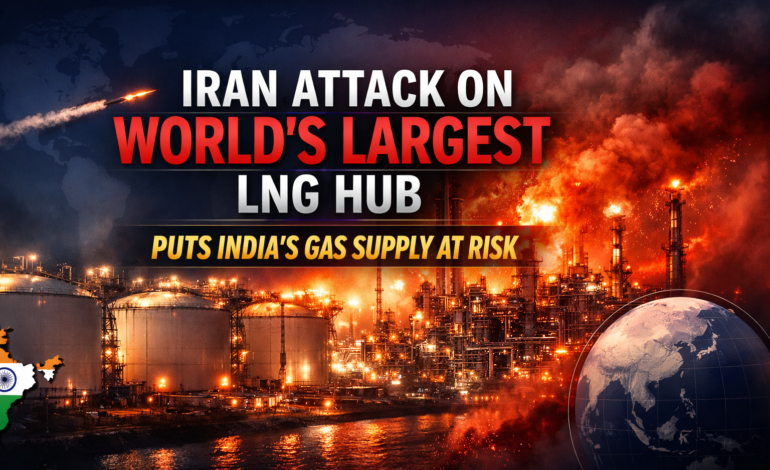
Iran attack on world’s largest LNG hub puts India’s gas supply at risk

India’s energy security has come under fresh pressure after Iran’s missile strike on Qatar’s Ras Laffan Industrial City, the world’s largest liquefied natural gas (LNG) hub. The attack, part of escalating tensions in West Asia, has raised concerns over potential disruptions to India’s gas supply, given its heavy dependence on the region.
Officials from the Ministry of Petroleum and Natural Gas acknowledged that any damage to Qatar’s LNG infrastructure would directly affect India. The country imports nearly 90 percent of its fuel from West Asia, with Qatar alone supplying close to half of India’s LNG demand. Ras Laffan serves as the primary export hub for these supplies, making it a critical link in India’s energy chain.
Joint Secretary Sujata Sharma stated that diversification remains the key strategy to mitigate such risks. India has already begun sourcing additional LNG cargoes from alternative suppliers, particularly the United States and Australia, to offset potential shortfalls. “We are affected by disruptions in West Asia, but we are actively securing supplies from other regions,” she said.
Also See: Trump says Israel acted alone in Iran gas field strike, warns against targeting Qatar
The global energy market reacted sharply to the developments. European gas prices surged by as much as 35 percent, while crude oil prices climbed to $114 per barrel before stabilizing. Analysts warn that prolonged disruption in Qatar, which accounts for nearly 19 percent of global LNG supply, could tighten markets for months.
India currently consumes around 189–195 MMSCMD of natural gas, with roughly half of this demand met through imports. Of the imported volume, approximately 60 MMSCMD comes from Qatar. Any prolonged outage could therefore force India to reduce consumption, especially in industrial and power sectors.
Experts suggest that while alternative suppliers like the US, Australia, and Russia can help bridge the gap, higher prices remain a concern for India’s cost-sensitive market.
Meanwhile, the government is also focusing on maritime security. With tensions rising in the Strait of Hormuz, several cargo vessels remain stranded, and India is working closely with international partners to ensure safe passage for ships and the safety of Indian seafarers.
Despite rising global crude prices, officials confirmed that there has been no immediate increase in domestic petrol and diesel prices. The government continues to monitor the situation closely as geopolitical tensions threaten to disrupt global energy flows further.
Also See: Jaishankar speaks with UAE FM as Iran strikes escalate, India pushes for West Asia stability