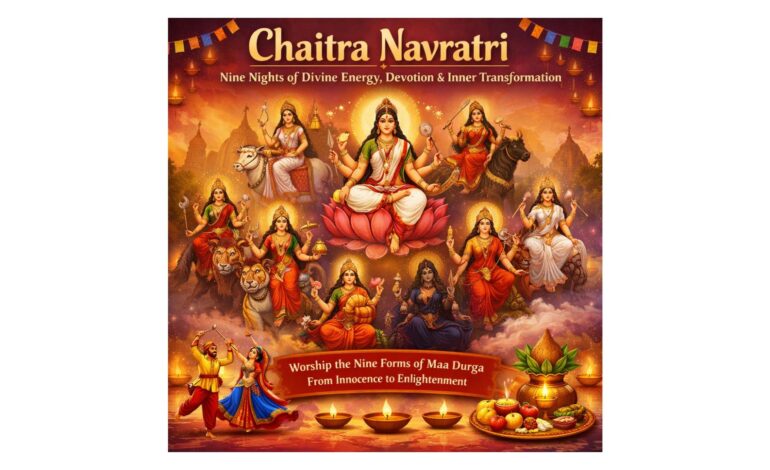
Chaitra NavratriNine nights of divine energy, devotion, and inner transformation

Chaitra Navratri is one of the most sacred Hindu festivals, marking the beginning of the Hindu lunar new year. It is dedicated to Goddess Durga and her nine divine forms, collectively known as Navadurga. Observed across India and by the global Hindu diaspora, the festival represents the victory of good over evil and the awakening of inner spiritual strength.
There are four Navratris observed each year. Chaitra Navratri (spring) and Sharad Navratri (autumn) are the most widely celebrated, while the two Gupt Navratris are observed more privately by spiritual practitioners. Devotees observe fasting (vrat), daily prayers, Mata Ki Chowki, Jagran, and temple visits, seeking blessings from Maa Durga in her various forms.
Each of the nine days is dedicated to a different form of the Goddess, symbolizing stages of human spiritual evolution from innocence to enlightenment.
Also See: Celebrating Durga Ashtami: Reverence, rituals and the triumph of Shakti
The nine divine forms of Maa Durga (Navadurga)
Day 1: Maa Shailaputri — the beginning of divine strength
Maa Shailaputri, daughter of the Himalayas, represents purity and foundational strength. Riding a bull and holding a trident and lotus, she symbolizes balance between power and calmness. She is associated with the Muladhara chakra.
Life lesson: Every journey begins with stability, innocence, and faith.
Day 2: Maa Brahmacharini — devotion and discipline
Maa Brahmacharini represents penance, simplicity, and unwavering devotion. Holding a rosary and water pot, she embodies focus and spiritual discipline. She is linked to emotional balance and self-control.
Life lesson: Growth comes through patience, sacrifice, and dedication.
Day 3: Maa Chandraghanta — courage and grace
With a crescent moon on her forehead and ten arms carrying weapons, Maa Chandraghanta symbolizes bravery and protection. She rides a tiger and represents fearlessness guided by grace.
Life lesson: Courage must be balanced with calmness and dignity.
Day 4: Maa Kushmanda — creator of the universe
Maa Kushmanda is believed to have created the universe with her divine smile. She represents cosmic energy, vitality, and creation, holding a pot of nectar that symbolizes life.
Life lesson: Positivity is the foundation of creation and growth.
Day 5: Maa Skandamata — nurturing mother
Maa Skandamata, mother of Lord Kartikeya, represents compassion, protection, and unconditional love. She embodies the nurturing power of motherhood.
Life lesson: True strength lies in selfless care and emotional generosity.
Day 6: Maa Katyayani — fierce protector
Maa Katyayani is the warrior form who destroyed the demon Mahishasura. She symbolizes justice, courage, and the destruction of evil forces.
Life lesson: Stand firmly for truth and justice.
Day 7: Maa Kaalratri — destroyer of darkness
Maa Kaalratri is the fiercest form of Durga, representing the destruction of fear, ignorance, and negativity. Despite her terrifying form, she offers ultimate protection.
Life lesson: Transformation requires confronting and overcoming fear.
Day 8: Maa Mahagauri — purity and peace
Maa Mahagauri symbolizes serenity, forgiveness, and spiritual cleansing. She represents calmness after struggle and the purification of the soul.
Life lesson: Peace follows hardship; forgiveness brings liberation.
Day 9: Maa Siddhidatri — giver of wisdom
Maa Siddhidatri grants knowledge, spiritual powers, and enlightenment. She represents the culmination of spiritual evolution and divine completion.
Life lesson: True fulfillment lies in wisdom and selfless sharing.
Spiritual and cultural significance
Navratri is both a cultural celebration and a spiritual discipline. Traditionally:
- First three days: dedicated to Maa Durga (strength)
- Next three days: dedicated to Maa Lakshmi (prosperity)
- Last three days: dedicated to Maa Saraswati (knowledge)
Devotees observe fasting, follow a sattvic diet, and participate in cultural practices such as:
- Garba and Dandiya in Gujarat
- Durga Puja in West Bengal
- Kanya Puja, where young girls are worshipped as manifestations of the Goddess
Each day is also associated with specific colors representing different energies of the divine feminine.
A festival of faith and inner awakening
Navratri is not only a religious celebration but also a symbolic journey of transformation. The nine forms of Maa Durga reflect the human path from innocence to wisdom, struggle to strength, and darkness to enlightenment.
As devotees chant “Jai Mata Di,” the festival becomes more than ritual—it becomes inner purification, strengthening of the spirit, and reconnection with divine energy.
In essence, Chaitra Navratri celebrates Shakti—the power within every individual—guiding life toward balance, purpose, and spiritual fulfillment.
Also See: Ram Navami: Devotion, dharma and the timeless recitation of the Ramayana