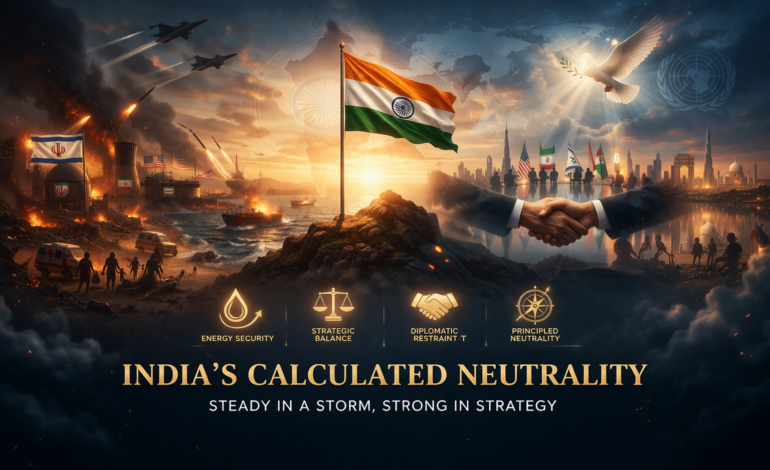
India’s calculated neutrality amid the West Asia conflict

By: Dr Avi Verma
The West Asia conflict, triggered by U.S. and Israeli strikes on Iranian facilities in late February 2026, has rapidly escalated into a widening geopolitical crisis with serious regional and global consequences. Rising civilian casualties, damage to critical infrastructure, and disruptions in the Strait of Hormuz — a key global energy corridor — have fueled market volatility, driving oil prices higher and deepening concerns across import-dependent economies, including India.
Peace talks: Between rhetoric and reality
Diplomatic efforts remain fluid and uncertain. U.S. officials, including former President Donald Trump, have spoken about a proposed 15-point ceasefire and broader peace framework aimed at de-escalation and protection of maritime trade routes.
However, Iran has firmly denied that formal negotiations are underway, insisting that any future dialogue must be based on strict conditions, including full respect for its sovereignty. This gap between public messaging and political reality underscores the fragility of current peace efforts.
At the same time, regional players such as Pakistan have stepped in as intermediaries, facilitating backchannel communications between involved parties. Their role highlights how certain states gain strategic relevance by acting as informal conduits during high-stakes conflicts.
India’s neutrality: Principle over opportunism
From India’s perspective, the crisis demands caution rather than alignment. New Delhi has adopted a position of principled neutrality, consistently calling for de-escalation, dialogue, and restraint without taking sides in the conflict.
External Affairs Minister S. Jaishankar has made India’s stance explicit, stating that the country will not act as a “go-between” in negotiations, rejecting transactional mediation roles that compromise strategic credibility. This approach reflects a deliberate calculation to preserve balanced relations with the United States, Israel, Gulf partners, and Iran, all of which are important to India’s energy security and broader foreign policy interests.
Pakistan versus India: Contrasting diplomatic roles
Pakistan’s emergence as a backchannel facilitator underscores its longstanding positioning as an intermediary in U.S.–Iran communication channels. While this places Islamabad briefly in the diplomatic spotlight, India has chosen restraint over visibility.
By avoiding immediate mediation, India seeks to protect long-term diplomatic capital rather than engage in short-term transactional influence. This ensures that its relationships with key global and regional partners remain stable and uncompromised.
Strategic implications for India
Potential gains:
- Sustained credibility with competing global and regional powers
- Greater flexibility to participate meaningfully when formal negotiations mature
Key risks:
- Exposure to volatile energy markets and regional instability
- Perception of reduced diplomatic activism, partly offset by its consistent neutrality
India’s approach reflects a broader strategy rooted in consistency and long-term positioning rather than reactive diplomacy.
Patience as a strategic asset
India’s refusal to assume an immediate mediator role should not be interpreted as disengagement. Instead, it reflects a calibrated strategy that balances concern for regional stability with the need to preserve trust across multiple stakeholders.
By maintaining principled neutrality while advocating dialogue and restraint, India positions itself as a credible and steady voice in an increasingly fragmented geopolitical landscape.
In a crisis defined by urgency and competing narratives, India’s strategy is built on patience. When conditions eventually align for substantive negotiations, its restrained yet consistent diplomacy is likely to carry lasting influence.