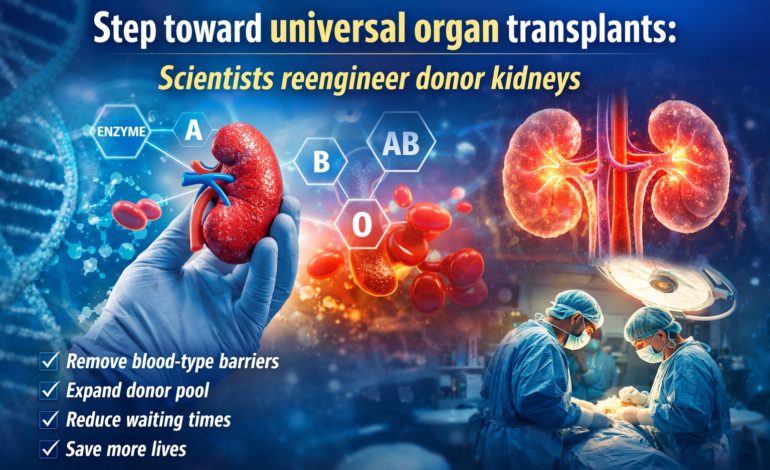
Step toward universal organ transplants: scientists reengineer donor kidneys

By: Dr. Avi Verma
In a breakthrough that could redefine the future of organ transplantation, scientists have successfully demonstrated a method to convert donor kidneys into “universal” organs—potentially eliminating one of the biggest barriers in saving lives: blood-type incompatibility.
Researchers at the University of British Columbia, working alongside international collaborators including teams in China, have developed a novel enzyme-based technique that removes blood-group markers from donor kidneys. These markers, known as antigens, are responsible for triggering immune rejection when an organ is transplanted into a patient with an incompatible blood type.
The science behind the breakthrough
Using specialized enzymes, the research team successfully stripped A-type antigens from a donor kidney, effectively transforming it into a Type O–like organ. Since Type O is considered a “universal donor” blood group, this modification allows the kidney to become more broadly compatible across recipients.
To evaluate this innovation in a real-world setting, the modified kidney was transplanted into a brain-dead patient with full family consent under controlled clinical conditions. The organ functioned normally for several days—demonstrating, for the first time, that blood-type conversion in human organs is feasible.
The study, published in Nature Biomedical Engineering, marks a crucial step in translating laboratory science into clinical application.
Challenges and limitations
Despite the encouraging results, researchers caution that the technology is still in its early stages. One key limitation observed during the trial was that blood-type markers began to reappear within a few days. This indicates that the current method does not yet provide a permanent solution.
Additionally, while the enzyme treatment may reduce the risk of immediate rejection, it does not completely eliminate the need for immunosuppressive medications—at least with current techniques. Long-term studies and further refinements will be essential before this approach can be used routinely in hospitals.
Why this matters
The global shortage of donor organs remains a critical healthcare challenge. In the United States alone, thousands of patients are on kidney transplant waiting lists, and many die each year before a suitable match is found.
Blood-type compatibility is one of the biggest barriers in organ allocation. Patients with Type O blood face the longest waiting times because they can only receive organs from Type O donors.
If perfected, this enzyme-based technology could:
- Dramatically expand the donor pool
- Reduce waiting times for transplant patients
- Improve survival rates and transplant success
- Create a more equitable organ allocation system
Looking ahead
Scientists believe this approach could eventually extend beyond kidneys to other organs such as the liver, heart, and lungs. While the concept of fully “universal” organs is still in development, this breakthrough offers a powerful glimpse into the future of transplantation medicine.
As research progresses, innovations like this may transform organ donation from a highly restrictive system into one that is more flexible, efficient, and life-saving.
Key takeaway
This landmark study demonstrates that it is scientifically possible to modify donor organs to overcome blood-type barriers—an achievement that could one day save countless lives worldwide.
Disclaimer
This article is for educational and informational purposes only. It is not intended as medical advice, diagnosis, or treatment. Patients should consult qualified healthcare professionals for personalized medical guidance.