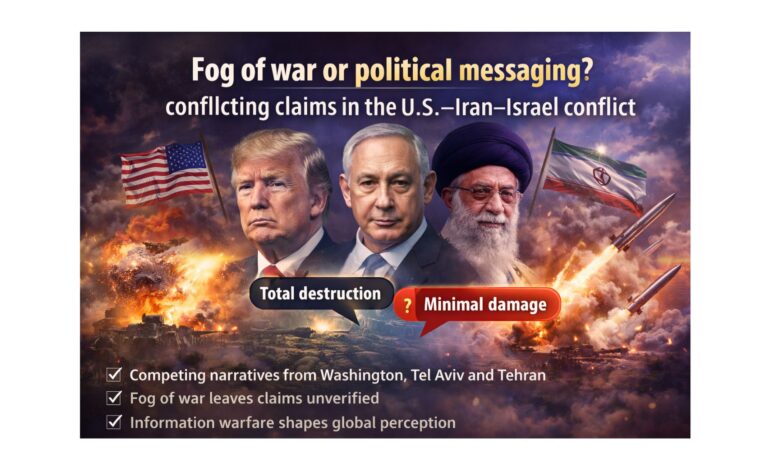
Fog of war or political messaging? conflicting claims around the U.S.–Iran–Israel conflict

By: Dr Avi Verma
Conflicting narratives from Washington, Tel Aviv, and Tehran have intensified, with each side projecting sharply different versions of reality. At the center of this information battle are sweeping claims of military success by the U.S. and Israel, and equally forceful denials by Iran.
Competing claims: Total damage vs. minimal impact
Donald Trump and Benjamin Netanyahu have asserted that joint operations have significantly degraded Iran’s military capabilities. According to their statements, key Iranian infrastructure—including missile systems, launch platforms, and strategic assets—has been “decimated,” resulting in a substantial reduction of Iran’s offensive and defensive capacity. The messaging suggests that Iran’s ability to sustain prolonged military engagement has been critically weakened.
In stark contrast, Iranian officials have dismissed these claims as exaggerated and misleading. Tehran insists that its core military strength remains intact, arguing that U.S. and Israeli forces failed to inflict any meaningful damage on its missile arsenal or operational readiness. Iranian statements go further, claiming that critical assets such as mobile missile launchers remain untouched and beyond the reach of adversarial strikes.
Iran has also escalated its rhetoric by warning against any potential ground invasion. Officials have stated that any deployment of U.S. or Israeli troops would be met with severe retaliation, asserting that “boots on the ground” would face consequences so significant that withdrawal would not be possible. This messaging appears aimed at deterrence, signaling both preparedness and confidence in defensive capabilities.
What can be verified?
At present, there is no independent, verifiable evidence fully supporting either side’s claims. While satellite imagery, intelligence leaks, and fragmented reports may indicate targeted strikes and localized damage, they do not conclusively validate assertions of either “decimation” or “negligible impact.”
Historically, in conflicts of this scale, both sides tend to:
- Overstate successes to maintain domestic and international support
- Understate losses to preserve morale and strategic ambiguity
The absence of neutral verification leaves the situation in a gray zone, where perception often substitutes for reality.
Strategic messaging and psychological warfare
The language used by both sides reflects more than battlefield assessment—it is part of a broader psychological and political strategy. Claims of having crippled an opponent serve to project strength, deter escalation, and reassure domestic audiences. Conversely, denying damage and projecting resilience reinforces national morale and signals readiness for prolonged conflict.
Trump’s declaration that the mission has been “accomplished” aligns with this pattern of assertive messaging. Similarly, Iran’s warnings about ground forces function as a deterrent narrative, aimed at raising the perceived cost of further escalation.
Economic and political context
The timing of these announcements also intersects with economic and political pressures. Rising oil prices, volatility in global markets, and domestic political considerations add layers of complexity to official statements. Strong declarations of success can influence market sentiment and public perception, particularly in an election-sensitive environment.
Comparisons with past administrations, including Joe Biden and Jimmy Carter, highlight how economic performance and foreign policy outcomes often become intertwined in political narratives.
Ground reality: Between assertion and uncertainty
Based on available information, the most balanced assessment is:
- Some level of damage to Iranian assets is likely, given the scale of reported operations.
- Claims of total destruction or negligible impact are both likely overstated.
- The conflict remains active, with no confirmed ceasefire or definitive outcome.
Conclusion
In modern warfare, the battle for narrative dominance runs parallel to the conflict on the ground. Statements from all sides must be viewed through the lens of strategic communication as much as factual reporting.
Until independently verified data emerges, the truth remains contested—shaped by competing interests, political timing, and the enduring “fog of war.”