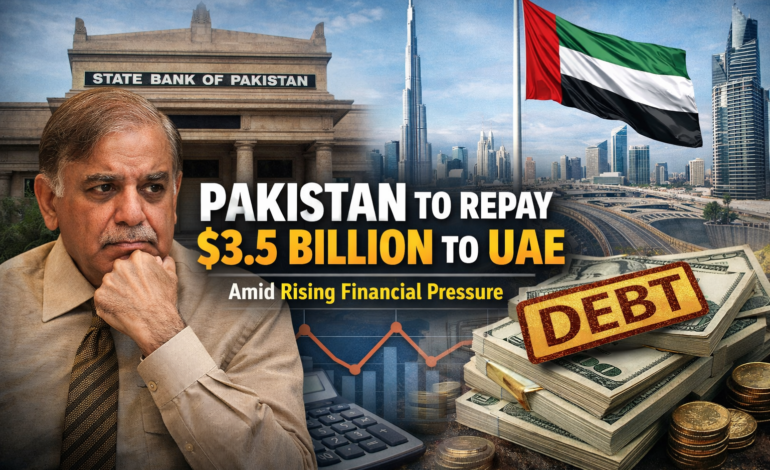
Pakistan to repay $3.5 billion to UAE amid rising financial pressure

Pakistan has agreed to repay approximately $3.5 billion in deposits and loans to the United Arab Emirates (UAE) by the end of April, following a request from Abu Dhabi for the immediate return of funds, according to officials and media reports.
The decision marks a shift from the long-standing practice of rolling over such deposits, which Pakistan has relied on to support its foreign exchange reserves. The move comes at a time of heightened regional tensions in West Asia and growing economic pressure on Islamabad.
Pakistan’s Ministry of Foreign Affairs, however, downplayed concerns, calling the repayment a “routine financial transaction” conducted under mutually agreed bilateral terms. The ministry also emphasized that the deposits reflected the UAE’s continued support for Pakistan’s economic stability.
Despite these assurances, the timing of the request has raised questions about underlying financial strain. A senior cabinet minister confirmed that the repayment will be made in three tranches: $450 million on April 11, $2 billion on April 17, and $1 billion on April 23. Part of the repayment includes a loan dating back to 1996–97.
Also See: Trump gives Iran 48-hour ultimatum to strike deal or reopen Hormuz
Officials indicated that the funds will likely come from the State Bank of Pakistan’s foreign exchange reserves, currently estimated at around $16.4 billion. The sizable outflow is expected to put additional pressure on reserves, even as authorities maintain that levels remain “comfortable.”
Parallel discussions are reportedly underway to convert a portion of the debt into investment, which could ease immediate liquidity concerns. However, the episode has drawn attention to Pakistan’s continued reliance on financial support from allies such as the UAE, Saudi Arabia, and China.
The repayment also highlights the constraints faced by Pakistan under its ongoing $7 billion International Monetary Fund (IMF) program, which requires maintaining external stability and limiting financial vulnerabilities. Islamabad has committed to preserving allied deposits until the program concludes in September 2027.
Economic challenges persist, with declining exports and weak foreign investment adding to the strain. Earlier this year, Prime Minister Shehbaz Sharif acknowledged the difficulty of repeatedly seeking external assistance, noting that it can limit policy flexibility.
Analysts say the rapid shift from rollover arrangements to full repayment underscores the urgency of strengthening Pakistan’s economic fundamentals. As the country navigates external debt obligations and IMF conditions, attracting sustainable investment and boosting exports remain critical priorities.
Also See: “Your sons more in danger with Trump”: Iran responds to US mother of missing pilot