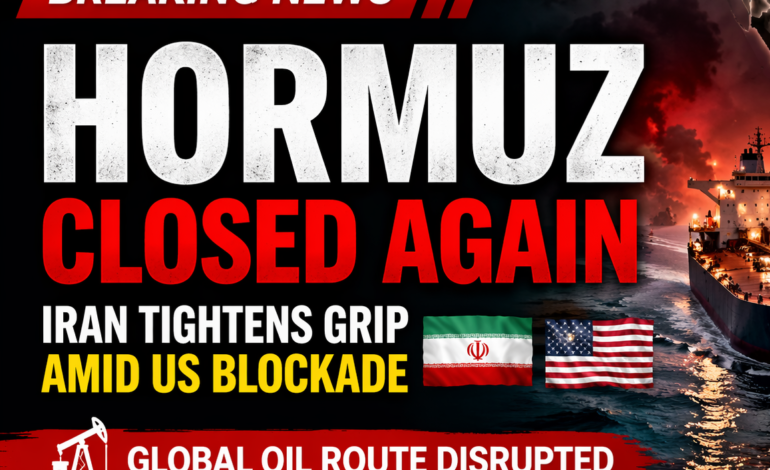
Strait of Hormuz closed again as Iran cites US blockade escalation

Tensions in the Middle East escalated sharply after Iran announced that the Strait of Hormuz has been closed again, citing the continued U.S. naval blockade as the primary reason. The move marks a significant reversal from Tehran’s earlier decision to allow limited commercial shipping during a fragile ceasefire phase.
Iran’s military command stated that the strategic waterway has returned to a state of “strict control,” warning that transit restrictions will remain in place as long as U.S. forces maintain pressure on Iranian ports and maritime activity. The announcement underscores the increasingly volatile standoff between Washington and Tehran, where both sides are leveraging control over sea routes without entering full-scale war.
The Strait of Hormuz is one of the most critical energy chokepoints in the world, handling nearly a fifth of global oil and gas shipments. Any disruption in this narrow passage immediately impacts global markets, pushing oil prices higher and increasing uncertainty across supply chains.
The renewed closure comes amid rising incidents at sea, including reports of Iranian patrol boats confronting and firing near commercial vessels. Shipping companies have responded by rerouting or halting operations, while insurance costs for vessels transiting the region have surged.
The United States has maintained that its blockade will continue until Iran agrees to broader terms, including limits on its nuclear program and regional activities. Iran, in turn, has framed the blockade as a violation of its sovereignty and a threat to free navigation, justifying its decision to restrict access to the strait.
For major energy importers like India, China, and European nations, the situation presents immediate challenges. Any prolonged disruption could lead to higher fuel prices, supply shortages, and increased economic pressure at a time when global markets are already fragile.
Diplomatic efforts are ongoing, with mediators attempting to revive negotiations. However, the repeated opening and closing of the Strait of Hormuz highlights the uncertainty surrounding any potential resolution.
As military presence intensifies and strategic posturing continues, the region remains on edge. The Strait of Hormuz is no longer just a transit route—it has become the central pressure point in a high-stakes geopolitical conflict with far-reaching global consequences.