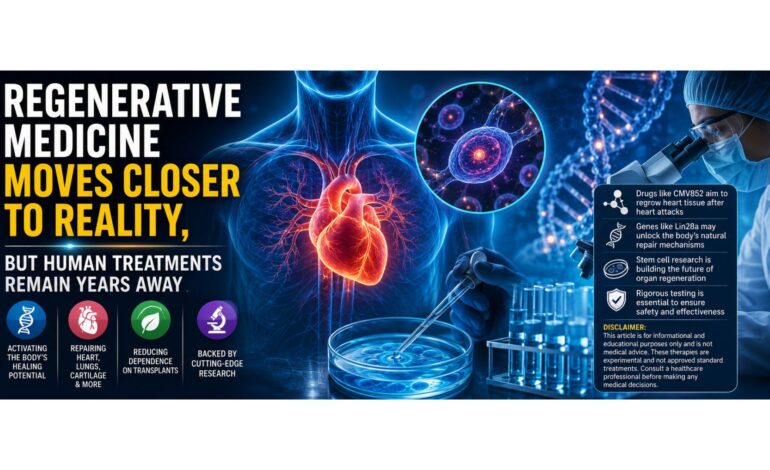
Regenerative medicine moves closer to reality, but human treatments remain years away

By: Dr. Avi Verma
Scientists at Scripps Research and Harvard University are reporting major advances in regenerative medicine — an emerging field focused on helping the body repair damaged tissues and organs using its own biological pathways rather than relying solely on transplants or artificial devices.
One of the most closely watched developments involves an experimental small-molecule drug called CMV852, being developed by researchers at Scripps Research and the
Calibr-Skaggs Institute. According to Scripps, the drug activates a cellular repair pathway known as YAP signaling, stimulating the growth of new heart muscle cells after a heart attack. In animal studies involving mice and pigs, researchers observed the formation of functional cardiac tissue and significant improvement in heart function. Human clinical trials have not yet begun, but investigational studies are expected to advance in the coming years.
The work is part of a broader scientific effort to harness the body’s dormant regenerative abilities. Michael Bollong and colleagues are studying how targeted small molecules may encourage damaged organs — including the heart, lungs, cartilage and retina — to repair themselves from within. Researchers believe this strategy could someday help treat chronic diseases associated with aging, fibrosis, heart failure and degenerative conditions.
Separately, researchers linked to Boston Children’s Hospital and Harvard have explored genes such as Lin28a, which appear to regulate tissue repair and cellular regeneration during early development. Scientists are investigating whether safely reactivating such pathways in adults could improve healing after injury or disease. However, experts caution that manipulating growth pathways carries potential risks, including uncontrolled cell growth and cancer, meaning extensive safety testing is still required before widespread human use.
Researchers at University of California, San Francisco and Cedars-Sinai Medical Center are also advancing stem-cell technologies aimed at growing organ-specific tissues in laboratories. While these developments represent important scientific progress, scientists emphasize that fully functional lab-grown human organs suitable for routine transplantation are still experimental and not yet clinically available.
The promise of regenerative medicine is enormous. If successful, these approaches could eventually reduce dependence on organ transplants, improve recovery after heart attacks and potentially slow aspects of age-related tissue decline. But for now, most of these therapies remain in preclinical or early-stage research, and experts stress that patients should not view them as available cures.
Disclaimer:
This article is intended for informational and educational purposes only and should not be considered medical advice. The therapies discussed are largely experimental and are not approved standard treatments for most medical conditions. Readers should consult qualified healthcare professionals before making any medical decisions.