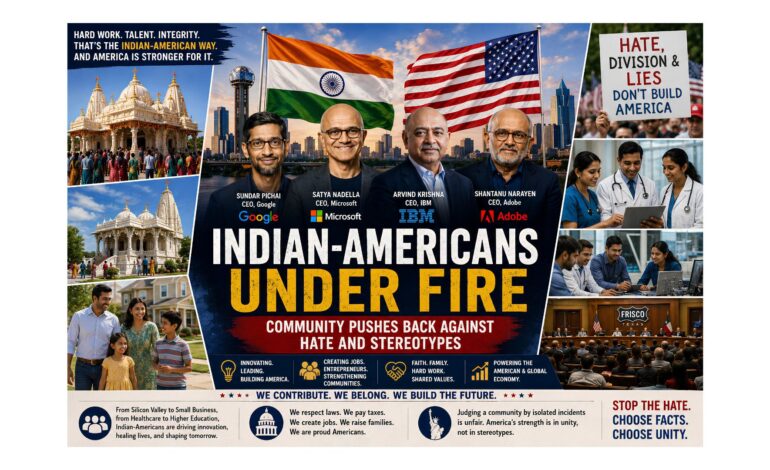
Outrage grows in Indian-American community over escalating anti-immigrant rhetoric in Texas

Community Warns of Rising Pattern of Targeted Hostility Amid Viral Incidents and Public Remarks
By: Dr. Avi Verma
The Indian-American community across Texas and the United States is expressing growing concern over an escalating pattern of anti-immigrant rhetoric, viral social media allegations, and politically charged public commentary targeting Indian professionals and religious minorities—particularly in the Dallas–Fort Worth region.
What began as localized debates over H-1B visa compliance and housing concerns has now evolved into a broader and increasingly polarizing public narrative. Community leaders say the shift reflects not isolated disagreements, but a sustained pattern of identity-based targeting that risks inflaming social tensions in rapidly diversifying suburbs.
Indian-Americans—who are deeply embedded in the U.S. technology sector, healthcare system, academia, and entrepreneurship—say the discourse has moved beyond policy critique into reputational generalizations affecting entire communities.
A Timeline of Escalation in 2026 (Verified Sequence)
A series of events in early 2026 contributed to the rising tensions:
The escalation began with Frisco City Council-related discussions in early February, where debates over demographic change, immigration, and community growth became increasingly politicized. These tensions were amplified between February 4–6, 2026, with further council-related activity on February 17, 2026, reflecting growing polarization in public forums.
The situation intensified when social media commentary by Kaylee Campbell gained traction. Following initial council-related friction on February 3, 2026, her posts questioning Indian residents escalated into viral claims. By February 19–20, 2026, her X post alleging housing “scams” and stating “They are not Americans, they are scammers” spread widely online, drawing sharp backlash from residents and advocacy groups.
On March 31, 2026, a confrontation involving H-1B worker Naveen Tummala at the Golconda Xpress food truck was recorded and circulated online, rapidly becoming a national talking point. By April 1, 2026, the video had entered mainstream discourse, further intensifying debate around immigration and employment narratives.
The issue escalated further when commentator Sara Gonzales appeared on Newsmax on April 24, 2026, amplifying claims framing H-1B workers within broader “scam” narratives, adding national visibility to what had been a local controversy.
The most serious flashpoint occurred during a May 19, 2026 Frisco City Council meeting, which ran into the early hours of May 20. The five-hour session, focused on zoning approvals for a mosque, Hindu temple, and Jain temple, became highly contentious.
During public comment, Jan. 6 rioter Edward “Jake” Lang delivered inflammatory remarks, including the derogatory phrase “Shit Hole”, alongside claims of an “Indian takeover” and broader anti-immigrant rhetoric. The remarks triggered immediate condemnation from attendees and community leaders.
City records and reporting confirm the meeting’s duration and the nature of the public disruption, which many residents described as deeply disturbing and inconsistent with norms of civic discourse.
Community Leaders Call It “Manufactured Hostility”
Indian-American organizations argue these incidents reflect a broader pattern in which isolated events are repeatedly amplified into sweeping narratives targeting entire communities.
“This is not policy debate anymore,” said one community advocate. “It is manufactured hostility designed to turn immigrant visibility into political vulnerability.”
They emphasize that immigration enforcement, housing concerns, and employment disputes must be addressed through legal frameworks—not viral outrage cycles or politically charged public commentary.
Civil rights advocates also warn that repeated amplification of such narratives risks normalizing discrimination against ordinary Indian-American families, professionals, and students.
Media Amplification and Polarization
The controversy has been further intensified by social media influencers and commentators who have linked isolated incidents to broader claims about fraud, displacement, and cultural incompatibility.
Residents across North Texas have pushed back, emphasizing that Indian-American families are deeply integrated into local schools, hospitals, businesses, and civic life, and contribute significantly to regional economic growth.
Contributions Often Overlooked in Public Debate
Despite rising tensions, Indian-American professionals continue to highlight their contributions to the United States.
Indian-origin leaders head major global corporations, while thousands of doctors, engineers, researchers, and entrepreneurs play a critical role in strengthening American competitiveness.
Indian-American physicians serve in underserved rural areas facing persistent shortages, while professionals across STEM fields drive innovation and economic expansion.
Community members argue that these contributions are increasingly overshadowed by selective narratives that misrepresent an entire population.
“Not a Debate—A Dangerous Pattern”
Community leaders say the current environment represents a shift from policy disagreement to identity-based scapegoating.
“What we are seeing is not accountability—it is scapegoating,” said a Texas-based professional. “A few incidents are being used to define millions of people who contribute every day to this country.”
They warn that inflammatory rhetoric in public forums risks eroding trust and increasing social division.
Call for Responsible Discourse
Faith leaders and civic organizations across Texas are urging restraint and a return to fact-based public discourse.
They emphasize that diversity has long been a defining strength of suburban growth in North Texas, where immigration has driven both economic development and cultural vibrancy.
Indian-American associations are calling on policymakers, media platforms, and public figures to reject divisive narratives and focus on constructive solutions grounded in evidence and constitutional principles.
Conclusion: A Test of Civic Values
While immigration policy will remain a legitimate subject of debate, community leaders stress that recent incidents—including the May 19 Frisco City Council meeting—highlight a troubling shift in tone.
The use of inflammatory language such as “Shit Hole” in a public civic setting has become a flashpoint, raising broader questions about civic responsibility and social cohesion.
Indian-Americans say they remain committed to the United States and its democratic ideals, but expect equal dignity in return.
As one resident stated: “We came here to build, contribute, and belong. We will not accept being turned into scapegoats for political convenience.”
X (Twitter):
“‘Shit Hole’ Remark at Frisco City Hall Sparks Outrage Amid Rising Anti-Indian Rhetoric in Texas”
Facebook:
“Frisco City Hall Controversy Ignites Outrage as Indian-American Community Pushes Back Against Escalating Anti-Immigrant Rhetoric”
“Frisco City Hall ‘Shit Hole’ Remark Triggers Outrage Across Indian-American Community”