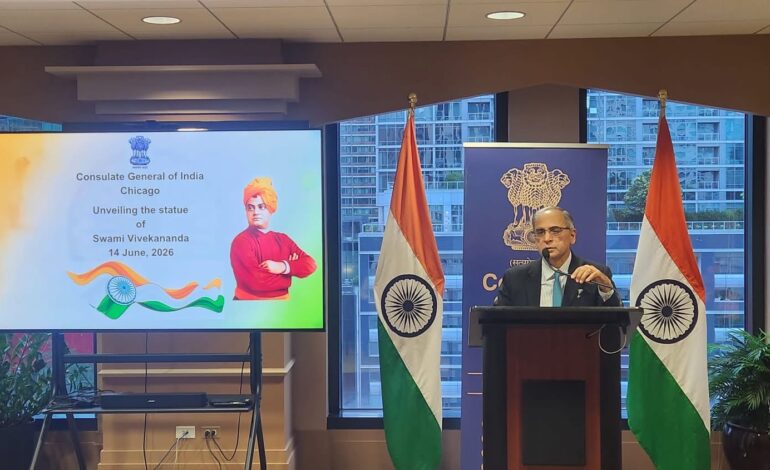
Ambassador Vinay Mohan Kwatra unveils Swami Vivekananda statue at Indian Consulate in Chicago

In a historic and deeply symbolic moment, India’s Ambassador to the United States, Vinay Mohan Kwatra, unveiled a life-size statue of Swami Vivekananda at the Consulate General of India in Chicago, honoring one of India’s greatest spiritual leaders whose teachings continue to inspire generations across the world.
The unveiling marked far more than the installation of a statue—it represented a tribute to the enduring legacy of a visionary monk whose message of universal brotherhood, tolerance, spiritual unity, and service remains profoundly relevant in today’s world.
The occasion carried special emotional and historical significance because of Chicago’s unique connection to Swami Vivekananda. It was here, in 1893, that the young monk from India delivered one of the most transformative speeches in modern spiritual history at the World’s Parliament of Religions.
When Swami Vivekananda began his address with the now-iconic words, “Sisters and Brothers of America,” he instantly won the hearts of thousands and received a standing ovation. More importantly, his speech introduced the spiritual wisdom of India and the philosophy of Vedanta to the Western world.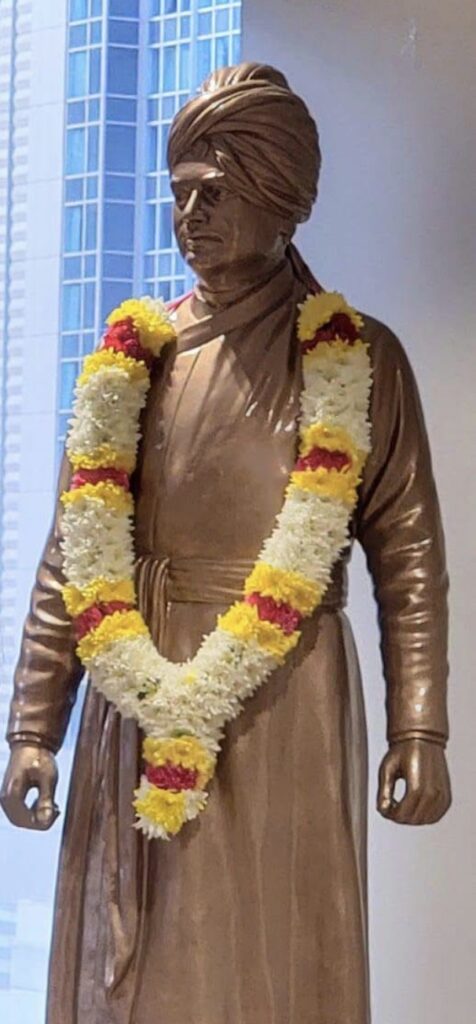
His address challenged sectarianism, religious intolerance, and division while promoting a timeless vision rooted in acceptance, compassion, and mutual respect. Swami Vivekananda spoke not only as a representative of Hinduism but as a messenger of humanity, advocating harmony among all religions and cultures.
At the time of his arrival in Chicago in July 1893, India was under British colonial rule and facing deep social, economic, and psychological challenges. Swami Vivekananda’s journey to America was not merely a spiritual mission; it was also a powerful statement of India’s civilizational strength and intellectual heritage.
Through his speeches and lectures across America, he presented Sanatan Dharma as a philosophy founded on tolerance, universal acceptance, reason, and spiritual inquiry. He emphasized that Hindu civilization had long taught the world the values of coexistence, compassion, and respect for all paths to truth.
More than 130 years later, the unveiling of Swami Vivekananda’s statue in Chicago serves as a symbolic homecoming. It reconnects the city with a defining moment in its own history—one that shaped global spiritual discourse and built a lasting intellectual bridge between East and West.
The statue now stands as a powerful reminder of Vivekananda’s timeless teachings and his enduring message that humanity rises not through division, but through unity, understanding, and service.
The ceremony drew community leaders, elected officials, spiritual representatives, and members of the Indian-American community, all reflecting on Swami Vivekananda’s lasting influence on interfaith dialogue, spiritual thought, and cultural exchange.
As India and the United States continue to deepen their strategic and cultural ties, Swami Vivekananda’s vision feels more relevant than ever. His teachings continue to inspire dialogue across civilizations and encourage societies to embrace peace, wisdom, and shared humanity.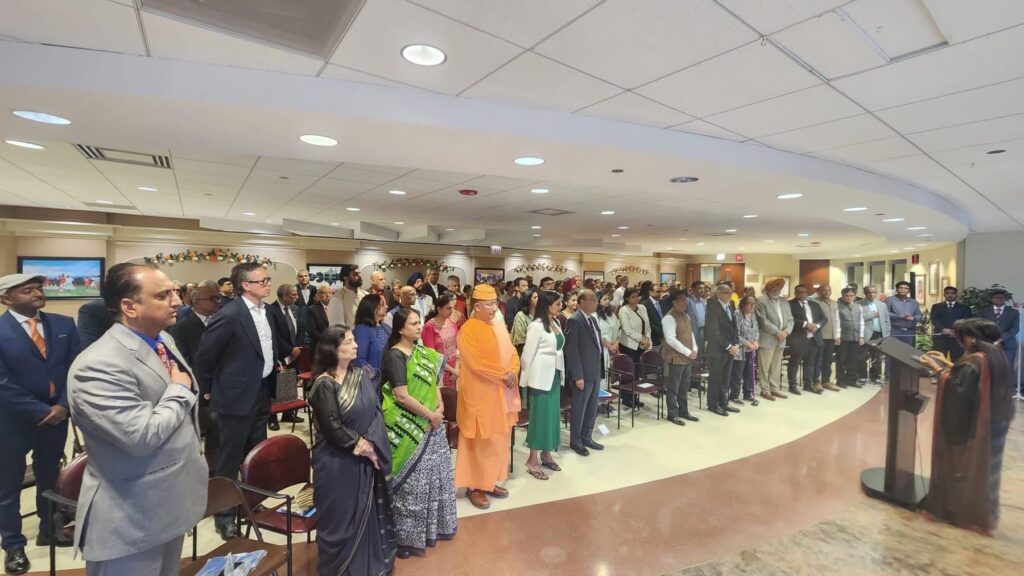
The installation of this statue in Chicago stands as a tribute not only to a great spiritual leader, but also to the universal values he championed—values that continue to unite people across cultures, faiths, and generations.
More than a monument in bronze, this statue is a living symbol of inspiration—reminding the world that Swami Vivekananda’s message remains as powerful today as it was in 1893.