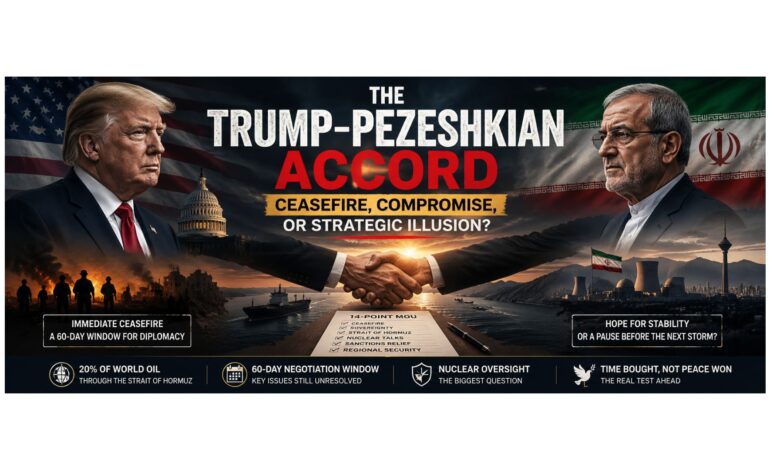
The Trump–Pezeshkian accord Ceasefire, compromise, or strategic illusion?

By: Dr Avi Verma
The signing of the 14-point Memorandum of Understanding (MOU) between U.S. President Donald Trump and Iranian President Masoud Pezeshkian marks one of the most consequential geopolitical developments in the Middle East in recent years. While many headlines present this as a historic breakthrough, the reality is more complex. This is not a peace treaty, it is a temporary de-escalation framework built on fragile trust, strategic compromise, and political necessity.
At its core, the agreement establishes an immediate cessation of hostilities, including in Lebanon, commits both sides to respect sovereignty, mandates reopening of the Strait of Hormuz, and creates a 60-day negotiation window to address broader issues including sanctions, Iran’s nuclear program, and regional security architecture.
The global implications are significant. The Strait of Hormuz carries nearly 20% of global oil trade, making its reopening vital for energy markets and supply chain stability. Yet despite the immediate relief, the most critical questions remain unresolved,particularly nuclear dismantlement, proxy militias, and long-term enforcement.
The winners
Donald Trump — Political and tactical victory
For President Trump, this agreement delivers a major political victory. He can present himself as the leader who halted a dangerous conflict without dragging the United States into another prolonged war in the Middle East, reinforcing his long-standing opposition to “endless wars.”
Trump also gains by securing de-escalation while limiting direct U.S. financial and military exposure. Reports suggest the proposed $300 billion reconstruction package will rely largely on private and Gulf-backed investment rather than American taxpayer money.
However, this victory comes with strategic compromises. Instead of immediate dismantling of Iran’s nuclear infrastructure, Washington has deferred the most difficult technical and political issues to future negotiations. Trump has won time and political momentum—but not yet a permanent strategic solution.
Iran — economic relief and strategic survival
Iran arguably gains the most immediate tangible benefits.
Tehran secures relief from direct military pressure, potential sanctions easing, access to frozen assets, and a pathway to restoring oil exports—critical lifelines for its struggling economy.
More importantly, Iran appears to have avoided outright capitulation. While the agreement includes commitments preventing Iran from acquiring nuclear weapons and references future oversight, there is no confirmed requirement for immediate dismantlement of its nuclear infrastructure.
This allows Tehran to preserve leverage heading into the next phase of negotiations. From Iran’s perspective, survival without surrender is itself a strategic victory.
The non-winners and losers
Israel — strategic isolation and uncertainty
The biggest strategic loser may be Israel.
Prime Minister Benjamin Netanyahu now faces a difficult dilemma. The accord addresses direct U.S.–Iran hostilities but leaves Israel’s primary security concerns only partially addressed—namely Iran’s nuclear capabilities, ballistic missile program, and support for regional proxies such as Hezbollah.
What makes this even more significant is that Israel is not a formal party to the agreement, despite being central to the broader conflict. This raises a critical question: where does this leave Israel?
Israeli officials have made it clear that Israel does not consider itself bound by the agreement and reserves the right to act unilaterally if it perceives an imminent threat.
This also raises an uncomfortable but important question: Is this the beginning of political fallout between Trump and Netanyahu?
For years, Trump and Netanyahu projected one of the strongest U.S.–Israel strategic alliances in modern history. Yet this agreement exposes visible cracks in priorities.
Trump’s focus is de-escalation, economic stability, and diplomatic victory. Netanyahu’s focus remains the long-term elimination of Iran’s military and nuclear threat—even if that requires continued military pressure.
This divergence may represent more than tactical disagreement; it may signal increasingly different visions for regional security. If Trump moves toward a broader settlement involving Iran and Gulf states, Israel could find itself increasingly isolated unless its security concerns are directly addressed.
Long-term regional stability — The ultimate gamble
The larger loser may ultimately be long-term regional stability.
This agreement functions more as a pause than a durable peace settlement. It creates breathing room but does not resolve the structural conflicts driving instability.
The biggest unanswered questions remain:
• Can the 60-day negotiation window produce a lasting agreement?
• Will Gulf states fully support reconstruction financing?
• Can nuclear verification satisfy both Washington and Tehran?
• Will proxy conflicts in Lebanon, Syria, and Gaza remain contained?
The framework’s survival depends heavily on political restraint, discipline, and momentum—three variables historically scarce in Middle Eastern diplomacy.
A single major escalation in Lebanon, the Gulf, or around nuclear facilities could derail the entire process.
Bottom line
No one has won peace yet. They have only won time.
Trump has won a diplomatic and political victory. Iran has gained economic breathing room and preserved strategic leverage. Israel, however, finds itself in perhaps the most uncomfortable position—watching negotiations that directly affect its security without having a seat at the table.
The most consequential question may no longer be whether the U.S. and Iran can sustain this agreement.
It may be whether Washington and Jerusalem can remain strategically aligned in the months ahead.
If that alignment weakens, this accord may be remembered not only as a ceasefire with Iran—but also as the moment the first serious cracks emerged in the Trump–Netanyahu strategic partnership.