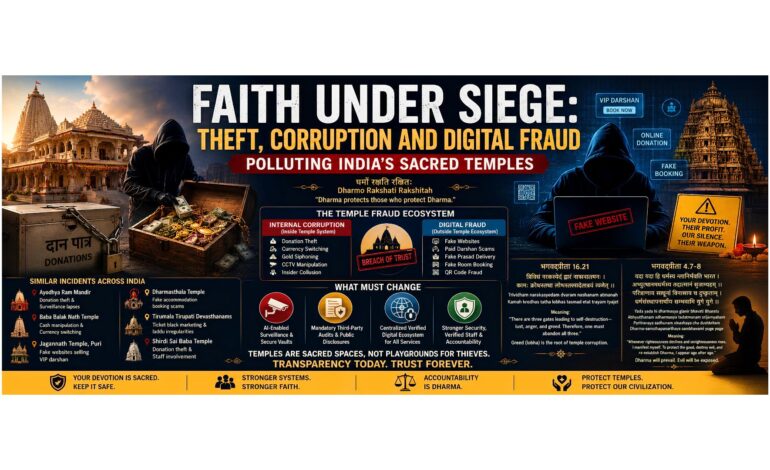
Faith under siege: Theft, corruption, and digital fraud polluting India’s sacred temples

By: Dr. Avi Verma
धर्मो रक्षति रक्षितः
Dharmo Rakshati Rakshitah
“Dharma protects those who protect Dharma.”
This timeless Sanskrit principle reminds us that when sacred institutions fail to uphold righteousness, society itself begins to weaken.
India’s temples are sacred centers of faith, devotion, and civilizational heritage. For millions of devotees, offerings symbolize gratitude, sacrifice, and surrender to the divine. People donate not because they are wealthy, but because they believe their contribution is sacred.
Yet a troubling pattern is spreading across the country. Internal theft, weak controls, and cyber fraud are turning temples into targets for corruption and criminal exploitation. What was once rare is now recurring: the abuse of faith itself.
This is no longer an isolated concern. It demands urgent attention.
Ayodhya Ram Mandir Scam: A National Wake-Up Call
The recent case involving the Shri Ram Janmabhoomi Temple in Ayodhya exposed serious lapses in cash handling, surveillance, and staff oversight. An SIT probe into alleged donation theft reportedly led to arrests and cash recovery, raising difficult questions about internal controls and accountability.
Investigators reportedly found irregularities in donation counting, surveillance coverage, staff verification, and cash movement. The most troubling aspect is that the alleged theft occurred inside the very system meant to protect devotees’ offerings.
The scandal has shaken public confidence and raised a broader question: if such vulnerabilities exist in one of India’s most protected temples, what is happening elsewhere?
The Exploitation Pipeline
Temple fraud now operates through two main channels: internal corruption and external digital fraud. On one side are insiders—staff, accountants, contractors, or officials—who exploit weak controls to siphon money, manipulate records, and steal offerings. On the other are cybercriminals who target devotees through fake websites, fraudulent QR codes, and deceptive booking portals.
Together, they form a dangerous ecosystem of exploitation.
TEMPLE FRAUD ECOSYSTEM
┌──────────────────┴───────────────────┐
▼ ▼
INTERNAL CORRUPTION DIGITAL FRAUD
(Inside Temple System) (Outside Temple Ecosystem)
• Donation theft • Fake websites
•Currency switching • Paid darshan scams
• Gold siphoning • Fake prasad delivery
• CCTV manipulation • Fake room booking
Similar Incidents Across India
The Ayodhya case is not an exception. Several major temples across India have faced similar incidents.
At the Baba Balak Nath Temple in Himachal Pradesh, accounting staff were accused of manipulating cash sorting by replacing higher-value notes with lower denominations and pocketing the difference. This was not random theft but a deliberate abuse of trust.
In Odisha, the Jagannath Temple administration in Puri had to issue repeated warnings after fraudsters launched fake websites selling “VIP darshan” passes. The irony is stark: darshan at Jagannath Temple is free, yet scammers monetized devotion by misleading pilgrims into paying for fake access.
In Karnataka, devotees visiting Sri Kshetra Dharmasthala Temple reportedly fell prey to fake accommodation booking portals, with families paying advance amounts to fraudulent websites only to discover they had been scammed upon arrival.
The Tirumala Tirupati Devasthanams, which manages one of the world’s richest temples, has also faced recurring allegations involving ticket black marketing, VIP darshan manipulation, and laddu distribution irregularities. While TTD has relatively advanced systems, loopholes continue to surface.
Similarly, the Shirdi Sai Baba Temple in Maharashtra has witnessed donation-related controversies and theft allegations over the years involving staff and vendors.
These cases show a troubling reality: no temple—large or small, public or private—is fully immune.
Vaishno Devi Shrine Board: Questions Over Use of Offerings
The Shri Mata Vaishno Devi Shrine Board is sustained by offerings from Hindu devotees who believe they are serving the goddess. Yet public criticism has grown over the use of shrine funds to establish and run a medical college. Reports and public debate have also alleged that a large share of the seats—figures cited as high as 85% in some discussions—are effectively reserved or made available to non-Hindus.
For many devotees, this is not a minor administrative issue. It raises concerns about whether the use of shrine funds reflects the intent of the donors.
Past coverage by IndoUS Tribune on the Vaishno Devi issue and the Baba Balak Nath matter shows that concerns over the treatment of Hindu religious institutions have surfaced repeatedly and cannot be dismissed as a one-time controversy.
How Temple Fraud Operates
| Internal Theft | Digital Scam |
| Donation skimming | Fake websites |
| Gold diversion | Fake booking portals |
| CCTV tampering | Fake darshan passes |
| Insider collusion | QR code fraud |
The methods differ, but the causes are the same: weak oversight, outdated systems, and poor accountability.
Government-Controlled vs Trust-Controlled Temples
A common debate is whether government-controlled temples are safer than privately managed trusts. The evidence suggests that corruption can exist under both systems.
ACCOUNTABILITY COMPARISON
──────────────────────────────────────────
Government-Controlled Private Trust-Controlled
──────────────────────────────────────────
+ State audits + Faster decisions
+ RTI access + Greater flexibility
– Bureaucratic delays – Limited public scrutiny
– Political influence – Opaque financial systems
──────────────────────────────────────────
Government-managed temples may have audit mechanisms and RTI access, but they often suffer from bureaucratic delays, weak enforcement, and political interference. Private trusts can move faster and adopt better technology, but many operate with limited transparency and weak public oversight.
The truth is simple: corruption thrives wherever accountability is weak.
What Must Change
India’s temple ecosystem urgently needs structural reform.
First, donation counting rooms and vaults must be secured with AI-enabled surveillance capable of detecting unusual movement, camera tampering, and suspicious behavior in real time.
Second, all temples above a defined donation threshold should undergo mandatory third-party audits with quarterly public disclosures.
Third, India needs a centralized verified digital ecosystem for darshan booking, accommodation, prasad delivery, and donations to eliminate fake portals and online fraud.
Temple security cannot continue to rely on outdated systems in a digital age.
भगवद्गीता 16.21
त्रिविधं नरकस्येदं द्वारं नाशनमात्मनः ।
कामः क्रोधस्तथा लोभस्तस्मादेतत्त्रयं त्यजेत् ॥
Trividham narakasyedam dvaram nashanam atmanah
Kamah krodhas tatha lobhas tasmad etat trayam tyajet
Meaning:
“There are three gates leading to self-destruction—lust, anger, and greed. Therefore, one must abandon all three.”
Among these, greed—lobha—lies at the heart of many temple corruption scandals today.
Faith Is Being Looted, and the System Is Failing
This is not ordinary theft. It is a breach of trust.
When a poor laborer places ₹101 in a temple hundi, he is not merely donating money—he is offering faith, sacrifice, and hope. That offering carries emotion, devotion, and trust.
When that money is stolen by insiders or looted by scammers, the harm is financial and spiritual.
The pattern is hard to ignore: weak oversight, delayed action, and damage control only after public exposure. Most major temples in India are directly or indirectly under government oversight, regulation, or political influence, so governments cannot evade responsibility when scams emerge.
Temple audits should be public. Security systems should be modern. Repeated lapses should not be tolerated. And officials who abuse their positions should not be shielded by politics.
Temples are sacred spaces, not financial playgrounds for thieves or corrupt insiders.
Devotees deserve transparency, accountability, and protection.
If airports, banks, and stock exchanges can be secured with advanced technology, temples should not remain vulnerable to theft, corruption, and digital fraud.
Faith should uplift society. It should never become a business model for criminals.
India must act now, firmly and transparently. When temples are compromised, the loss is not only money. It is trust.
भगवद्गीता 4.7–8
यदा यदा हि धर्मस्य ग्लानिर्भवति भारत ।
अभ्युत्थानमधर्मस्य तदात्मानं सृजाम्यहम् ॥
परित्राणाय साधूनां विनाशाय च दुष्कृताम् ।
धर्मसंस्थापनार्थाय सम्भवामि युगे युगे ॥
Yada yada hi dharmasya glanir bhavati Bharata
Abhyutthanam adharmasya tadatmanam srijamyaham
Paritranaya sadhunam vinashaya cha dushkritam
Dharma-samsthapanarthaya sambhavami yuge yuge
Meaning:
“Whenever righteousness declines and unrighteousness rises, I manifest myself. To protect the good, destroy evil, and re-establish Dharma, I appear age after age.”
This is both a warning to those who exploit faith and a reminder that Dharma ultimately prevails.
Prime Minister Narendra Modi Shri Ram Janmbhoomi Teerth Kshetra PMO India Ministry of Home Affairs Ministry of Electronics & IT Indian Cyber Crime Coordination Centre (I4C) Ministry of Culture Press Information Bureau Shri Ram Janmbhoomi Teerth Kshetra Shri Mata Vaishno Devi Shrine Board Tirumala Tirupati Devasthanams (TTD)
Tirumala Tirupati Devasthanams (TTD)
Official Website
https://www.tirumala.org
Official Booking Portal
https://ttdevasthanams.ap.gov.in
Official X
https://x.com/TTDevasthanams
Executive Officer
https://www.tirumala.org/Administration
Sri Kshetra Dharmasthala
Official Website
https://www.shridharmasthala.org
Baba Balak Nath Temple (Deotsidh)
Official Website
https://hptdc.in/deotsidh-baba-balak-nath/
Temple Information (Himachal Government)
https://himachaltourism.gov.in
Additional Accounts Worth Tagging
Press Information Bureau
https://x.com/PIB_India
MyGov India
https://x.com/mygovindia
Digital India
https://x.com/DigitalIndia
National Informatics Centre (NIC)
https://x.com/NICMeity
Jagannath Temple, Puri (Shree Jagannath Temple Administration)
Official Website
https://www.shreejagannatha.in
Chief Administrator
https://www.shreejagannatha.in/administration
Shri Mata Vaishno Devi Shrine Board
Official Website
https://www.maavaishnodevi.org
Chief Executive Officer (CEO)
https://www.maavaishnodevi.org/administration.aspx
Shri Ram Janmabhoomi Teerth Kshetra (Ayodhya)
Official Website
https://srjbtkshetra.org
Official X
https://x.com/ShriRamTeerth
Chairman
Mahant Nritya Gopal Das
General Secretary
Champat Rai