A Supreme Court term that reshaped power in America

By: Dr Avi Verma
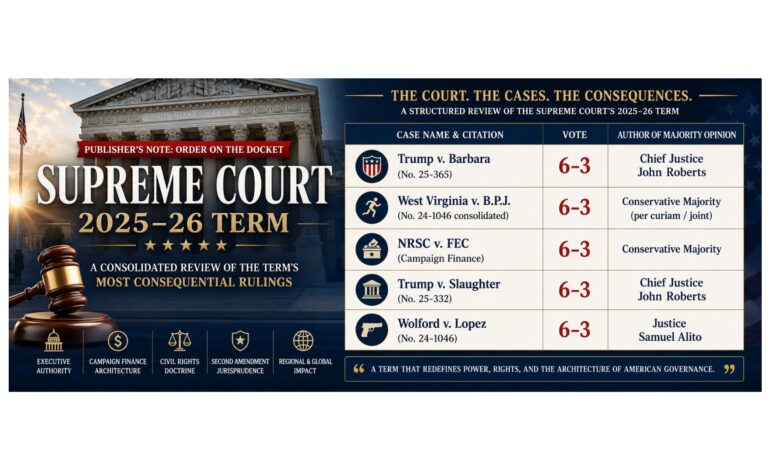
As we close the record on another consequential judicial cycle, our legal editorial desk presents a consolidated analysis of the Supreme Court’s recently concluded 2025–26 term. This briefing is intended as both an executive overview and an internal docket reconciliation, reflecting our best-faith verification of the term’s publicly reported decisions and their institutional significance.
The final weeks of June 2026 produced a series of closely divided and structurally significant opinions touching on executive authority, campaign finance architecture, civil rights doctrine, and Second Amendment jurisprudence. Below is our compiled editorial review of the term’s most consequential rulings, organized in a structured reference format and followed by contextual analysis of their broader legal and political implications.
Case Analyses & Structural Legacy ( Note for Sunil and Pooja Format this Chart nicely)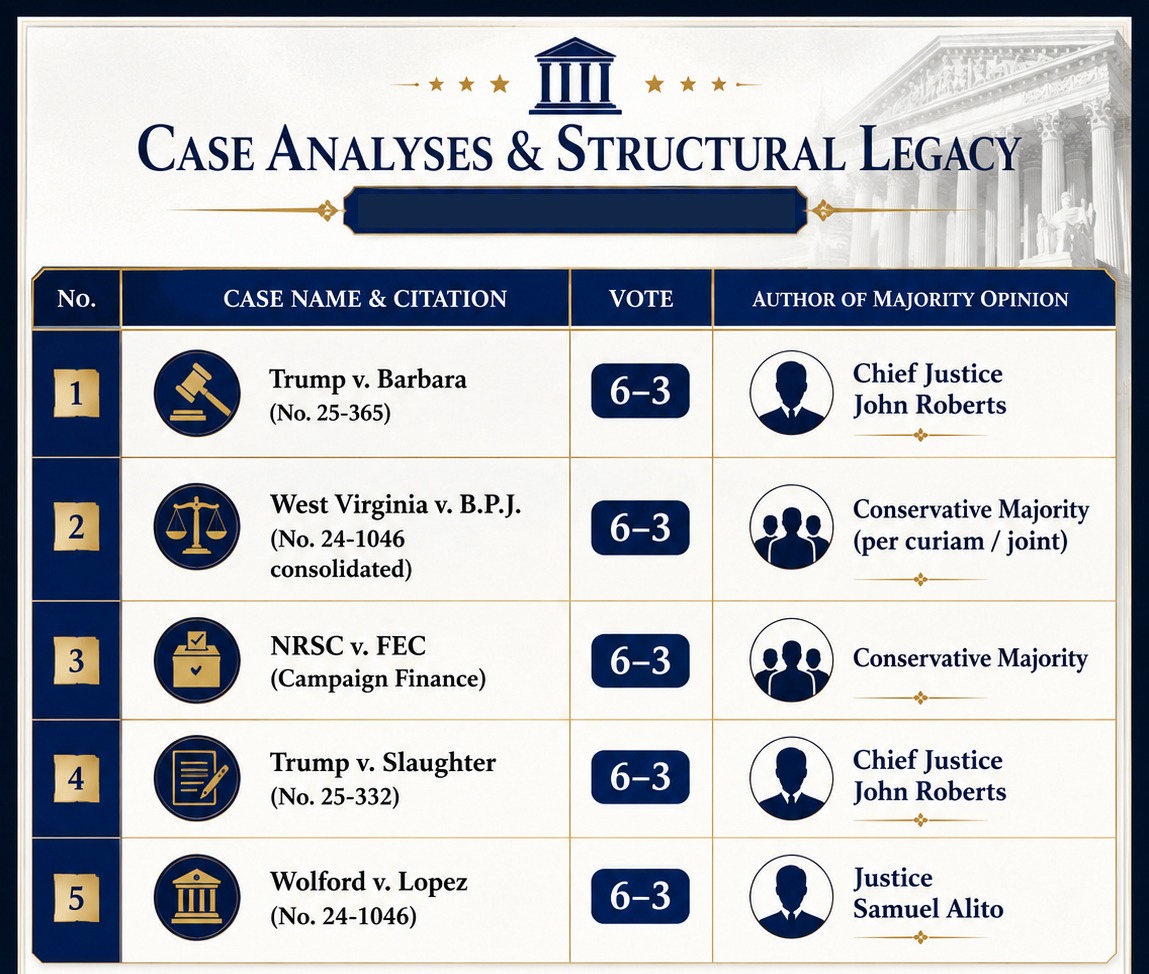
1. Trump v. Barbara: Constitutional Safeguards on Citizenship
The Ruling:
In a closely divided 5–4 decision, the Court struck down Executive Order No. 14160, which sought to deny automatic birthright citizenship to U.S.-born children of undocumented or temporary immigrants. Chief Justice John Roberts authored the majority opinion, joined by Justices Amy Coney Barrett and the Court’s three liberal justices. Justice Brett Kavanaugh concurred in the judgment on narrower statutory reasoning, while Justices Alito, Thomas, and Gorsuch dissented.
The Implications:
The ruling reaffirmed a strict reading of the Fourteenth Amendment’s Citizenship Clause and preserved longstanding constitutional interpretations of birthright citizenship. It also avoided a major legal disruption that could have produced significant uncertainty regarding statelessness and administrative enforcement.
2. West Virginia v. B.P.J.: The Title IX Re-anchoring
The Ruling:
In a 6–3 alignment, the Court upheld state-level restrictions limiting participation in school and collegiate sports to biological sex categories.
The Implications:
The decision reinforces a biologically defined framework within Title IX-related athletic regulations. It provides legal validation for state legislatures adopting sex-based eligibility rules in competitive sports, while intensifying ongoing national debate over gender identity in educational settings.
3. NRSC v. FEC: Deregulating the Party Machinery
The Ruling:
The Court struck down statutory limits on coordinated party expenditures, allowing political party committees to engage in unrestricted financial coordination with candidate campaigns.
The Implications:
By removing the legal separation between party committees and candidate financing structures, the ruling significantly reshapes the campaign finance landscape. It strengthens centralized party control over electoral spending while reducing the operational role of independent political action committees in competitive races.
4. Trump v. Slaughter: Executive Consolidation Over Federal Watchdogs
The Ruling:
In a 6–3 decision authored by Chief Justice Roberts, the Court invalidated long-standing precedent limiting presidential removal power over independent agency heads, effectively overturning Humphrey’s Executor v. United States. The decision upheld the termination of FTC Commissioner Rebecca Slaughter.
The Implications:
The ruling substantially expands the unitary executive doctrine, reinforcing presidential authority over federal regulatory leadership. Independent agencies—including those governing consumer protection, trade regulation, and financial oversight—are now more directly subject to executive control, raising structural questions about regulatory continuity across administrations.
5. Wolford v. Lopez: The Default Rule on Concealed Carry
The Ruling:
Justice Samuel Alito, writing for a 6–3 majority, struck down state “default prohibition” frameworks governing concealed carry on private property open to the public, absent explicit owner prohibition.
The Implications:
The Court held that states cannot presume firearm exclusion without affirmative notice from property owners. While private entities retain the ability to prohibit firearms through signage or policy, the decision effectively shifts the default legal presumption toward broader lawful carry access in public-facing private spaces.
Political and Global Macro-Impact
Politically, the 2025–26 term operates as a structural accelerant for both major parties heading into the next election cycle. The Democratic response is likely to coalesce around regulatory independence (Slaughter) and campaign finance reform (NRSC), while Republican policymakers gain jurisprudential reinforcement in Second Amendment and Title IX-aligned rulings. Even partial losses, such as Barbara, are likely to be reframed in legislative terms as calls for statutory clarification.
Globally, the term presents a dual message. The preservation of birthright citizenship doctrine in Barbara reinforces continuity with established international human rights norms regarding nationality and statelessness. In contrast, the weakening of independent regulatory insulation in Slaughter introduces greater perceived variability in U.S. regulatory enforcement, potentially affecting international financial forecasting and corporate compliance planning.
The Roberts Legacy: Institutional Balance vs. Structural Transformation
Chief Justice John Roberts’s role in this term underscores a defining judicial paradox.
On one hand, Trump v. Barbara reflects a commitment to constitutional textual stability and institutional restraint in matters of citizenship and executive overreach. On the other, Trump v. Slaughter marks a profound doctrinal expansion of presidential control over the administrative state, effectively reshaping nearly a century of regulatory precedent.
Taken together, the term reinforces Roberts’s dual identity: an institutional stabilizer in high-visibility constitutional disputes, and simultaneously a central architect in the recalibration of executive power within the federal bureaucracy. The long-term legacy of this balance—between restraint and expansion—will likely define scholarly debate on the Roberts Court for years to come.