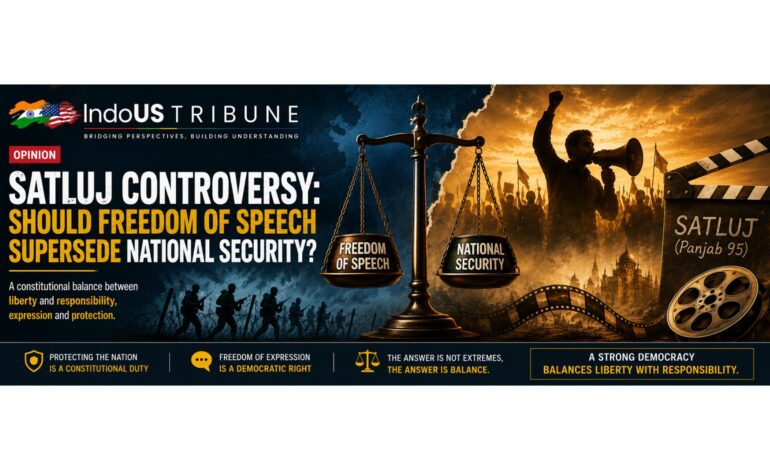
Satluj controversy: Should freedom of speech supersede national security?

By: Avi Verma, MD(h)
Publisher, IndoUS Tribune
The controversy surrounding Satluj (formerly Panjab 95) has reignited one of the most important constitutional debates of our time: Should freedom of speech supersede national security?
This is the burning question being asked by IndoUS Tribune.
Every democracy proudly upholds freedom of expression. It is one of the cornerstones of a free society. Yet no democracy—not India, not the United States, not the United Kingdom, nor any other constitutional nation—treats this freedom as absolute. Every constitutional right carries corresponding responsibilities, and every democracy recognizes that certain reasonable restrictions become necessary when public safety, national security, or communal harmony are at stake.
A simple analogy explains this principle better than pages of constitutional law: You have every right to walk down the road swinging your walking stick. But your freedom ends where another person’s nose begins.
The same principle applies to freedom of speech.
People have every right to question governments, expose injustice, criticize institutions, and debate history. But that freedom cannot extend to actions that may inflame communal tensions, revive separatist sentiments, encourage violence, or threaten the unity and security of the nation. Rights and responsibilities must always walk together.
The film Satluj, inspired by the life of human rights activist Jaswant Singh Khalra, revisits one of the darkest periods in modern Indian history—the Punjab militancy of the 1980s and early 1990s. Khalra’s investigations into alleged illegal disappearances and cremations remain an important part of India’s human rights discourse, and no mature democracy should object to examining uncomfortable chapters of its past. History should be studied honestly, not erased.
However, history also demands completeness.
Many within the Hindu community have questioned why discussions surrounding the Punjab militancy era frequently highlight allegations against the State while giving comparatively little attention to the thousands of innocent civilians, police personnel, security forces, public officials, and Hindu victims who were killed during years of brutal terrorist violence. While estimates of casualties vary among different sources, there is no dispute that Punjab witnessed immense suffering across multiple communities.
If history is to be retold, should it not reflect the pain of all those who suffered?
Can any historical narrative claim moral authority if it tells only one side of a tragedy?
These are legitimate questions—not only for governments but also for filmmakers.
Reports indicate that the Central Board of Film Certification (CBFC) sought extensive modifications before clearing the film for theatrical release. Rather than accepting those recommendations, the filmmakers chose to bypass theatrical certification altogether and release the unedited version through an OTT platform.
Legally, they may have acted within the framework governing digital streaming platforms. But legality alone does not answer the larger ethical question.
Should filmmakers be permitted to bypass one regulatory framework simply by changing the method of distribution?
More importantly, should celebrity filmmakers—with enormous influence and worldwide audiences—be allowed to shape highly sensitive historical narratives that may influence public opinion while remaining insulated from the social consequences their work may produce?
Cinema is not merely entertainment.
It shapes public memory.
It influences generations.
It can heal societies—or reopen old wounds.
With such extraordinary influence comes an equally extraordinary responsibility.
This responsibility becomes even greater when influential personalities who enjoy global platforms, and in many cases spend much of their professional lives outside India, produce films dealing with unresolved national conflicts. They certainly possess the right to tell stories. But should that right include the freedom to present selective narratives on deeply sensitive issues that continue to affect India’s social fabric, while simultaneously generating commercial success from controversy?
Freedom of expression should never become a commercial shield behind which one-sided historical narratives are packaged for profit.
If a filmmaker chooses to revisit one of India’s most painful chapters, the audience deserves the complete picture—not a version that selectively amplifies one set of victims while overlooking others whose suffering is equally real.
That does not strengthen democracy.
It weakens public trust.
At the same time, governments must exercise restraint. National security cannot become an excuse to suppress every uncomfortable opinion or inconvenient historical debate. Democracies grow stronger by confronting difficult truths openly, fairly, and transparently. Any restriction imposed by the State must satisfy constitutional standards, remain proportionate, and be subject to judicial oversight.
The answer, therefore, is neither unrestricted freedom nor unchecked censorship.
The answer is responsible freedom.
Creative liberty is one of democracy’s greatest strengths. But liberty without responsibility can become recklessness. History without context can become propaganda. Art without balance can deepen division instead of encouraging understanding.
The Satluj controversy offers India an opportunity to establish an important principle for the digital age. OTT platforms have transformed entertainment by allowing creators to reach millions instantly across the world. But technological innovation should not become a means of bypassing legitimate safeguards when issues involving national security, communal harmony, or separatist movements are involved.
The debate before us is not whether films should criticize governments. They should.
It is not whether history should be questioned. It must.
Nor is it whether artists should enjoy freedom of expression. They unquestionably should.
The real question is whether freedom of speech should supersede national security.
IndoUS Tribune believes the answer is no.
A democratic nation has not only the right but the constitutional duty to protect its citizens, preserve communal harmony, and safeguard its sovereignty. Freedom of expression remains meaningful only when the nation itself remains secure, peaceful, and united.
The wisdom of democracy lies not in choosing one constitutional value over another, but in balancing both.
Just as one’s freedom to swing a walking stick ends where another person’s nose begins, artistic freedom must also recognize constitutional boundaries where there exists a credible risk of violence, separatist propaganda, or threats to national security.
That is not an attack on free speech.
It is the very principle that allows free speech to survive within a stable democracy.
India’s future will not be strengthened by silencing debate, nor by allowing every form of expression to proceed without responsibility. It will be strengthened by encouraging honest scholarship, balanced storytelling, respect for every victim, and constitutional restraint from both the State and its citizens.
That is the balance worthy of the world’s largest democracy.