Hindu congregation files federal lawsuit seeking to clear path for Elgin temple project

By: Dr. Avi Verma
A Hindu congregation has filed a federal lawsuit seeking to overturn a nearly 60-year-old court order that it says has become the final obstacle preventing construction of a major Hindu temple and community complex in Elgin.
Umiya Mataji Sansthan Chicago Midwest (UMSCM) filed the lawsuit on July 14 in the U.S. District Court for the Northern District of Illinois against the City of Elgin and more than 200 neighboring property owners, challenging a 1967 Cook County Circuit Court consent decree that restricts its 34-acre property at 890 Galt Boulevard to industrial use.
The congregation argues that the decades-old land-use restriction violates its constitutional right to religious freedom under the First Amendment and conflicts with the Religious Land Use and Institutionalized Persons Act (RLUIPA), a federal civil rights law that protects religious institutions from discriminatory land-use regulations.
Represented by Chicago law firm Mauck & Baker, UMSCM contends that the consent decree has prevented both religious and residential development on the property. The lawsuit asks the federal court to vacate or modify the restriction so the congregation can move forward with its long-planned temple and community campus.“The Hindu community is simply seeking the same opportunity afforded to other faith communities—a permanent place of worship and housing for its members,” attorney John Mauck, counsel for the congregation, said in a statement.
Temple and community campus planned
According to plans submitted to the City of Elgin, the proposed development includes an 86,000-square-foot Hindu temple with a maximum height of 90 feet, approximately 33 townhomes, educational and cultural facilities, community gathering spaces, and 536 parking spaces. The current proposal is significantly smaller than an earlier concept that envisioned a 231,000-square-foot temple and 38 townhomes.
UMSCM purchased the property with the vision of creating not only a place of worship but also a cultural, educational, and social center serving the growing Hindu community throughout the Chicago metropolitan area.
In January 2026, the Elgin City Council voted 6-3 to approve the project’s rezoning and preliminary plat after months of public hearings. However, city officials made clear that final approval could not be granted unless the 1967 consent decree was first removed or modified by the courts.
Residents raise traffic and environmental concerns
The proposed development has generated considerable public discussion over the past year.
Residents living near the property have expressed concerns about increased traffic congestion along U.S. Route 20, potential impacts on nearby wetlands, and the overall scale of the project. During public hearings before the City Council, some residents argued that the development could significantly increase traffic in the area and place additional pressure on local infrastructure.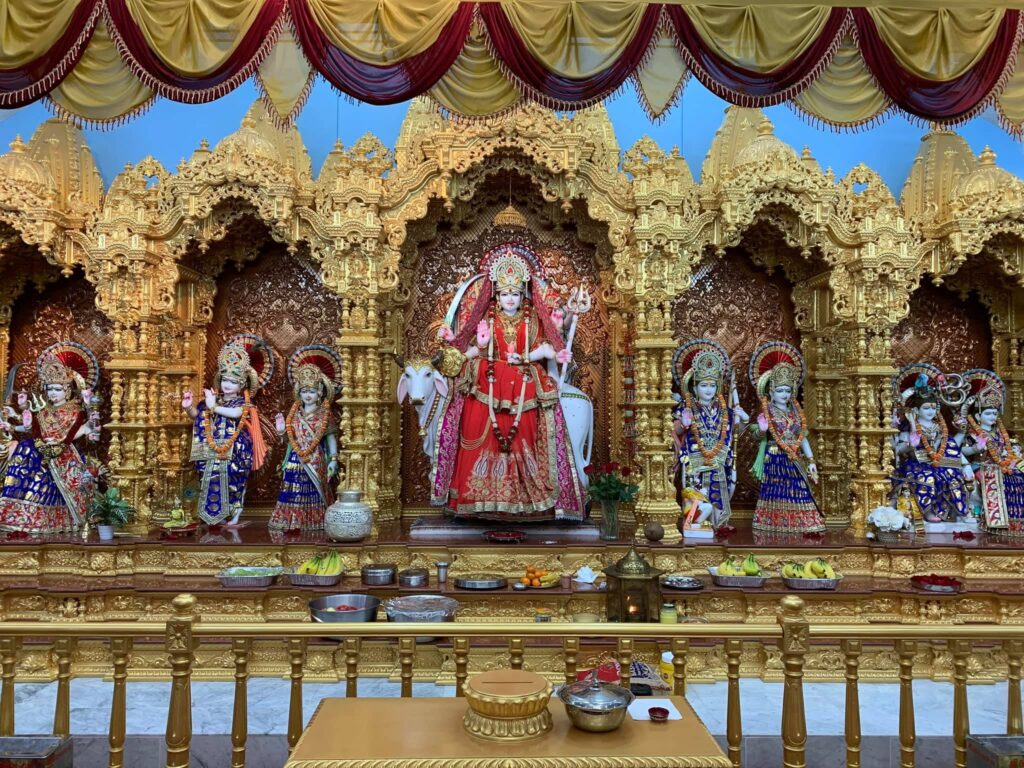
Project opponents have consistently maintained that their objections are based on land-use planning, environmental considerations, and traffic management—not the religious nature of the proposed temple.
Mayor David Kaptain has previously indicated that the City of Elgin supports the temple project in principle but has been legally constrained by the existing court order. The city is named in the lawsuit primarily because it is responsible for administering and enforcing the decades-old land-use restriction.
A potentially significant religious freedom case
Legal experts say the case could become an important test of RLUIPA, the federal law enacted in 2000 to protect religious institutions from land-use regulations that place a substantial burden on religious exercise unless governments can demonstrate a compelling public interest pursued through the least restrictive means.
If the federal court determines that the 1967 consent decree violates RLUIPA or constitutional protections, it could vacate or modify the restriction, clearing the way for Elgin to issue final approvals for one of the largest Hindu temple and community developments proposed in the Chicago region.
Serving the Kadva Patidar community
Founded in 2016, Umiya Mataji Sansthan Chicago Midwest serves members of the Kadva Patidar community across the Midwest. Inspired by the blessings of Maa Umiya, the organization is dedicated to promoting community unity, education, healthcare, scientific advancement, business development, employment opportunities, and cultural preservation.
Beyond religious worship, the proposed Elgin campus is envisioned as a center for education, community service, cultural programs, youth development, and charitable activities, providing a permanent home for one of the region’s growing Hindu communities.
As the federal case moves forward, its outcome will be closely watched by religious organizations, municipal governments, and land-use advocates nationwide. The court’s decision could help define how longstanding private land-use restrictions interact with modern constitutional protections for religious freedom and federal civil rights law.