Rare episodes hidden in the Valmiki Ramayana

By: Rajendra Kapil
Hanuman Ji’s Childhood
In the Ramcharitmanas, there is no description of the birth or childhood of Hanuman Ji. His first appearance comes in the Kishkindha Kand, when Lord Rama and Lakshmana, while searching for Mother Sita, arrive near Rishyamuk Mountain. Seeing the two mighty warriors, Sugriva becomes anxious and sends Hanuman Ji to discover their identity.
Disguised as a Brahmin, Hanuman Ji approaches the two brothers and asks:
को तुम्ह स्यामल गौर सरीरा, छत्रीरूप फिरहु बन बीरा
Captivated by their divine appearance, he continues:
मृदुल मनोहर सुन्दर गाता, सहत दुसह बन आतप बाता
कि तुम्ह तीनि देव महँ कोऊ, नर नारायन की तुम्ह दोऊ
Once Hanuman Ji realizes that they are Lord Rama and Lakshmana, he respectfully escorts them to Sugriva. He helps establish the historic friendship between Lord Rama and Sugriva, after which Sugriva and his entire Vanara army wholeheartedly join Rama’s mission to search for Mother Sita.
Unlike the Ramcharitmanas, the Uttara Kanda of the Valmiki Ramayana contains a detailed narration of Hanuman Ji’s birth and childhood.
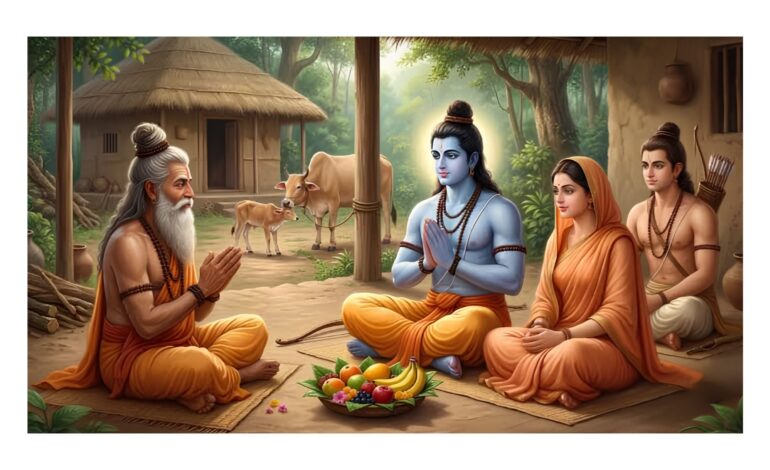
Once, Sage Agastya visited Lord Rama’s royal court. During their conversation, Lord Rama expressed deep gratitude for Hanuman Ji’s unmatched devotion and invaluable service. Sage Agastya then asked, “Would you like to hear about Hanuman Ji’s childhood?” At Lord Rama’s request, the sage began narrating the sacred story.
Sage Agastya Begins the Story
The sage said that everyone knows Hanuman Ji was the divine son of Vayu Deva (the Wind God) and Mother Anjana, with Kesari as his earthly father. Because of his divine origin, he is also known as Maruti Nandan, as Maruti is another name for the Wind God. Hence, Hanuman Ji is lovingly called Pawan Putra (Son of the Wind).
Even as a child, Hanuman Ji possessed extraordinary divine powers.
Sage Agastya quoted:
सत्यमेतद्रघुश्रेष्ट यदूबवीषि हनूमतः ।
न बले विद्यते तुल्या न गता न मता परः ॥ १५॥
He explained that Hanuman Ji possessed incomparable strength, wisdom, and speed. No one among gods or humans could match him in these qualities.
Sage Agastya then described a golden mountain called Sumeru, where King Kesari ruled. His queen, Anjana, performed severe penance before giving birth to a divine child named Hanuman.
One day, while Hanuman Ji was still very young, Mother Anjana went deep into the forest to collect fruits. She did not return for a long time.
शालिशूकनिभाभासं प्रासूतेमं तदाऽञ्जना ।
र फलान्याहतकामा वै निष्क्रान्ता गहनेचरा ॥ २१ ॥
The little child became hungry. Unable to find food, he cried loudly. At that moment, he saw the rising red Sun and mistook it for a ripe fruit. Believing it to be something delicious to eat, he leaped toward the sky to catch it.
बालाकाभियुखो बालो बाळाक इव मूर्तिमान् ।
ग्रहीतुकामो बालाक छुवतेऽम्बरमध्यगः ॥ २४ ॥
The Sun, however, was far away. Hanuman Ji continued flying toward it with astonishing speed. The gods watched this incredible sight with amazement. They wondered how such extraordinary speed could exist in such a young child. If he possessed such power in infancy, what would his abilities become when he reached adulthood?
King Kesari also witnessed the event and became worried for his son’s safety. If the child flew too close to the blazing Sun, he might be burned by its intense heat.
Sage Agastya quoted:
तमनुपुवते वायुः पुवन्त पुत्रमात्मानः ।
सर्यदाहभयाद्रक्षस्तुपारचयशी तल! ॥ २८ ॥
To protect his son, Vayu Deva followed closely behind Hanuman Ji while cooling the surrounding air like ice.
Meanwhile, Surya Deva also saw the innocent child approaching. Realizing that the child knew no danger, the Sun God decided not to harm him. Through his divine vision, Surya Deva also understood that this child would one day perform many indispensable services for Lord Rama. Therefore, Hanuman Ji had to be protected.
Hanuman Ji, Rahu, and Indra
Another episode in the Valmiki Ramayana describes that at the very moment Hanuman Ji rushed toward the Sun, Rahu was also approaching to swallow the Sun during an eclipse.
यमेव दिवसं होष ग्रहीतुं भास्करं प्लुतः ।
तमेव दिवसं राहुर्जिघुक्षति दिवाकरम् ॥ ३१॥
अनेन च परामृष्टो राहुः सूयरथापरि ।
अपक्रान्तस्ततस्रस्तो राहुथन्द्राकमद्नः ॥ ३२ ॥
As soon as Hanuman Ji touched the upper part of Surya Deva’s chariot, Rahu became frightened and fled. He rushed to Lord Indra, seeking help.
Mounted on his celestial elephant Airavata, Indra came to confront Hanuman Ji. He struck the child with his mighty Vajra (thunderbolt), which hit Hanuman Ji on the chin. It is said that the mark of that blow remained on his chin forever, and from this incident came the name Hanuman, derived from Hanu (jaw or chin).
Why Hanuman Ji Became Known as Pawan Putra
Just as Indra could withhold rain and disturb the world, Vayu Deva also possessed the power to stop the movement of air.
Angered by Indra’s attack on his son, Vayu withdrew the life-giving wind from the universe. Immediately, all living beings began to suffer. The gods became alarmed and approached Vayu Deva, begging forgiveness and requesting him to restore the life-sustaining air for the welfare of all creation.
Sage Agastya quoted:
राहोर्वचनमास्थाय ततः स कुपितोऽनिलः ।
अशरीर! शरीरेषु वायुश्चरति पाळयन्॥ ६० ॥
शरीरं हि विना वायं समतां याति दारुभिः ।
वायः प्राणः सुखं बायर्वायुः सवेमिदं जगत् ॥ ६१॥
Vayu Deva became pleased and restored the flow of air. He declared that from then onward he would exist invisibly within every living being as breath itself. We all know that life cannot exist without air. It is the very foundation of existence.
From that time, Hanuman Ji became renowned as Pawan Putra, the Son of the Wind, and all the worlds acknowledged his unmatched strength and speed.
Hanuman Ji’s Divine Powers in Service of Lord Rama
When Hanuman Ji later met Lord Rama, it was this extraordinary speed that enabled him to leap across the mighty ocean in search of Mother Sita.
During the great war between Rama and Ravana, when Lakshmana was rendered unconscious, Hanuman Ji flew to the Himalayas with incredible swiftness and brought back the Sanjivani herb, saving his life.
Hanuman Ji is supreme not only in strength but also in wisdom. There is no task beyond his ability, and there is no sincere prayer of a devotee that he cannot fulfill.
That is why Goswami Tulsidas wrote:
कवन सो काज कठिन जग माहि, जो नहीं तात होई तुम्ह पाहि
And when it comes to serving Lord Rama, Hanuman Ji never hesitates. At the very mention of Rama’s work, he becomes instantly ready:
रामकाज लगि तव अवतारा, सुनतहि भयहु परवता कारा
I offer my humble salutations to Lord Hanuman, the eternal devotee of Lord Rama.
Jai Shri Ram!