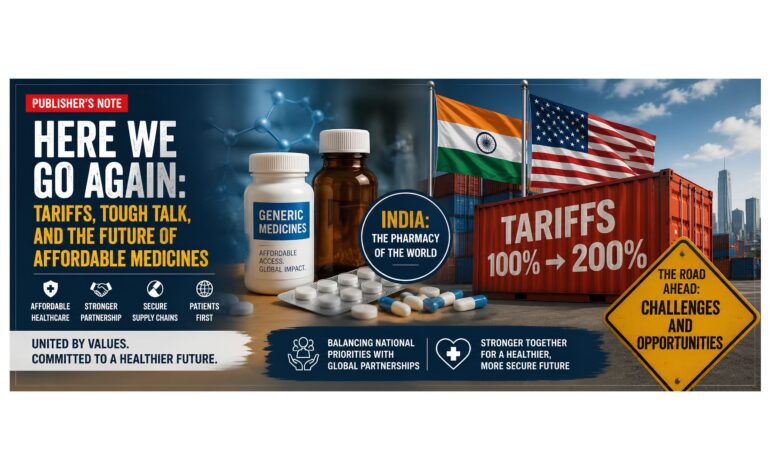
Here we go again: Tariffs, tough talk, and the future of affordable medicines

By: Avi Verma
Here we go again.
President Donald Trump has once again turned to tariffs—this time targeting one of the most critical sectors in U.S.-India trade: generic medicines.
Under the President’s newly announced plan, imported generic drugs will continue to enter the United States tariff-free for the next two years, beginning August 1, 2026. Thereafter, tariffs are proposed to rise sharply—first to 100 percent and eventually 200 percent. The administration’s goal is clear: encourage pharmaceutical companies to manufacture more medicines in America and reduce dependence on foreign suppliers.
While the announcement has sent shockwaves through India’s pharmaceutical industry, the issue deserves a balanced analysis rather than an emotional reaction.
India is rightly known as the “Pharmacy of the World.” It is one of the largest producers of generic medicines and supplies roughly 40 percent of the generic medicines used in the United States by volume. Nearly 38 percent of India’s pharmaceutical exports are shipped to the U.S., making America its largest pharmaceutical market. For decades, this partnership has benefited both countries—Indian manufacturers have supplied affordable medicines, while American patients have gained access to lower-cost treatments.
The first question is simple: Who ultimately pays the tariff?
Although tariffs are imposed on imports, history suggests that much of the added cost eventually works its way through the supply chain. Healthcare experts warn that significantly higher import costs could result in higher prescription drug prices or increased pressure on insurers and public healthcare programs if domestic production does not expand quickly enough.
At the same time, the administration’s argument cannot be dismissed.
The COVID-19 pandemic exposed America’s dependence on overseas manufacturing for essential medicines. Strengthening domestic pharmaceutical production is a legitimate national security objective. Every nation has the right to ensure reliable access to life-saving drugs during global emergencies.
The challenge lies in execution.
Building pharmaceutical manufacturing facilities is a long-term undertaking. It requires billions of dollars in investment, FDA approvals, specialized equipment, and a highly skilled workforce. Industry leaders have repeatedly argued that generic drug manufacturing operates on thin profit margins, making rapid relocation to the United States economically difficult. Even with a two-year transition period, reshoring production will not happen overnight.
Another important factor is the broader U.S.-India relationship.
Today, the partnership extends well beyond trade. The two democracies cooperate closely in defense, technology, healthcare, higher education, semiconductors, and Indo-Pacific security. Neither Washington nor New Delhi benefits from allowing pharmaceutical tariffs to overshadow a relationship that has become increasingly important to global stability.
For Indian pharmaceutical companies, the proposal presents both risk and opportunity. Larger firms may expand manufacturing within the United States to preserve market access, while smaller companies may struggle with the enormous investment required. The coming two years will likely determine which companies adapt successfully.
There is also an irony that deserves attention. The United States has relied on Indian manufacturers precisely because they have consistently supplied safe, effective, and affordable generic medicines. Policies intended to strengthen domestic manufacturing should avoid unintentionally making healthcare more expensive for American patients.
The larger debate is not whether America should strengthen domestic manufacturing—it should. The real question is whether tariffs alone are enough. History suggests they are only one part of the solution. Expanding pharmaceutical production will also require investment incentives, regulatory efficiency, workforce development, and close collaboration with industry.
This should not become a contest between America First and India First. It should be about patients first.
The next two years provide an opportunity—not merely to prepare for higher tariffs, but to negotiate practical solutions that strengthen America’s pharmaceutical security while preserving one of the world’s most successful healthcare partnerships.
The U.S.-India relationship has grown because both nations recognize their shared democratic values and mutual economic interests. It would be unfortunate if healthcare cooperation became an unintended casualty of trade policy.
Ultimately, this proposal should be judged not by the size of the tariff, but by its results. If it succeeds in rebuilding American pharmaceutical manufacturing without significantly increasing healthcare costs or damaging a vital strategic partnership, it will have achieved its purpose. If, however, it leads to higher drug prices, supply disruptions, or unnecessary friction between trusted allies, both countries—and millions of patients—could pay the price.
The next two years will reveal whether this policy becomes a catalyst for stronger supply chains or another chapter in an increasingly protectionist global economy.