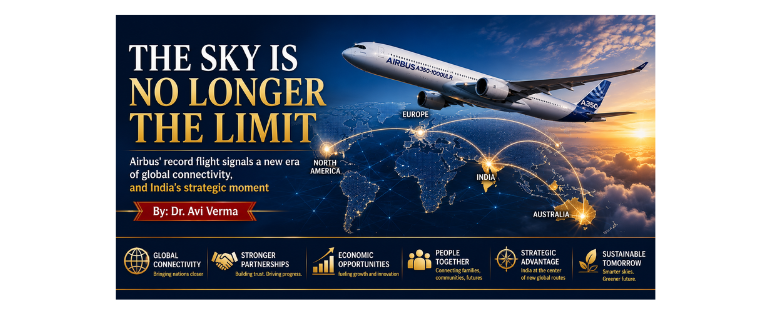
The sky is no longer the limit: Airbus’ record flight signals a new era of global connectivity, and India’s strategic moment

By: Dr. Avi Verma
The Airbus A350-1000ULR’s record-breaking nonstop flight from Melbourne to Toulouse, completed in 24 hours and 24 minutes, is far more than an engineering achievement. It marks a pivotal moment in global aviation, one that has the potential to reshape diplomacy, commerce, and people-to-people ties across the Indo-Pacific and beyond.
For decades, advances in aviation have brought nations closer, accelerated trade, and strengthened international partnerships. Airbus and Qantas’ Project Sunrise represents the next leap in that journey. When Qantas launches nonstop flights from Sydney to London and New York in 2027, it will eliminate one of commercial aviation’s last major obstacles: distance.
The significance extends well beyond shorter travel times.
It reflects the Indo-Pacific’s emergence as the world’s new economic and strategic center. Over the past two decades, global influence has steadily shifted toward this region, where India, Australia, Japan, the United States, and other democratic partners are deepening cooperation in trade, technology, security, and investment. Aviation is becoming a critical enabler of that transformation.
Modern diplomacy is driven not only by government agreements but also by the movement of business leaders, researchers, students, entrepreneurs, tourists, and families. Every new nonstop route strengthens these connections and creates new opportunities for collaboration.
For India, the implications are especially significant.
India is one of the world’s fastest-growing aviation markets. Expanding airport infrastructure, rising incomes, and growing international travel are expected to make Indian passengers among the largest users of long-haul air services over the next decade.
Although Project Sunrise will initially connect Australia directly with Europe and North America, its technological breakthrough has wider implications. As aircraft continue to push the limits of range, nonstop services linking Indian cities with Australia, the eastern United States, and even Latin America become increasingly realistic. Such routes could strengthen trade, investment, tourism, and reinforce India’s position as a bridge between East and West.
The benefits extend across sectors. Faster travel supports global supply chains by enabling quicker executive mobility. Technology partnerships rely on face-to-face collaboration. Universities gain from greater academic exchanges, while medical tourism, international conferences, and cultural diplomacy all become more accessible when travel is simpler and more direct.
The impact will also be felt by India’s global diaspora, now numbering more than 35 million people. Shorter journeys mean stronger family connections, easier business travel, and closer cultural ties between communities spread across India, North America, Europe, Australia, and beyond.
Project Sunrise also highlights the value of international collaboration. Combining European aerospace innovation, Australian airline leadership, and global engineering expertise, it reflects the same spirit of cooperation that underpins initiatives such as the Quad and broader Indo-Pacific partnerships.
History has repeatedly shown that connectivity drives progress. Railways transformed economies in the nineteenth century. Commercial aviation connected continents in the twentieth. In the twenty-first century, ultra-long-haul flights are becoming another foundation of globalization, supporting resilient supply chains, stronger alliances, and deeper international engagement.
Challenges remain. Ultra-long-haul travel must continue improving passenger comfort, operational efficiency, and environmental sustainability. Airbus has addressed many of these concerns through greater fuel efficiency, lighter aircraft systems, improved cabin humidity, circadian lighting, and dedicated wellness spaces designed to reduce fatigue during flights lasting nearly an entire day.
The broader message, however, is clear.
The Airbus A350-1000ULR’s historic journey demonstrates how technology continues to reshape the world, not by changing geography, but by making it more accessible.
For India, whose economic ambitions are increasingly global, that is an important development. As New Delhi strengthens partnerships with Washington, Canberra, Tokyo, Brussels, and London, direct long-haul air links will become as strategically valuable as digital infrastructure and maritime corridors. They will carry investors, innovators, students, diplomats, and ideas that drive economic growth and international cooperation.
The record-breaking flight from Melbourne to Toulouse is therefore more than an aviation milestone. It is a glimpse of a future where geography matters less, connectivity matters more, and the strength of relationships, rather than the distance between nations, defines global influence.