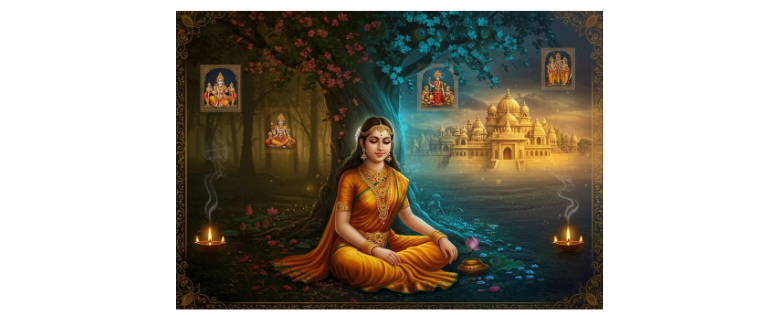
Rare episodes hidden in the Valmiki Ramayana: The real reason behind Sita’s second exile

By: Rajendra Kapil
We all know that Mata Sita endured two periods of exile during her lifetime. The first was the fourteen-year exile she spent alongside Lord Rama, honoring his father’s promise. The second came after Lord Rama’s coronation, when Sita was pregnant.
The commonly accepted belief regarding her second exile is that public opinion had turned against Lord Rama. People questioned how he could bring back and accept as his queen a woman who had spent a long period under Ravana’s captivity. Her purity was doubted by society.
Interestingly, Goswami Tulsidas does not narrate this episode in the Ramcharitmanas. However, when Sage Valmiki recounts this event in the Valmiki Ramayana, he mentions an ancient curse that ultimately led to the separation of Rama and Sita. In this article, we shall attempt to examine this lesser-known aspect in detail.
Tulsidas was extremely careful while describing the purity of Mata Sita.
In the Aranya Kanda of the Ramcharitmanas, when Lord Rama realized that great danger was about to befall Sita, he anticipated that an extraordinary calamity was approaching. Therefore, one day, when Lakshmana had gone into the forest to gather fruits and flowers, Lord Rama advised Sita to enter the sacred fire so that whatever was destined to happen would happen only to her divine reflection.
According to Tulsidas, when Ravana abducted Sita, he abducted only her illusory image (Chhaya Sita), while the real Sita remained safely protected in the fire.
After the war with Ravana ended and Sita was brought before Lord Rama, she was asked to undergo the Agni Pariksha (Trial by Fire) so that all doubts regarding her purity could be removed.
सुनहु प्रिया ब्रत रुचिर सुसीला, मैं कछु करबि ललित नरलीला
तुम्ह पावक महूँ करहु निवासा, जों लगि करों निसाचर नासा
जबहि राम सब कहा बखानी, प्रभु पद धरि हियँ अनल समानी
निज प्रतिबिंब राखि तहँ सीता, तैसइ सील रूप सुविनीता
After the completion of the exile, Lord Rama returned to Ayodhya, where his coronation was celebrated with great splendor.
The entire city rejoiced, celebrating what is now commemorated as Deepavali. Rama, along with his brothers, began ruling the kingdom peacefully and happily, enjoying the prosperity and responsibilities of royal life.
During this period, Mata Sita became pregnant.
Since the episode of Sita’s second exile was closely associated with public criticism, Tulsidas chose not to continue the narrative beyond this point in the Ramcharitmanas. Sage Valmiki, however, describes the events that followed in considerable detail.
One day, while Lord Rama was alone, his minister Bhadra approached him and informed him about the conversations taking place throughout Ayodhya concerning Sita’s character.
These discussions, he explained, were beginning to tarnish the king’s reputation.
कीदशं हृदये तस्य सीतासं भोगजं सुखम् । अङ्कमारोप्य तु पुरा रावणेन बलाद्धताम्॥ १७॥
लङ्कामपि पुरा नीतामशाकवनिकां गताम्। रक्षसां वशमापन्नां कथं रामो न कुत्स्यति ॥१८॥
अस्माकमपि दारेषु सहनीयं भविष्यति ।। यथा हि कुरुते राजा प्रजा स्तमनुवर्तते ॥१९॥
The citizens openly questioned Sita’s return.
They said that Ravana had forcibly carried her away in his arms to Lanka, where she had remained under his control. She had first been confined within his palace and later imprisoned in the Ashoka Vatika.
Despite all this, they argued, Lord Rama had accepted her with honor and reinstated her as the Queen of Ayodhya.
Such conduct by the king, they believed, would set an undesirable example for society.
“If the king behaves in this manner,” they said, “the people will naturally follow his example.”
It is widely believed that Lord Rama sent Sita into exile for the second time in order to preserve the dignity of the kingdom and protect himself from public criticism.
But was this the only reason?
According to Sage Valmiki, the answer is no.
The responsibility of escorting Sita to the forest once again fell upon Lakshmana.
ऋषीणां चैव सर्वेषामपापां जनकात्मजाम् । एवं शुद्धसमाचारा देव गन्धर्व सन्नियो ॥ ९ ॥
लङ्काद्वीपे महेन्द्रेण मम हस्ते निवेशिता ।अन्तरात्मा च मे वेत्ति सीतां शुद्धां यशस्विनीम् ॥१०॥
Lord Rama knew beyond any doubt that Sita was absolutely pure.
His own conscience bore witness to her innocence.
Yet, as the ruler of Ayodhya, he also carried the immense responsibility of protecting the kingdom’s moral code and preserving public confidence in the throne.
He explained his painful dilemma to Sita.
For the sake of her husband’s duty and the welfare of the kingdom, Sita once again accepted a tremendous personal sacrifice.
When Lord Rama sought the opinion of his brothers, none of them supported sending Sita away. They all advised him to ignore public gossip.
But Rama remained unwavering in what he believed to be his duty.
Rare Episodes Hidden in the Valmiki Ramayana
The Real Reason Behind Sita’s Second Exile (Part 2)
When Lakshmana hesitated to carry out Lord Rama’s painful command, Rama spoke to him not merely as an elder brother, but as the King of Ayodhya. Bound by royal duty, Lakshmana had no choice but to obey.
With a heavy heart, Lakshmana approached Mata Sita and expressed his helplessness. He conveyed Lord Rama’s command with deep sorrow, unable to conceal his grief.
Remarkably, there was neither anger nor resentment on Sita’s face.
Instead, she smiled gently and encouraged Lakshmana to fulfill his duty. She understood that Lord Rama was acting not out of personal desire, but out of his obligation as a king. She accepted the decision as yet another sacrifice for Lok Kalyan—the welfare of society.
एवमुक्तः सुमन्त्रेण राजवेश्मनि लक्ष्मण: । प्रविश्य सीतामासाद्य व्याजहार नरषभः ॥६॥
स्वया किलेष नूपतिवर वे याचितः प्रभु: । नृपेण च प्रतिज्ञातमाज्ञप्तश्नाश्रमं प्रति ॥ ७॥
Lakshmana then requested the royal minister and charioteer, Sumantra, to prepare the chariot.
Once the chariot arrived, Lakshmana stood before Mata Sita with folded hands and respectfully requested her to accompany him.
Even at that heartbreaking moment, Sita showed no trace of displeasure. She accepted her husband’s command with complete serenity.
She firmly believed that whatever was unfolding was ultimately for the greater good and felt blessed that she could contribute to such a noble purpose.
Lakshmana, however, found the task almost unbearable.
Every step of the journey weighed heavily upon his heart.
After leaving Mata Sita at the Ashram of Sage Valmiki, Lakshmana began his return journey to Ayodhya.
His mind was filled with unbearable sorrow and remorse.
Seeing Lakshmana’s grief, Sumantra attempted to console him.
दृष्टा तु मेथिलीं सीतामाश्रमे संप्रवेशिताम् । सन्तापमगमदघोरं लक्ष्मणो दीनचेतनः ॥ १ ॥
Sumantra then narrated a mysterious episode that very few people knew.
He explained that this was a secret revealed to him long ago by King Dasharatha, who had instructed him never to disclose it.
“But today,” Sumantra said, “seeing your profound sorrow, I am compelled to tell you the truth.”
According to Sumantra, the separation of Rama and Sita was not caused solely by public criticism.
Behind it lay an ancient curse that had been destined to unfold long before the birth of Lord Rama.
What was that curse?
यद्यप्यहं नरेन्द्रेण रहस्यं श्रावितं पुरा । तथाप्युदाहरिष्यामि दैवं हि दुरतिक्रमम् ॥१८॥
येनेदमीदृशं प्राप्त दुःखं शोकसमन्वितम् । न त्वया भरतस्याग्रे शत्रु ध्नस्यापि सन्निधौ ॥१९॥
Sumantra recalled that many years earlier, King Dasharatha had once been attending a spiritual gathering with Sage Vashistha, Sage Durvasa, and several other revered rishis.
During the discourse, King Dasharatha respectfully asked about the future destiny of his son, Rama.
It was then that Sage Durvasa revealed a profound secret.
Rare Episodes Hidden in the Valmiki Ramayana
The Real Reason Behind Sita’s Second Exile (Part 3)
Sage Durvasa narrated an incident from ancient times.
Long before the Treta Yuga, a fierce war had broken out between the Devas and the Asuras.
Defeated in battle, the Asuras fled and sought refuge in the Ashram of Sage Bhrigu.
In Sage Bhrigu’s absence, his compassionate wife granted them asylum and promised them protection.
When Lord Vishnu learned that the enemies of the Devas had been given sanctuary, He became enraged.
Overcome by divine wrath, He used His Sudarshan Chakra and severed the head of Sage Bhrigu’s wife.
ततस्तां निहतां दृष्टा पत्नी भृगुकुलोद्रह; । शशाप सहसा क्रुद्धो विष्णं रिपुकुलादेनम् ॥१४॥
When Sage Bhrigu returned to the Ashram and found his wife lying lifeless, he was overwhelmed with grief.
Upon learning what had happened, he was filled with righteous anger.
With tears in his eyes, he addressed Lord Vishnu:
यस्मादवध्यां मे पत्नीमवधीः क्रोधमूच्छितः तस्मात्वं मानुषे लोके जनिष्यसि जनादंन॥१५॥
“O Vishnu!
My wife did not deserve death.
Blinded by anger, You killed one who was innocent.
Therefore, I curse You.
In the Treta Yuga You shall be born in the mortal world as a human being.
You too shall endure prolonged separation from Your beloved wife.
Just as I suffer today in the agony of losing my wife, You too shall experience the unbearable pain of separation—without any fault of Your own.”
By then, Lord Vishnu’s anger had subsided.
He realized the gravity of His action.
But the curse had already been pronounced.
Standing before Him was the great sage Bhrigu, whose tapasya commanded the highest reverence.
To uphold the sanctity of a sage’s words, Lord Vishnu accepted the curse with humility.
लोकानां क्वसंप्रियाथ तु तं शापं ग्रह्ममुक्तवान् । इति शप्तो महातेजा भूगुणा पूर्वजन्मनि ॥१८॥
इहागते हि पुत्र त्वं तव पार्थिवसत्तम । राम इत्यभिविख्यातस्रिषु लोकेषु मानद ॥ १९ ॥
Thus, in the Treta Yuga, Lord Vishnu incarnated as Lord Rama and fulfilled Sage Bhrigu’s curse.
While public criticism and royal duty became the immediate circumstances surrounding Sita’s second exile, Sumantra’s narration suggests that the deeper cause had already been ordained by destiny through the ancient curse.
Accepting the suffering with complete dignity, Lord Rama endured separation from Mata Sita for the welfare of society, the preservation of Raj Dharma, and the fulfillment of divine destiny.
The author concludes that this lesser-known episode from the Valmiki Ramayana offers another perspective on one of the most painful chapters in the Ramayana and reminds us that the Lord willingly bore immense personal sorrow for the protection of righteousness and the welfare of humanity.
May Lord Rama, who willingly endured every hardship for His devotees and for the establishment of Dharma, continue to shower His grace upon us and protect us through His divine blessings.
With humble reverence at the sacred feet of the Lord—
Jai Shri Ram!