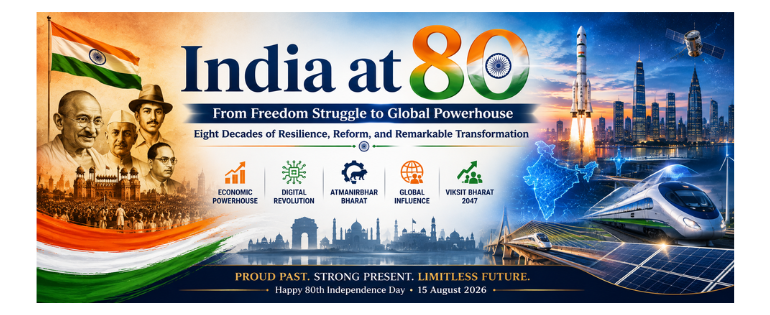
India at 80: From Freedom Struggle to Global Powerhouse

Eight Decades of Resilience, Reform, and Remarkable Transformation
By: Dr. Avi Verma
As India prepares to celebrate its 80th Independence Day on August 15, 2026, the spirit of freedom will resonate not only across the Indian subcontinent but around the world. From the historic Red Fort in New Delhi to community celebrations across the United States and every continent where the Indian diaspora has established a presence, the Tiranga will be unfurled with pride, gratitude, and celebration.
For millions of Indians, this is more than an annual national celebration. The 80th Independence Day represents a historic milestone—a moment to reflect on an extraordinary journey that began in 1947 with hope, determination, and immense challenges.
When India became independent, the nation inherited the difficult legacy of colonial rule: a fragile economy, limited industrial infrastructure, widespread poverty, low literacy rates, and the enormous challenge of building a modern democracy. Many questioned whether India could survive as a united nation.
Eight decades later, India has answered those questions through its achievements.
The story of India since independence is a story of resilience—the resilience of its people, the strength of its democratic institutions, and the determination of generations that worked to transform a developing nation into one of the world’s most influential countries.
From an Agrarian Economy to a Global Economic Force
At independence, India was primarily an agricultural economy with limited industrial capacity. Today, it stands among the world’s largest economies and has become a major engine of global growth.
India’s economic transformation has been driven by decades of institution building, economic reforms, entrepreneurship, technological innovation, and the energy of its young population.
The economic liberalization reforms of 1991 opened new opportunities, integrating India more deeply with global markets. Since then, the nation has witnessed extraordinary growth in information technology, manufacturing, pharmaceuticals, financial services, infrastructure, and entrepreneurship.
Today, India’s economy has crossed the $4 trillion milestone, placing it among the world’s largest economies. Its sustained growth has made India one of the fastest-growing major economies, attracting global investments and strengthening its role in international trade.
However, India’s greatest economic asset is not only its size—it is its people.
The success of Indian professionals leading global corporations, pioneering scientific discoveries, building startups, and contributing to innovation worldwide demonstrates the extraordinary talent and ambition of Indians.
The Indian diaspora, particularly in the United States, has become a powerful bridge between nations, contributing significantly to technology, medicine, education, business, and public service.
The Digital Revolution: India’s Technology Leap
Perhaps one of India’s most remarkable transformations has been its digital revolution.
A nation that once struggled with limited access to financial services has built one of the world’s most advanced digital ecosystems.
Through initiatives such as Digital India, Aadhaar, and the Unified Payments Interface (UPI), India has connected hundreds of millions of citizens to digital banking, payments, and government services.
UPI has become a global example of how technology can promote financial inclusion by empowering ordinary citizens, small businesses, and rural communities.
India’s technological ambitions extend far beyond digital payments.
The country has made historic achievements in space exploration, including the success of the Chandrayaan lunar missions, advances in satellite technology, and growing capabilities in artificial intelligence, semiconductor manufacturing, biotechnology, and advanced research.
India is no longer only a consumer of technology—it is increasingly becoming a creator and innovator.
From Defense Dependence to Strategic Self-Reliance
Another major transformation has been India’s approach to national security and defense manufacturing.
At independence, India relied heavily on imported defense equipment. Today, through the vision of Atmanirbhar Bharat (Self-Reliant India), the nation is developing indigenous defense capabilities.
India has strengthened its aerospace, naval, missile, and advanced technology sectors while gradually emerging as a defense exporter.
This transformation reflects a broader national goal: becoming self-reliant while remaining an active partner in global cooperation.
India’s Growing Voice in Global Affairs
At 80, India’s influence extends far beyond its borders.
As the world’s largest democracy and the most populous nation, India has become a key participant in discussions on global economic stability, climate change, energy security, technology, and international peace.
India’s leadership in forums such as the G20 demonstrated its ability to bring diverse nations together and highlight the concerns of developing countries.
Its role as a voice for the Global South reflects India’s long-standing belief that global institutions must become more representative and inclusive.
India’s demand for reform of the United Nations Security Council represents this changing global reality. India argues that institutions created after World War II must evolve to reflect the world of today, where emerging nations play a much larger role.
With nearly one-sixth of humanity, a rapidly growing economy, and increasing diplomatic influence, India believes its greater representation is essential for a more balanced global order.
The Journey Continues
The 80th Independence Day is not only a celebration of how far India has come—it is also a reminder of the road ahead.
The next phase of India’s journey will require continued focus on education, healthcare, innovation, employment creation, environmental sustainability, and inclusive economic development.
The vision of Viksit Bharat 2047, a developed India by the centenary of independence, represents the next great national mission.
As the Tiranga rises on August 15, 2026, it will symbolize the sacrifices of freedom fighters, the achievements of eight decades, and the aspirations of a billion-plus people determined to build an even brighter future.
India’s story is still being written.
And after 80 years of independence, one truth stands clear:
India has moved from seeking its place in the world to actively shaping the future of the world.
To be continued in Part 2 in Aug 14, 2026 editiony.