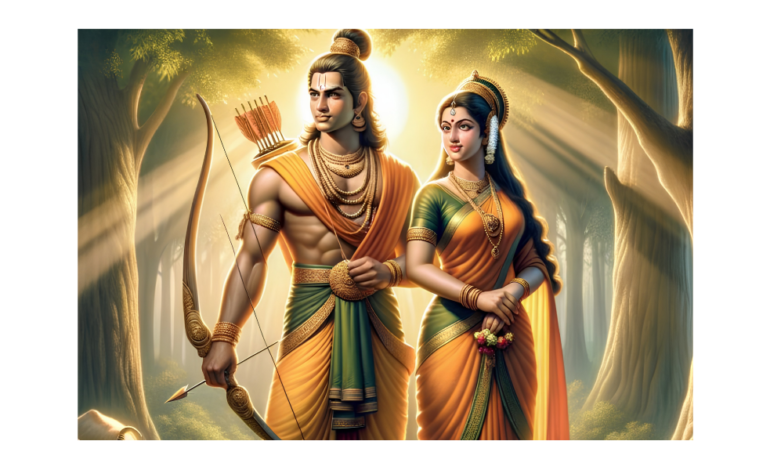
Rare Episodes Hidden in the Valmiki Ramayana

By: Rajendra Kapil
Why Did Sita Advise Lord Rama to Follow Ahimsa?
The epics are filled with accounts of the loving relationship between Lord Rama and Sita. In almost every sacred text, Sita is portrayed as Rama’s devoted, virtuous and faithful wife. In the Ramcharitmanas, Tulsidas ji has lavishly praised Sita’s beauty, grace, character and gentle nature. When Rama first saw Sita in the garden of King Janaka, he was so captivated that he simply stood gazing at her. Not a word came from his lips. Tulsidas ji could only write:
Kankan kinkini nupur dhuni suni,
Kahat Ram Lakhan san Ramu hridaya guni.
Manahu Madan dundubhi dinhi,
Manasa biswa vijaya kahu kini.
Hearing the sweet sound of Sita’s anklets, a wave of love stirred in Rama’s heart. He began sharing his feelings with Lakshmana, but then examined his own thoughts. “I have never felt this way before. What is happening to me?” He remembered the dignity and discipline of the Raghu dynasty:
Raghubansinh kar sahaja subhau,
Manu kupanth pag dharai na kau.
A true descendant of Raghu never sets foot on the wrong path. And yet, he felt himself momentarily carried away.
Sita was no less overwhelmed. Looking at Rama’s beauty, she found herself unable to describe what she saw:
Syam gaur kimi kahun bakhani,
Gira anayan nayan binu bani.
Such was his enchanting beauty that the tongue had no eyes with which to describe it, and the eyes had no words with which to speak. What they witnessed was beyond description.
Such was the first meeting of Rama and Sita—a meeting that, after the swayamvar, blossomed into the sacred bond of marriage.
After their marriage, Sita came to Ayodhya and lived in her husband’s home with great restraint, dignity and grace. The responsibility and honor of being Rama’s queen fell upon her, and she carried it with love and devotion.
Then came the tragic moment when King Dasharatha was compelled to announce Rama’s exile to the forest. All of Ayodhya was plunged into grief.
This episode is narrated in broadly similar form in both the Ramcharitmanas and the Valmiki Ramayana. But what follows takes a somewhat different form in Valmiki’s account.
As Rama, Lakshmana and Sita wandered through the forests, they encountered many Rakshasas. Some were truly wicked and cruel and had been tormenting the sages and ascetics. But Sita also witnessed that some others, who were not necessarily guilty of any personal wrongdoing, were being killed simply because they were associated with the Rakshasas.
One day, seeing the killing of those she considered innocent, Sita’s heart became deeply troubled. She was overcome with compassion and decided to speak to Rama about it.
Here we see a different aspect of Sita—one who is deeply moved by the suffering of others. Sage Valmiki portrays this side of her in the ninth Sarga of the Aranya Kanda. Here Sita does not appear merely as a wife; she emerges as a thoughtful counselor, offering Rama a profound discourse on Ahimsa—non-violence.
This article is a small attempt to bring that lesser-known aspect of Sita to light.
Adharmam tu susukshmena vidhina prapyate mahan,
Nivrittena cha shakyo ayam vyasanat kamajad iha.
Trini eva vyasanani atra kamajani bhavanti uta,
Mithya vakyam tu paramam tasmat gurutara ubhau.
Para dara abhigamanam vina vairam cha raudrata,
Mithya vakyam na te bhutam na bhavishyati Raghava.
One day, while sitting beside Rama, Sita spoke to him with great humility:
“Dear Aryaputra, you are a great and noble man. You are free from the weaknesses and addictions born of worldly desire. Yet the work in which you are engaged—the killing of Rakshasas—is, indirectly, taking you toward a path that concerns me deeply.
She then explained more seriously that, according to her understanding, three serious vices arise from uncontrolled desire. The first is false speech, or lying. Ordinary people often resort to falsehood to serve their own interests. The second is desire for another man’s wife. The third is cruelty toward another without any personal enmity or provocation.
“I know very well that you can never speak falsely. Nor could the desire for another woman ever arise in a disciplined man like you. Such a degrading desire, which destroys righteousness, neither exists in you nor ever will.
“There is no one in this world who embodies dignity and restraint as you do. You are a devoted husband, committed to righteousness and truth. That is why I hold you in such great respect.”
Tritiyam yad idam raudram para prana abhihimsanam,
Nirvairam kriyate mohat tat cha te samupasthitam.
“But there is one matter that troubles me deeply—the taking of other lives without enmity. The work that now stands before you, which you are undertaking with your brother Lakshmana in Dandakaranya, causes me great anguish.
“I constantly think about this. And because I care about your welfare, I fear that your daily involvement in violence may bring you toward a path that is contrary to your own nature.”
Snehat cha bahumanat cha smaraye tvam na shikshaye,
Na kathanchana sa karya grihita dhanusha tvaya.
Buddhir vairam vina hantum Rakshasan Dandaka ashritan,
Aparadham vina hantum loko vira na kamayE.
“Because of the affection and respect I have for you, I request that you do not regard all Rakshasas as your enemies. Please do not kill those who have committed no offense.
“I am not saying this to teach you, but because I care deeply for you.”
Kva cha shastram kva cha vanam kva cha kshatram tapah kva cha,
Vyaviddham idam asmabhih desha dharmah tu pujyatam.
“Where is the bearing of weapons, and where is the life of a forest ascetic? Where is the rigorous duty of a Kshatriya, and where is compassion toward living beings? These appear to be contradictory paths.
“Please consider what I have said and, as far as possible, reduce this violent course of action.”
Stri chapalat etad udahritam me dharmam cha vaktum tava kah samarthah,
Vicharya buddhya tu saha anujena, yat rochate tat kuru ma achirena.
“I have spoken these words perhaps because of the natural impulsiveness attributed to a woman. Please consider them carefully with your brother, and then do whatever you believe to be right.”
Rama listened to Sita’s words with great seriousness. After reflecting upon them for some time, he replied.
Hitam uktam tvaya Devi snigdhaya sadrisham vachah,
Kulam vyapadishantya cha dharmajne Janak atmaje.
Rama said:
“Devi, your great affection for me has prompted you to offer this advice regarding non-violence. You have spoken out of concern for my welfare, and I respect the feelings behind your words.
“But you know very well that the greatest duty of a Kshatriya is to protect those who are helpless and suffering. Whenever someone is in danger or surrounded by misery, it is the duty of the Kshatriya to protect them.”
Te cha arta Dandakaranye munayah samshita vratah,
Mam Site svayam agamy sharanayah sharanam gatah.
“There are many sages and ascetics living peacefully in this forest. They do not trouble anyone. They simply wish to live in peace and pursue their spiritual practices.
“But these Rakshasas repeatedly disrupt their lives. At times they even kill the sages and make them their food.
“These sages have come to me seeking refuge and asking for protection. Under such circumstances, it becomes my sacred duty to help them. It is my vow that I will never turn away one who seeks my protection.”
Sharanagat kahu je tajahin nij hit anahit anumani,
Te nar pavar papamay, tinhahi bilokat hani.
“This remains my position even today. I have already promised these sages that I will protect them. I cannot now turn back from that promise.
“The Raghu dynasty has always been known for keeping its word:
Raghukul reeti sada chali aayi,
Pran jahi par vachan na jayi.
“If I become a participant in sin while carrying out this duty, I am prepared to accept that consequence. I am even prepared to suffer the punishment for that sin.”
Samshritya na cha shakshyami jivamanah pratishravam,
Muninam anyatha kartum satyam ishtam hi me sada.
“I will not abandon my vow. I will fulfill my duty and stand against those who torment these sages. I cannot go back on my word, because upholding truth has always been dear to me.
“Yet, whatever you have said out of love and respect, I honor it. You are the daughter of Mithila, and such thoughtful counsel befits you.
“I am grateful that, by remaining beside me, you continually inspire me to walk the righteous path.”
This was a deeply affectionate conversation between Rama and Sita, in which both expressed their positions with clarity and conviction. More importantly, both made an effort to understand the other’s feelings.
Sita’s message was one of compassion and non-violence, while Rama’s response emphasized duty, protection of the innocent, the responsibility of a Kshatriya and the sanctity of a promise.
Neither dismissed the other. Their disagreement did not create discord; instead, it demonstrated mutual respect.
This rare episode from the Valmiki Ramayana presents Sita not merely as a devoted wife, but as a woman of compassion, moral courage, wisdom and independent thought. It also offers a timeless lesson for married couples: a strong relationship does not require two people to agree on everything. It requires the freedom to express one’s concerns, the patience to listen, the wisdom to understand, and the maturity to allow the final decision to emerge from dharma and reason.
Jai Shri Ram.