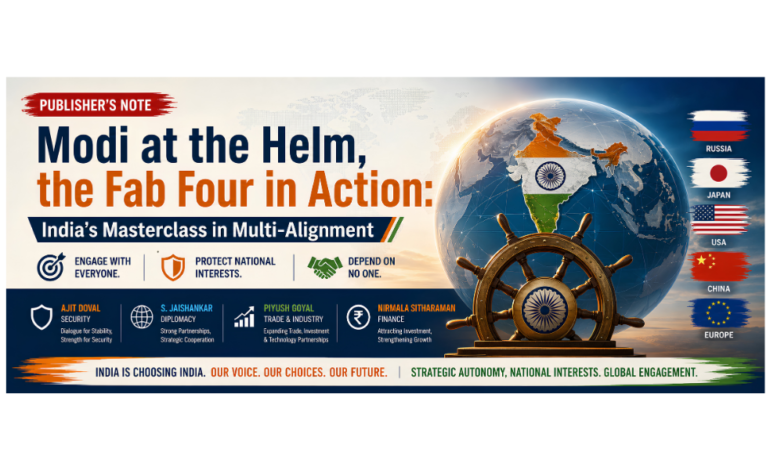
Modi at the Helm, the Fab Four in Action: India’s Masterclass in Multi-Alignment

By: Dr Avi Verma
There are moments in international diplomacy when a nation’s strategy becomes visible not through one dramatic speech, but through several carefully coordinated moves taking place across the world.
India appears to be experiencing such a moment.
At the center is Prime Minister Narendra Modi, providing the strategic direction. Around him, four of India’s most important policymakers—External Affairs Minister S. Jaishankar, National Security Adviser Ajit Doval, Commerce and Industry Minister Piyush Goyal, and Finance Minister Nirmala Sitharaman—have recently been pursuing interconnected diplomatic, security and economic objectives.
The Indian media has aptly described this coordinated outreach as the diplomacy of the “Fab Four.”
Perhaps the better description is: Modi at the helm, with the Fab Four carrying India’s interests to different centers of global power.
This is not simply a series of foreign visits. It represents a larger philosophy of Indian foreign policy: engage with everyone, protect national interests and avoid becoming dependent on any single power or bloc.
Four Leaders, Four Strategic Fronts
The significance of the Fab Four lies in the different but complementary responsibilities they are handling.
Ajit Doval’s engagement with China addresses India’s most challenging security relationship. Dialogue does not diminish India’s determination to protect its borders; rather, maintaining communication can help prevent tensions from becoming larger confrontations.
S. Jaishankar’s engagement with Russia reinforces a relationship that remains important for energy, defense, trade and strategic cooperation. At a time of extraordinary geopolitical turbulence, maintaining that channel is in India’s national interest.
Nirmala Sitharaman’s outreach to Canada and the United States demonstrates that closer engagement with Russia or China does not mean India is turning away from the West. Attracting investment and maintaining relationships with Western financial and business communities remain central to India’s growth.
And then there is Piyush Goyal’s important mission to Japan.
Goyal recently led India’s largest-ever business delegation to Japan, with more than 200 representatives from sectors including manufacturing, semiconductors, clean energy, steel, automobiles, financial services, healthcare and startups. The mission focused on expanding trade, investment, technology partnerships and high-value manufacturing.
Japan’s importance should not be underestimated. As India seeks to become a major manufacturing and technology hub, Japanese capital, industrial expertise and advanced technology can become powerful accelerators.
This is diplomacy serving economic development.
Modi’s Message to Putin: Friendship Does Not Mean Silence
Prime Minister Modi’s meeting with Russian President Vladimir Putin in Bishkek demonstrated another dimension of India’s approach.
India and Russia share a historic strategic relationship. Yet partnership does not require silence.
Modi told Putin that the world must move from “endless war to an end of war,” reiterating India’s support for peace efforts and an end to the conflict in Ukraine.
The message was significant.
India has resisted pressure to abandon its independent foreign policy, but it has also consistently advocated dialogue and diplomacy.
For India, peace is not simply a moral objective. It is also an economic necessity.
War disrupts energy markets, trade, supply chains and global growth. An end to the Ukraine conflict would therefore serve interests far beyond the battlefield.
America Is Too Important to Ignore
At the same time, New Delhi understands another reality: India cannot afford a full-scale economic confrontation with the United States.
America remains one of India’s most important economic, technological and strategic partners. Trade, investment, defense cooperation and technology have created deep connections between the two countries. The Indian American community adds another powerful bridge between the world’s two largest democracies.
India can disagree with Washington without becoming anti-American.
That distinction is fundamental.
India’s objective should be neither surrender nor confrontation.
It should be negotiation from a position of strength.
Diversification Is India’s Economic Insurance
This is where the Fab Four strategy becomes particularly important.
India is not replacing one dependency with another. It is expanding its options.
Russia remains important for energy and strategic cooperation. Japan is increasingly important for investment, technology and manufacturing. The United States remains essential to India’s economic and technological ambitions. Western financial markets remain important sources of capital.
China remains a formidable strategic competitor and an unavoidable economic reality.
Managing all these relationships simultaneously is not diplomatic confusion.
It is strategic diversification.
The world has demonstrated repeatedly that excessive dependence can become a vulnerability. Tariffs can change. Wars can disrupt energy supplies. Supply chains can be weaponized. Financial restrictions can suddenly affect businesses and economies.
India’s answer is therefore to create alternatives.
Not an Anti-American Alliance
It would be a mistake to interpret this diplomatic surge as an attempt to construct an anti-U.S. alliance.
If that were India’s objective, its Finance Minister would not be engaging Western investors, while its Commerce Minister would not be strengthening economic partnerships with Japan.
India is not choosing between Washington, Moscow, Beijing or Tokyo.
India is choosing India.
That is the essence of strategic autonomy.
It does not mean remaining equidistant from every country. It means retaining the freedom to move closer to any country when India’s interests require it—and to disagree when those interests demand it.
India at Every Table
The world is no longer neatly divided into two camps. It is multipolar, competitive and unpredictable.
India therefore needs diplomacy that is equally flexible.
The coordinated outreach of Jaishankar, Doval, Goyal and Sitharaman, under the strategic direction of Prime Minister Modi, represents precisely that approach.
The Fab Four are not traveling the world to select India’s camp in somebody else’s geopolitical contest.
They are helping ensure that India has its own voice, its own choices and its own seat at every important table.
And perhaps that is the most important lesson of this diplomatic moment.
India is not building walls against the world. It is building bridges in every direction—while ensuring that every bridge ultimately serves India’s national interest.
— Dr. Avi Verma
Publisher, IndoUS Tribune