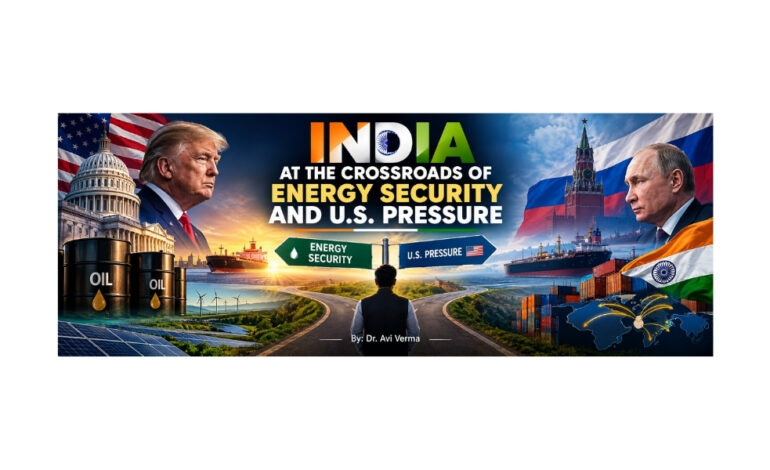
India at the Crossroads of Energy Security and U.S. Pressure

By: Dr. Avi Verma
The U.S. House of Representatives has taken a consequential step that could test one of America’s most important strategic relationships in Asia.
On September 16, the House passed the Lindsey O. Graham Sanctioning Russia and Iran Act of 2026 by a bipartisan vote of 262–159. The legislation now goes to President Donald Trump for his signature.
For India, the most consequential provision is the authority it gives the U.S. President to impose tariffs of up to 100% on countries purchasing Russian crude oil or natural gas or facilitating sanctions evasion. India is explicitly identified among the countries potentially subject to these duties.
But an important distinction must be made: the bill does not automatically impose a 100% tariff on India. It creates the legal mechanism and presidential authority to impose such a tariff.
That distinction leaves considerable room for diplomacy—but it also creates a powerful instrument of economic pressure.
What is Washington trying to accomplish?
The fundamental American objective is to reduce Russia’s revenues from energy exports and thereby limit Moscow’s ability to finance its war in Ukraine.
The legislation goes considerably beyond oil. It targets Russian officials, financial institutions, energy interests and vessels associated with sanctions evasion, including the so-called Russian “shadow fleet.” The secondary-tariff provision is designed to put pressure on countries that continue purchasing Russian energy.
The logic is straightforward: if Russia’s biggest customers face serious economic consequences for buying Russian oil, they may reduce those purchases, thereby shrinking Moscow’s energy revenues.
For Washington, tariffs are therefore not merely a trade measure. They are being used as a geopolitical instrument.
But that strategy carries risks of its own.
Why India is particularly exposed
India imports most of the crude oil it consumes. Russian crude became increasingly important after 2022, when Western sanctions and the restructuring of global energy markets redirected Russian oil toward Asian buyers.
For India, the arrangement was economically attractive. Discounted Russian crude reduced input costs for Indian refiners, helped contain the import bill and supported India’s ability to supply a rapidly growing economy.
Russia remains India’s largest single crude supplier. Kpler data indicate that India imported about 2.08 million barrels per day of Russian crude in August, approximately 45% of its total crude imports. That was already a significant decline from July’s roughly 56% share, demonstrating that India’s oil basket is capable of changing as market conditions evolve.
This is an important point: India is not completely dependent on Russian oil, but Russia remains too important to replace overnight without economic consequences.
India can buy more from the Middle East, the United States, Venezuela, Africa and other producers. But replacement barrels may come with different prices, transportation costs, insurance costs and refinery economics.
The question is therefore not simply whether India can replace Russian crude.
It is how much replacement will cost India.
The 100% tariff threat
The larger danger lies in the second side of the equation.
The United States is one of India’s most important export markets. A 100% tariff, if imposed broadly, could severely affect Indian exporters in sectors ranging from textiles and apparel to engineering goods, pharmaceuticals, chemicals, gems and jewelry, information-linked services and other trade-dependent industries.
The impact would not be confined to large corporations. Small and medium-sized Indian manufacturers integrated into U.S.-bound supply chains could also face significant pressure.
At the same time, American importers and consumers would not necessarily escape the consequences. Indian goods entering the United States at dramatically higher costs could mean higher prices, reduced competitiveness and supply-chain disruptions.
That creates an unusual situation: a tariff intended to pressure India could also impose costs on American businesses and consumers.
This is why the actual tariff rate—and how Washington chooses to apply it—will matter far more than the headline 100% figure.
Is this really about Russia—or also about India-U.S. trade?
That is one of the central questions.
The stated purpose of the legislation is to increase economic pressure on Russia. However, the tariff authority gives Washington substantial leverage over countries such as India and China.
India is simultaneously negotiating the future shape of its economic relationship with the United States. Consequently, the threat of tariffs could become part of a broader negotiating framework involving market access, trade concessions and India’s continued purchase of Russian energy.
Some Indian analysts have described this as an attempt to use tariff pressure to force India toward a particular trade or energy position. Those are analytical interpretations rather than established facts, but they illustrate why New Delhi is treating the legislation as a matter extending beyond the Ukraine conflict.
India’s response: energy security first
New Delhi’s response has so far been firm but measured.
The Ministry of External Affairs has reiterated that India remains firmly committed to ensuring energy security for its 1.4 billion people through diversified sourcing and changing market conditions. India has also stated that it will take all necessary measures to protect its trade and economic interests.
The government has said the issue has already been discussed at senior levels with American interlocutors and that India has clearly communicated its concerns about the potential impact on bilateral relations and international energy markets. It is also working with Indian trade and industry bodies to assess the implications.
That response points toward a multi-track Indian strategy.
First: diplomacy. India has every reason to negotiate before any punitive tariff is actually imposed. The fact that the legislation gives the President discretion is significant. There remains space for exemptions, lower tariffs, adjustments or negotiated arrangements.
Second: diversification. India is already reducing its exposure to any single supplier. Recent increases in purchases from Venezuela and other markets demonstrate that diversification is underway.
Third: protect Indian exports. New Delhi will need contingency plans for industries heavily dependent on the U.S. market, including helping companies diversify into Europe, the Middle East, Africa and Asia.
Fourth: strengthen domestic resilience. India must reduce the vulnerability created by its dependence on imported crude by accelerating renewable energy, electric mobility, domestic production, strategic petroleum reserves and energy efficiency.
Fifth: preserve strategic autonomy. India’s challenge is to maintain its relationship with Washington without allowing any external power to dictate the entirety of its energy policy.
The bigger question for India and America
There is a legitimate American objective in trying to restrict Russia’s ability to finance the war in Ukraine.
There is also a legitimate Indian objective in securing affordable and reliable energy for its population and economy.
These objectives do not necessarily have to become mutually exclusive.
India has repeatedly demonstrated that it can diversify its energy sources while maintaining independent foreign-policy choices. The United States, meanwhile, has a strategic interest in a strong India—not simply as a trading partner, but as a major Indo-Pacific power.
A tariff war between the world’s largest democracy and one of its most important strategic partners would therefore carry consequences far beyond the immediate oil dispute.
The House vote should be viewed neither as an automatic 100% tariff on India nor as a development that can be ignored.
It is a warning, a negotiating instrument and a new source of economic uncertainty.
India’s response must be equally strategic: negotiate firmly, diversify intelligently, protect exporters, strengthen energy security and keep every diplomatic channel open.
The lesson from this episode is perhaps the most important one of all:
India’s energy security cannot depend on one supplier, just as India’s economic future cannot depend on one export market.
Strategic autonomy in the 21st century will not mean choosing between America and Russia.
It will mean building an India strong enough to engage with both—and with the rest of the world—on the basis of its own national interests.