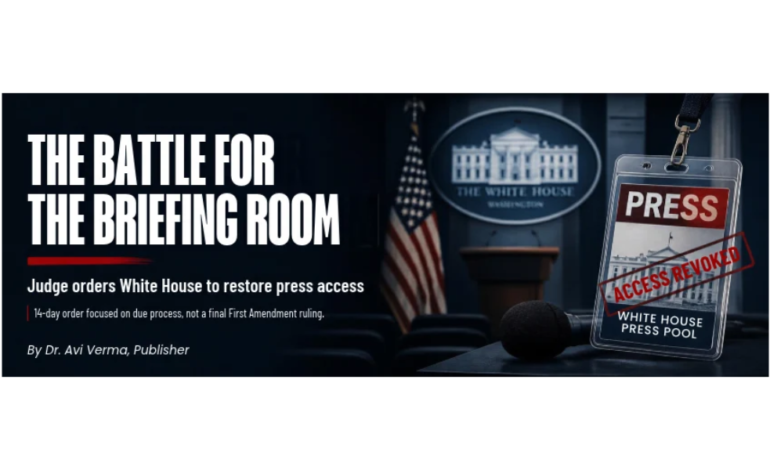
The Battle for the Briefing Room : By Dr. Avi Verma

By: Dr Avi Verma
A significant legal and constitutional dispute over White House press access has entered a new phase after a federal judge ordered the Trump administration to restore access for journalists from CNN, MS NOW and Politico.
The dispute began on September 19, after the Trump administration barred journalists from the three outlets and deactivated or confiscated their White House press credentials. President Donald Trump had accused the organizations of reporting what he described as “fiction and lies.” The administration later argued in court that the outlets had engaged in conduct involving national-security concerns and the publication of sensitive information.
The three news organizations filed a federal lawsuit alleging violations of the First and Fifth Amendments. The White House, meanwhile, argued that access to the White House is a privilege rather than an unrestricted right and that the president has authority to control access to the complex, particularly where national-security concerns are involved.
The Court’s Intervention
U.S. District Judge Timothy J. Kelly issued a 14-day temporary restraining order shortly after midnight on September 24, directing the administration to “immediately return, reinstate, and restore” the journalists’ press credentials.
Judge Kelly found that the outlets were likely to succeed on their argument that the government had violated constitutional due-process requirements by revoking their credentials without adequate notice and an opportunity to respond. Importantly, however, the judge did not issue a final ruling on the outlets’ First Amendment claims.
The temporary order therefore does not settle the larger constitutional dispute. It restores access while the case proceeds.
A Brief Confrontation at the White House
The court order initially did not produce an immediate return to normal operations.
On Thursday morning, journalists from the three organizations reported that they were still being turned away from the White House. The outlets asked the court for an emergency hearing, alleging that the administration was not complying with the order.
The situation changed later that day. The administration restored the journalists’ access, returned confiscated credentials and informed the court that the reinstatement process had been completed. Judge Kelly subsequently declined to hold the requested emergency hearing.
CNN and MS NOW nevertheless reported that some of their journalists were subsequently denied access to cover Chinese President Xi Jinping’s arrival for a White House state dinner, adding another complication to the dispute.
The Press Pool Becomes Part of the Dispute
The controversy also affected the White House television press pool, through which major networks share video coverage of presidential events.
Following the ban, ABC, CBS, NBC and Fox News suspended participation in the presidential television pool while CNN remained excluded. The dispute therefore temporarily affected not only the three targeted organizations but also the broader system through which television networks provide shared coverage of presidential activities.
The issue became particularly significant during President Trump’s meetings with world leaders, including Chinese President Xi Jinping, when questions arose about how presidential events would be visually covered.
What the Administration Argues
The administration’s legal position centers on executive authority and national security.
Government lawyers have argued that physical access to the White House is not an absolute constitutional right and that the president must retain authority to protect the complex and control access to sensitive information.
The Justice Department has cited specific reporting by the three outlets that it says involved sensitive or classified information or raised national-security concerns. Those allegations remain part of the litigation and have not been finally adjudicated.
What the News Organizations Argue
CNN, MS NOW and Politico contend that the ban was retaliation for coverage the administration disliked and that government officials cannot use access credentials to discriminate against news organizations because of their reporting.
Their lawsuit relies on both First Amendment press protections and Fifth Amendment due-process rights.
The court’s initial ruling addressed the latter issue. Judge Kelly concluded that the abrupt revocation of existing credentials, without adequate notice and an opportunity to respond, likely violated constitutional due-process requirements. He did not yet decide whether the administration’s actions independently violated the First Amendment.
The Constitutional Questions Ahead
The case raises several questions with implications beyond these three organizations:
How much control does a president have over access to the White House?
When does a security or operational decision become an unconstitutional restriction on the press?
Can press credentials that have already been granted be revoked without notice and an opportunity to respond?
Can the government distinguish between news organizations based on the content or perceived accuracy of their reporting?
These questions are not yet fully resolved by the temporary restraining order.
Judge Kelly has given the news organizations until September 28 to seek a preliminary injunction that could continue blocking enforcement of the ban while the underlying lawsuit proceeds. The administration could appeal if a longer-term injunction is issued.
A Larger Test for the Press and the Presidency
The immediate conflict involves three news organizations and one administration, but the legal principles at stake are broader.
The White House has a legitimate responsibility to protect national security and manage access to a highly secure federal facility. At the same time, presidential administrations operate under public scrutiny, and journalists depend on access to report directly on government activities.
The courts are now being asked to determine where those interests meet—and where the constitutional limits lie.
For the public, the significance of this dispute extends beyond CNN, MS NOW or Politico. It concerns the rules governing access between the government and the independent press, and whether those rules can change when an administration objects to particular coverage.
For now, the court has restored access temporarily, but the larger constitutional battle is far from over. The next major step is expected after the September 28 deadline, when the court will consider whether the temporary protections should continue while the case moves forward.