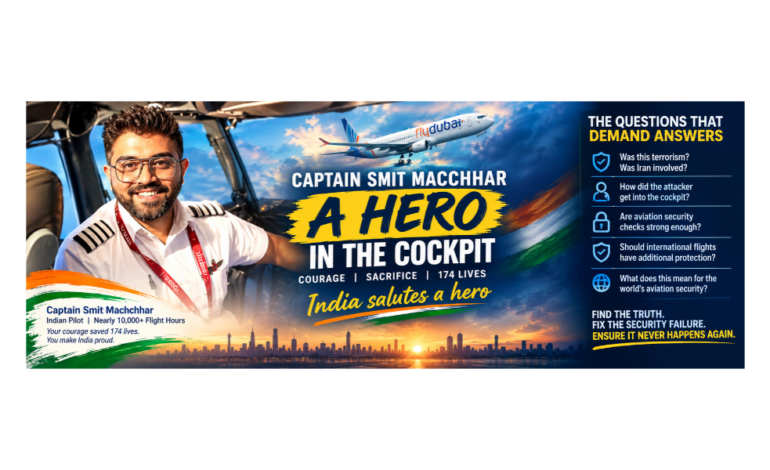
A hero in the cockpit: Questions the world must answer

By: Dr. Avi Verma
There are moments when courage is measured not in words, but in blood, pain and an extraordinary determination to save human lives.
The terrifying incident aboard Flydubai Flight FZ1073 on September 30 was one such moment.
The Dubai-to-Tel Aviv flight, carrying 174 people, was thrown into chaos when the co-pilot allegedly attacked Captain Smit Machchhar inside the cockpit. The aircraft went into a dramatic descent, prompting an emergency response and ultimately a diversion to Tabuk, Saudi Arabia. According to accounts reported by Israeli officials and passengers, the wounded captain managed to open the cockpit door, allowing passengers and crew to enter and help overpower the attacker.
Captain Smit Machchhar: India salutes a hero
Captain Smit Machchhar deserves an international salute.
Seriously wounded and bleeding, he apparently understood that his own life was in immediate danger, but that 173 other people were depending upon him.
He opened the cockpit door.
That courageous act gave passengers and crew the opportunity to intervene and prevent what could have become an unspeakable aviation catastrophe. Additional qualified pilots aboard the aircraft also helped stabilize the situation and bring the aircraft safely to the ground.
Captain Machchhar is an Indian pilot who previously flew for SpiceJet and has accumulated nearly 10,000 hours of flying experience. He is now recovering in Saudi Arabia after undergoing medical treatment.
India should be immensely proud of him.
He did not know whether he would survive. Yet, under extraordinary physical and psychological distress, he acted to protect the lives entrusted to him.
That is heroism.
It is also a reminder that India’s aviation professionals serve the world with extraordinary skill and dedication.
Condemnation must be unambiguous
Whatever the ultimate motive behind this attack, an attempt to seize control of a passenger aircraft through violence must be condemned without qualification.
If investigators establish that the co-pilot deliberately attempted to crash the aircraft, then this was not simply a cockpit altercation. It was an extraordinarily dangerous assault on innocent human beings.
And if it was politically or ideologically motivated, it must be described for what it was: a cowardly attack on civilians who had done nothing to deserve it.
The passengers included a large number of Israelis. Their nationality, religion or destination cannot make them legitimate targets.
There can be no justification for attempting to murder innocent passengers because of a political conflict elsewhere.
Was this terrorism? Was Iran involved?
These are legitimate questions, but they are questions, not established facts.
Israeli officials have raised the possibility of terrorism. Israeli Prime Minister Benjamin Netanyahu has also said it is too early to determine whether there was an Iranian role. The UAE Attorney General has ordered a formal investigation specifically to determine the circumstances, motives and whether the incident involved terrorist activity, prior planning or outside direction.
That investigation must be allowed to do its job.
Was this an individual act?
Was there ideological motivation?
Was the flight deliberately targeted because it was carrying Israeli passengers?
Was there outside direction or financing?
Was the Gaza conflict somehow connected?
Was Iran involved?
At present, there is insufficient publicly established evidence to answer those questions.
But they must all be examined.
The most troubling question: Security
Perhaps the most important question is how a violent attack could be carried out by a member of the flight crew inside the cockpit.
Aviation security has spent decades focusing on passengers carrying weapons onto aircraft. The Flydubai incident highlights another vulnerability: the insider threat.
How was the alleged attacker screened?
What security and background checks were conducted?
Were there warning signs?
Was the crew member properly assessed before being cleared to fly?
Could anything in his professional, medical or behavioral history have raised concerns?
These questions are not accusations. They are essential aviation-security questions.
The UAE investigation must answer them.
Should international flights have additional protection?
The incident also deserves a serious review of cockpit-security procedures.
Should certain high-risk international routes have an additional qualified pilot immediately available?
Should airlines routinely carry additional qualified crew on selected routes?
Should plain-clothes security personnel be deployed selectively based on intelligence and threat assessments?
Should cockpit access protocols be redesigned to ensure that a wounded or incapacitated pilot can summon assistance?
There is no reason to wait for another tragedy before studying these possibilities.
The fact that additional qualified pilots were reportedly aboard this flight and helped bring the aircraft safely down is particularly significant. Their presence may have been crucial.
Israel’s security establishment must also ask questions
The incident should prompt a serious review by Israeli aviation-security authorities.
Israel is one of the world’s most experienced countries in aviation security because it has faced aviation terrorism for decades.
The fact that an aircraft carrying predominantly Israeli passengers could experience such a crisis inside the cockpit requires careful examination.
Israel has already indicated that it will increase scrutiny of pilots flying into the country. That is a reasonable security question to examine, but the review should be evidence-based, professionally conducted and coordinated internationally.
Security cannot stop at the airport entrance.
The entire aviation chain, from recruitment and pilot vetting to cockpit access, intelligence sharing and emergency response, must be examined.
The international implications
This incident involved multiple countries: the UAE, Saudi Arabia, Israel, India and Oman.
The aircraft was UAE-registered; the flight originated in Dubai; it was bound for Israel; it diverted to Saudi Arabia; the captain is Indian; and the alleged attacker has been reported as Omani, although official confirmation of his nationality and motive remains part of the developing investigation.
The aircraft also transmitted an international hijacking alert, and Israeli authorities responded to the emergency.
This therefore goes far beyond one airline or one flight.
If investigators eventually establish terrorism or foreign direction, the consequences could extend into international security, aviation policy and regional diplomacy.
If they establish an individual act without an organized connection, the aviation industry will nevertheless have to confront the insider-security vulnerability.
Either way, the world needs answers.
Captain Machchhar has given us the most important answer
In the midst of fear and uncertainty, one thing is already clear.
Captain Smit Machchhar did not surrender.
He was wounded. He was bleeding. He was confronted with the possibility of death.
Yet he acted.
He opened that cockpit door.
That decision gave others a chance to fight back, helped prevent an unimaginable tragedy and brought 174 people home alive.
For that, we offer Captain Smit Machchhar our deepest respect.
India salutes you. Israel salutes you. The international aviation community salutes you.
And to whoever deliberately brought violence into that cockpit, if that is what the investigation ultimately establishes:
There is no political cause, grievance or ideology that can justify deliberately putting innocent human lives at risk. Such an act is cowardly, criminal and indefensible.
Now the responsibility belongs to investigators and aviation authorities.
Find the truth.
Find the security failure.
Find out whether anyone else was involved.
And then make sure that what happened aboard Flight FZ1073 never happens again.